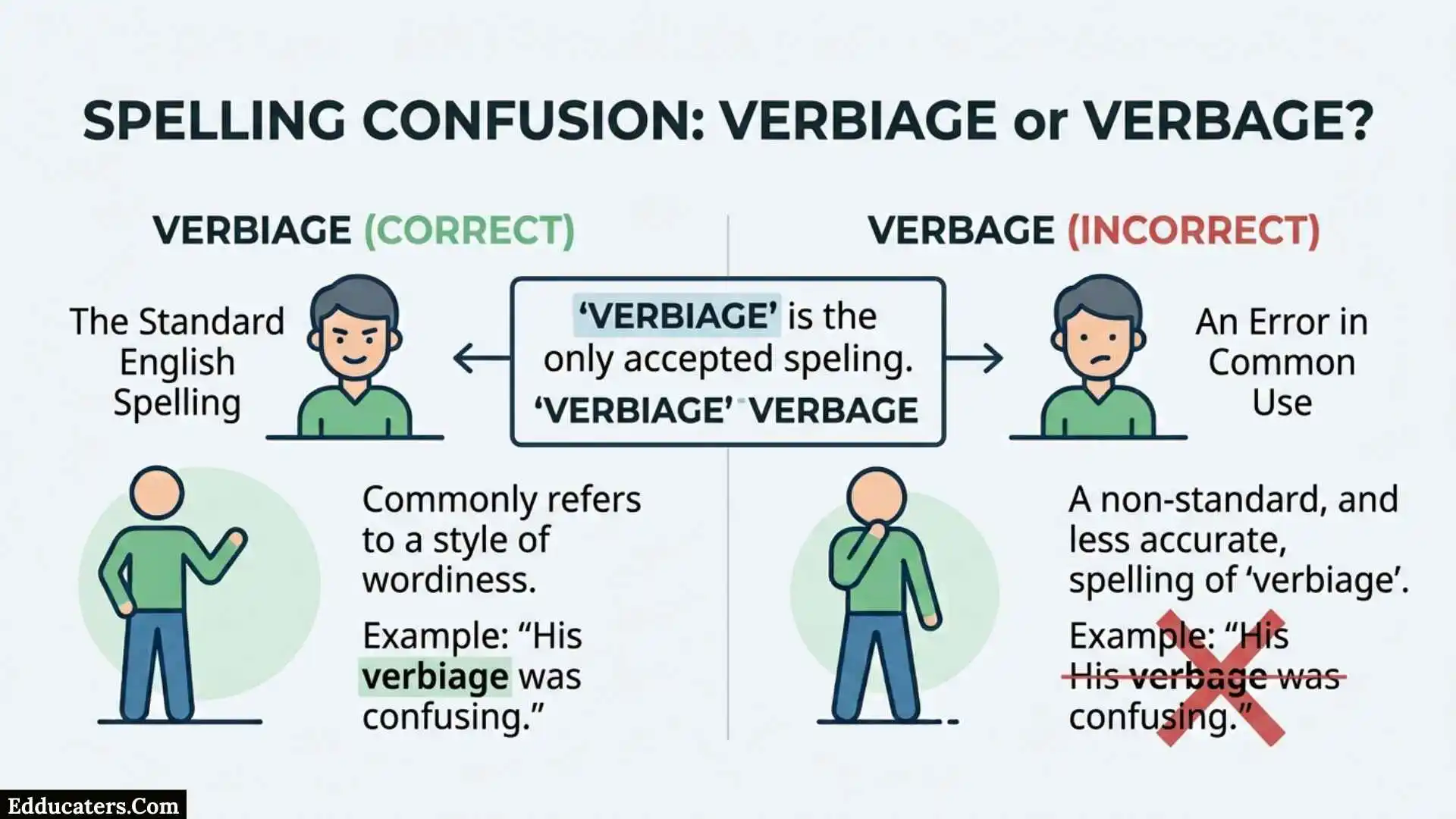
If you are deciding between verbiage or verbage, use verbiage in standard English. It is the established dictionary spelling and the form you should choose for professional, academic, business, and formal writing.
Verbiage can mean the words or wording used to express something. It can also carry a more critical meaning: an excessive amount of complicated or unnecessary language. Major dictionaries recognize these meanings, although Oxford and Cambridge emphasize the negative sense more strongly than Merriam-Webster.
Verbage is the spelling you may encounter when people leave out the i. If you are proofreading a report, writing an email, preparing an essay, or publishing website content, verbiage is the safer standard choice.
This guide explains the difference between the two spellings, what verbiage really means, whether verbage is a word, how to pronounce verbiage, when to use it, and how it differs from related terms such as wording, verbosity, vocabulary, and jargon.
Quick answer:
Verbiage ✓ is the standard spelling. Verbage is a commonly encountered variant or misspelling and is best avoided in formal writing.
Verbiage or Verbage: The Quick Comparison
The easiest way to settle the question is to compare the two forms.
| Word | Standard choice? | What it means | Best use |
| Verbiage | Yes | Wording, language, or excessive/complicated wording | Formal and informal writing |
| Verbage | Generally avoid | A form encountered in informal usage | Avoid when standard English is expected |
If you are writing a sentence such as:
Please review the verbiage in the contract.
Verbiage is the appropriate spelling.
If you write:
Please review the verbage in the contract.
Most readers will understand you, but the spelling may be treated as an error in edited or formal writing.
The one-word answer
When a spelling checker, editor, teacher, client, or professional reader expects standard English, choose:
verbiage
The extra i is important.
Why the confusion happens
Verbage looks reasonable at first glance. The beginning of verbiage resembles verb, and the ending resembles a familiar English word-building pattern.
Pronunciation can also make the spelling less obvious. When someone hears the word rather than sees it written, it is easy to assume that the middle i is not there.
That explains why the incorrect or nonpreferred form appears in everyday writing. It does not make verbage the better choice for formal communication.
What Does Verbiage Mean?
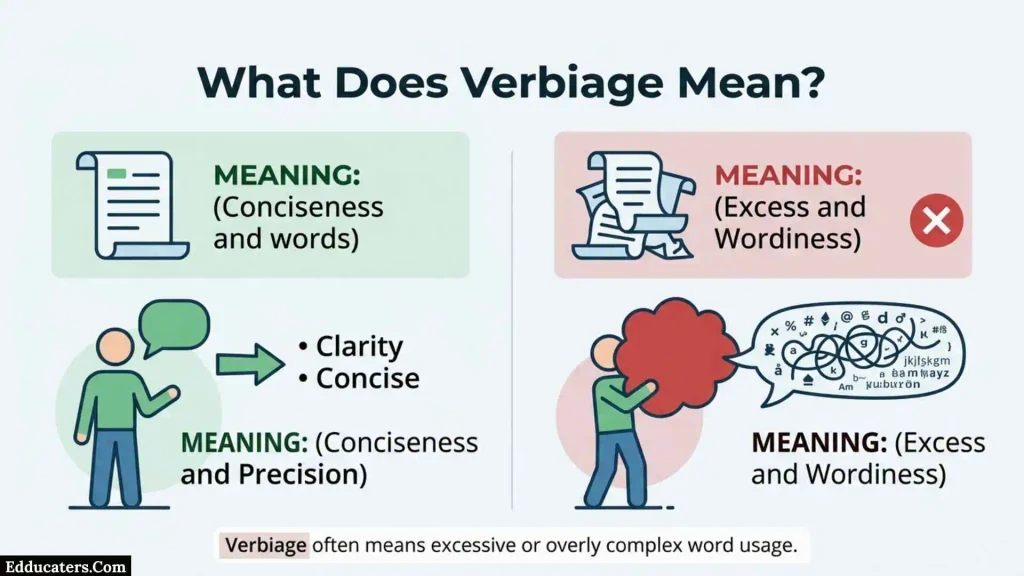
Verbiage is a noun referring to words, wording, or a particular way of expressing something.
However, there is an important point that is often missed: verbiage does not always mean “too many words.”
Merriam-Webster records two established senses. One refers to a profusion of words that usually have little or unclear content. The other means the manner in which someone expresses themselves in words, or their diction.
Oxford and Cambridge place more emphasis on the critical sense, defining verbiage as language that uses too many words or unnecessarily difficult words.
This gives the word two useful contexts.
Verbiage can mean wording
In some contexts, verbiage simply means the language or wording used in a document or statement.
For example:
The company changed the verbiage on its website.
Here, the speaker is talking about the wording on the website. There is no necessary criticism that the wording is excessive.
Another example:
The agreement uses similar verbiage in several sections.
Again, verbiage means the wording or language used.
This neutral sense is recognized by Merriam-Webster.
Verbiage can mean excessive or complicated language
The word can also be critical.
For example:
The report contains unnecessary technical verbiage.
Here, verbiage suggests that the report uses too much complicated language.
This is the sense emphasized by Oxford and Cambridge. Oxford describes it as using too many words, or more difficult words than necessary, to express an idea. Cambridge similarly defines it as complicated language containing many unnecessary words.
Why context matters
Consider these two sentences:
The legal team revised the verbiage of the contract.
The legal team removed unnecessary legal verbiage from the contract.
The first sentence uses verbiage neutrally to mean wording.
The second clearly criticizes the language as unnecessary or overly complicated.
This distinction matters because saying “verbiage always means unnecessary words” is too restrictive. Merriam-Webster explicitly recognizes the broader wording sense.
Is “Verbage” a Word?
This is where the answer requires more care than simply saying “verbage is not a word.”
Verbiage is the established standard spelling. However, verbage does appear in real-world English usage, so calling it completely nonexistent would be misleading.
For practical writing, the important question is not whether someone somewhere has used verbage. The better question is:
Which spelling should I use when I want standard, widely accepted English?
The answer is verbiage.
Why “verbage” appears so often
Several factors make verbage an easy spelling to create.
First, the word visually resembles verb. Second, English contains many nouns ending in -age, so verbage looks like a word that could naturally have been formed from verb.
But the established spelling is verbiage, with the i before age.
Should you use “verbage” in formal writing?
Generally, no.
If you are writing:
- a business proposal
- an academic paper
- a resume
- a professional email
- a legal document
- website copy
- an article
- a report
- a presentation
use verbiage.
Even when a reader understands verbage, using the standard spelling removes an unnecessary distraction.
What if you see “verbage” in published writing?
Do not assume that every appearance of verbage proves it is the preferred spelling.
Published and online writing contains misspellings, informal variants, regional usage, and editorial choices. Search engines can also index nonstandard spellings because people actually use them.
For your own writing, the safest rule remains simple:
Use verbiage unless you have a specific reason to reproduce another person’s wording.
Verbiage or Verbage in English
Verbiage or Verbage Meaning
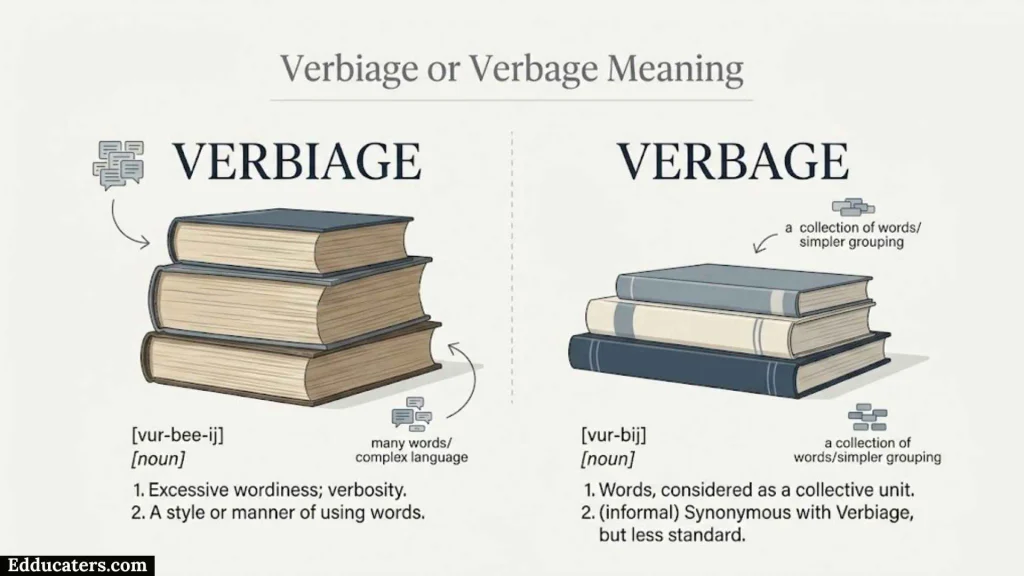
Verbiage is the correct and standard English spelling. It refers to the words used to express an idea, especially when there are more words than necessary or when the language sounds overly complicated.
Verbage is generally considered a misspelling of verbiage. Although you may see “verbage” used informally, it is not the preferred spelling in standard English.
For example, if someone says, “The report contains too much verbiage,” they mean that the report uses unnecessary or excessive words. Depending on the context, however, verbiage can simply refer to the wording or language used in a particular document.
So, when you are writing professionally, academically, or for formal communication, use “verbiage,” not “verbage.”
Verbiage Synonym
The best synonym for verbiage depends on the meaning intended in a sentence. When it refers to unnecessary or excessive wording, suitable synonyms include:
- Wordiness
- Verbosity
- Excess wording
- Prolixity
- Overwriting
- Rambling
- Redundancy
- Excessive language
When verbiage simply means the wording used to express something, possible alternatives include:
- Wording
- Language
- Phrasing
- Expression
- Terminology
- Text
For instance, “The verbiage in the contract is difficult to understand” could be rewritten as “The wording in the contract is difficult to understand.”
Verbiage or Verbage Pronunciation
Verbiage is pronounced with the stress on the first syllable. The standard pronunciation is represented in IPA as /ˈvɜːr.bi.ɪdʒ/ in British English and commonly /ˈvɝː.bi.ɪdʒ/ in American English.
Verbiage
/ˈvɝː.bi.ɪdʒ/
Give feedback
The word has three syllables, and the first syllable receives the primary stress. Because verbage is not the standard spelling, it is better to learn and use the pronunciation associated with the correct word, verbiage.
Verbiage or Verbage Grammar
From a grammar and usage perspective, verbiage is the correct word. It is a noun and can be used when discussing the wording, language, or excessive use of words in speech or writing.
For example:
- The verbiage in the agreement is difficult to understand.
- We need to simplify the verbiage on the website.
- The editor removed unnecessary verbiage from the article.
Verbage is generally treated as a spelling error rather than a standard alternative. If you are writing an essay, business email, article, report, or other formal content, choose verbiage.
It is also worth noting that verbiage does not always mean “bad writing.” In some contexts, it simply describes the particular wording used in a document or statement. The surrounding sentence determines whether the word has a neutral or slightly critical meaning.
Verbiage or Verbage Examples
Here are several examples showing how verbiage can be used correctly:
- The verbiage in the contract was too complicated for the average reader.
- Please review the verbiage before we publish the announcement.
- The editor removed unnecessary verbiage from the introduction.
- The legal verbiage made the agreement difficult to understand.
- We should simplify the verbiage on the product page.
- Her presentation was clear and concise, without unnecessary verbiage.
In each example, verbiage refers either to the wording itself or to an excessive amount of wording.
Verbiage in a Sentence
Here is a simple example of verbiage in a sentence:
The verbiage in the email was unnecessarily complicated.
This sentence uses verbiage to describe the wording of the email. It suggests that the writer used language that could have been simpler or clearer.
Another example is:
We need to change the verbiage on the website to make the instructions easier to understand.
Here, verbiage has a more neutral meaning. It simply refers to the wording used on the website.
Define Verbiage or Verbage
To define verbiage, the simplest explanation is: the words or wording used to express something, particularly when the language is unnecessarily lengthy or complicated.
The word verbiage can therefore have two closely related uses. It may refer neutrally to the wording of a particular statement, document, or piece of writing. It can also have a negative sense when someone wants to criticize writing for being too wordy.
Verbage, on the other hand, is generally not accepted as the standard spelling. If you are looking for the correct English word, the answer is verbiage.
How do You Spell Verbiage or Verbage?
The correct spelling is verbiage.
It is spelled:
V-E-R-B-I-A-G-E
A common mistake is to write verbage, probably because the word looks as though it should be related directly to “verb.” However, the standard English spelling is verbiage.
If you are unsure which form to use in professional or academic writing, always choose verbiage.
Is it Verbiage or Verbage?
It is verbiage.
Verbiage is the standard English spelling, while verbage is generally considered a misspelling. Although “verbage” occasionally appears in informal writing or online communication, it is best avoided in edited or formal English.
A quick way to remember the difference is:
Correct: verbiage
Incorrect/nonstandard: verbage
For example, write:
The report contains unnecessary verbiage.
Rather than:
The report contains unnecessary verbage.
Verbiage 中文
Verbiage 在中文中的意思需要根据具体语境来理解。
它通常可以翻译为:
- 措辞 — wording or phrasing
- 用词 — choice of words
- 文字表达 — written expression
- 冗词 — unnecessary words
- 冗长的措辞 — unnecessarily lengthy wording
- 繁琐的语言 — overly complicated language
例如:
The verbiage in the contract is difficult to understand.
可以翻译为:
合同中的措辞很难理解。
如果 verbiage 强调“不必要的文字过多”,那么也可以根据上下文翻译为“冗长的措辞”或“冗词”。
How to Use Verbiage in a Sentence
You can use verbiage as a noun when talking about the wording or language used in speech, writing, documents, contracts, websites, or other forms of communication.
For example:
The verbiage in this document needs to be simplified.
This means that the wording in the document should be made clearer or easier to understand.
You can also use it when criticizing overly complicated writing:
The article contains too much unnecessary verbiage.
Here, verbiage has a negative sense because it suggests that the writer has used more words than necessary.
Another neutral example is:
The company changed the verbiage of its privacy policy.
In this sentence, verbiage simply means the wording of the policy.
Why Is Verbiage Spelled With an “I”?
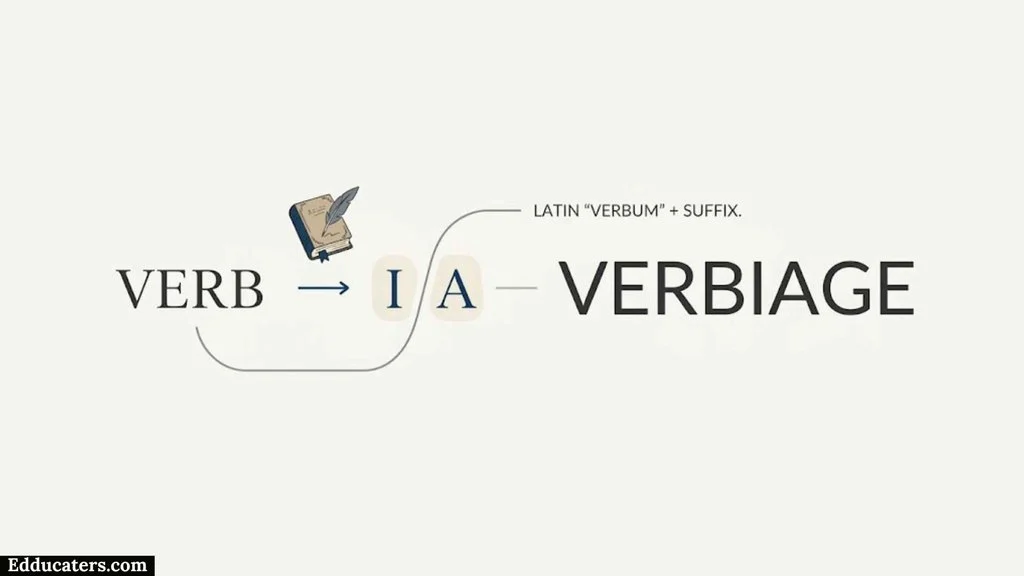
The spelling becomes easier to remember when you look at the word’s history.
Merriam-Webster traces verbiage to French verbier, a verb associated with trilling or warbling, and notes the influence of French verbe, meaning “word” or “verb.” Its first known English use is dated to around 1721.
Oxford likewise traces the word to French and ultimately connects it with verbe and the Latin verbum, meaning “word” or “verb.”
The spelling is not simply “verb + age”
This is an important misconception.
It may look as though the word was created by adding -age to verb. Its history is more complicated than that.
That is why trying to reconstruct the spelling as:
verb + age = verbage
leads you in the wrong direction.
The established English word is:
verbiage
Learning the word as a whole is more reliable than trying to build its spelling from verb.
A simple spelling memory trick
Remember:
Verbiage has an “i.”
You can also connect it with verbal and words:
verbiage → verbal language → wording
When proofreading, look specifically for the missing i.
Verbiage vs. Wording: What’s the Difference?
Wording is often the clearest alternative to verbiage.
Wording simply refers to the particular words used to express something. It is usually neutral.
Verbiage can also refer to wording, but it may suggest complicated, excessive, or unnecessary language depending on context. Merriam-Webster recognizes both the neutral and critical senses.
| Term | Typical meaning | Tone |
| Wording | The particular words used | Neutral |
| Verbiage | Words or wording; sometimes excessive or complicated language | Neutral to critical |
| Verbosity | Use of more words than necessary | Usually critical |
| Jargon | Specialized language used by a particular group | Neutral to critical |
| Vocabulary | The words a person or subject uses or knows | Usually neutral |
When “wording” is better
If you want to be extremely clear and neutral, wording is often the better choice.
Instead of:
Please improve the verbiage of this sentence.
you could write:
Please improve the wording of this sentence.
The second version is simpler and more direct.
When “verbiage” is useful
Verbiage can be useful when discussing language in a professional context, especially when the precise wording of something matters.
For example:
The contract’s verbiage needs to remain unchanged.
Or:
We need to revise the verbiage used in the product description.
The word is common in discussions about contracts, policies, marketing materials, websites, and official statements.
Verbiage or Verbosity
These words are related, but they are not interchangeable in every sentence.
Verbiage describes words or wording.
Verbosity describes the quality or habit of using too many words.
For example:
The verbiage in the report is difficult to understand.
This focuses on the language used in the report.
The writer’s verbosity makes the report difficult to read.
This focuses on the writer’s tendency to use too many words.
A useful way to remember the difference
Think of the distinction this way:
Verbiage = the language or wording
Verbosity = excessive wordiness
A document can have complicated verbiage without necessarily being extremely long. Conversely, a writer can be verbose even when the vocabulary itself is simple.
Verbiage vs. Vocabulary
Vocabulary is another word that should not be confused with verbiage.
Vocabulary refers to the words that a person knows or uses, or the words associated with a particular subject, profession, or language.
For example:
Medical students need to learn a large medical vocabulary.
This refers to specialized words.
But:
The medical verbiage in the instructions is difficult for patients to understand.
This refers to the way the information is expressed.
The practical difference
Ask yourself:
Am I talking about the words themselves or the way something is written?
If you mean the collection of words, vocabulary may be correct.
If you mean the wording of a particular document or statement, verbiage may be appropriate.
Verbiage vs. Jargon
Jargon refers to specialized terms and expressions used by a particular profession, group, or field.
Examples include:
- legal jargon
- medical jargon
- technical jargon
- financial jargon
- computer jargon
Jargon is not automatically bad. Specialized terms can make communication more precise among people who understand them.
The problem arises when jargon is used with an audience that does not understand it.
For example:
The engineer’s technical jargon confused the customer.
You could also say:
The technical verbiage confused the customer.
But the two sentences focus on different things.
Jargon focuses on specialized terminology.
Verbiage focuses more broadly on the language or wording.
How to Use Verbiage Correctly
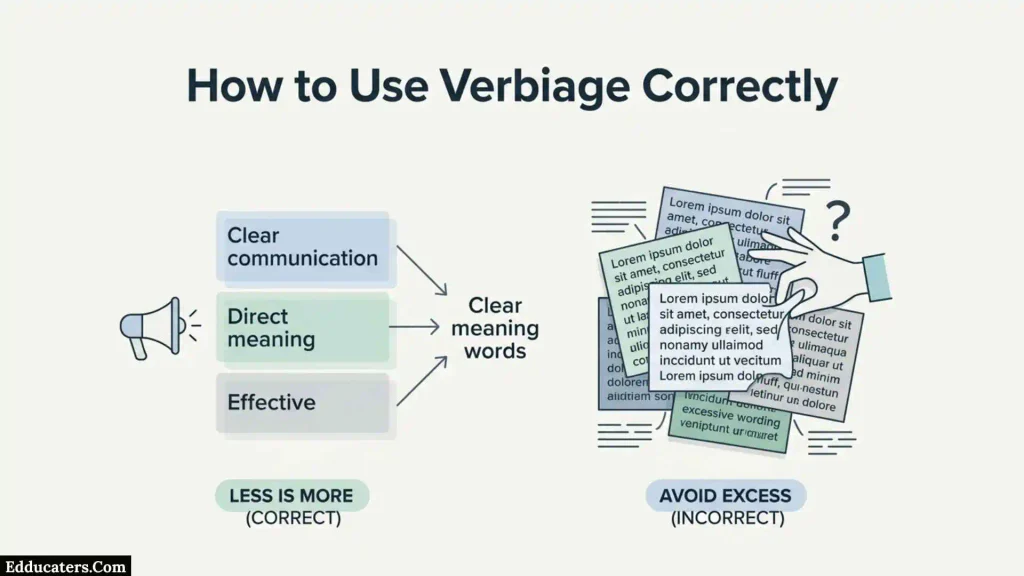
The easiest way to understand verbiage is to see it in realistic situations.
Business example
We need to update the verbiage in the customer agreement.
Here, verbiage means the wording of the agreement.
A marketing manager might say:
The new product verbiage sounds too technical for our target audience.
Here, the word refers to the language used in the marketing material.
Academic example
The professor suggested removing unnecessary verbiage from the research paper.
Here, verbiage has its critical meaning: unnecessary wording.
A student might instead say:
I need to simplify the verbiage in my introduction.
This means the introduction’s language should be made clearer.
Legal example
The attorneys reviewed the verbiage of the proposed agreement.
Here, verbiage refers to the exact wording of the agreement.
Legal language often requires careful attention to wording because small differences can affect interpretation. That makes verbiage a natural term in this context.
Website and content example
The editor changed the verbiage on the product page to make the instructions easier to understand.
Here, verbiage means website copy or wording.
A content editor could also say:
Remove unnecessary verbiage and make the instructions more direct.
In this sentence, the word has its critical sense.
Everyday example
I didn’t understand the verbiage in the letter.
This means the wording or language of the letter was difficult to understand.
A simpler alternative would be:
I didn’t understand the wording in the letter.
Both work, but wording is more straightforward.
Correct and Incorrect Examples
Seeing the spelling in context makes the distinction easier.
| Less appropriate | Standard form |
| Please change the verbage. | Please change the verbiage. |
| The contract contains confusing verbage. | The contract contains confusing verbiage. |
| We need better verbage for the advertisement. | We need better verbiage for the advertisement. |
| The report has too much verbage. | The report has too much verbiage. |
The important correction is the same every time:
verbage → verbiage
However, there is another editing question worth asking: Do you need the word verbiage at all?
Sometimes a simpler word is better.
Instead of:
Please revise the verbiage in this sentence.
you could say:
Please revise the wording in this sentence.
Clear writing is not always about choosing the most sophisticated word. It is about choosing the word that communicates the idea most precisely.
Common Mistakes With Verbiage
Knowing the spelling is only part of using the word correctly.
Mistake 1: Leaving out the “i”
The most obvious mistake is writing:
verbage
instead of:
verbiage
If you are writing formally, check for this spelling carefully.
Mistake 2: Assuming verbiage always means “bad writing”
This is too broad.
Merriam-Webster recognizes a neutral sense in which verbiage means a manner of expressing oneself in words or diction.
So:
The company changed the verbiage of its announcement.
does not necessarily mean the original announcement was bad.
Mistake 3: Treating verbiage and verbosity as identical
They overlap, but they describe different things.
Verbiage can refer to wording.
Verbosity specifically focuses on excessive use of words.
Using verbosity when you mean “the wording” can therefore change the meaning.
Mistake 4: Using a complicated word when “wording” is clearer
Consider your audience.
If you are sending a simple message to a customer, this may be clearer:
We changed the wording to make the instructions easier to understand.
rather than:
We revised the verbiage to improve comprehensibility.
The second sentence is not necessarily wrong, but it is less direct.
Mistake 5: Assuming more formal language is automatically better
Good professional writing is usually clear, precise, and appropriate for its audience.
If wording communicates your idea more clearly than verbiage, use wording.
How to Make Your Writing Less Verbose
Because verbiage can describe excessive language, it is useful to know how to identify unnecessary wording.
Remove repeated ideas
If two sentences communicate the same point, consider combining them.
Instead of:
The meeting was postponed to a later date. The meeting will now take place at a later time.
write:
The meeting was postponed.
The shorter version communicates the same basic idea.
Replace unnecessarily complicated phrases
Look for long expressions that can be replaced with simpler ones.
For example:
At this point in time
can often become:
Now
And:
Due to the fact that
can often become:
Because
This does not mean every longer phrase is wrong. The goal is to remove language that adds length without adding meaning.
Keep the audience in mind
Technical language may be appropriate for experts but confusing for general readers.
A software engineer and a first-time software user may need different wording even when they receive the same information.
The best writing is not necessarily the shortest writing. It is writing in which every important word earns its place.
A Simple Decision Guide: Which Word Should You Use?
When you are unsure whether to use verbiage, wording, verbosity, vocabulary, or jargon, use this quick decision process.
Are you choosing between “verbiage” and “verbage”?
↓
Do you want the standard spelling?
↓
Choose “verbiage.”
If you are choosing between related words:
Are you referring to the particular words used in a sentence or document?
→ Wording
Are you referring to excessive use of words?
→ Verbosity
Are you referring to the collection of words someone knows or uses?
→ Vocabulary
Are you referring to specialized language used by a particular profession or group?
→ Jargon
Are you referring generally to the language or wording of a statement or document?
→ Verbiage can work.
This decision guide helps prevent a common problem in formal writing: choosing a sophisticated-sounding word when a simpler word would be more precise.
How Do You Pronounce Verbiage?
Cambridge gives the standard pronunciation in both British and American English. The British pronunciation is represented as /ˈvɜː.bi.ɪdʒ/, while the American pronunciation is /ˈvɝː.bi.ɪdʒ/.
For an easy approximation, you can think of it as:
VER-bee-ij
The pronunciation contains the middle bee sound, which can help you remember the spelling.
Why pronunciation causes spelling mistakes
When people hear verbiage, the middle vowel sounds can be easy to overlook.
That can lead someone to spell the word as:
verbage
rather than:
verbiage
Remembering the pronunciation as VER-bee-ij can make the spelling easier to recall.
Is “Verbiage” Formal or Informal?
Verbiage is generally associated with formal or professional language.
Oxford and Cambridge both label their definitions as formal, with a disapproving sense.
You may see it in:
- business communication
- legal documents
- government statements
- technical writing
- marketing
- journalism
- academic discussion
- editing
- professional correspondence
However, being a formal word does not mean it is always the best word.
If your audience is unfamiliar with the term, wording may be easier to understand.
When Should You Avoid the Word Verbiage?
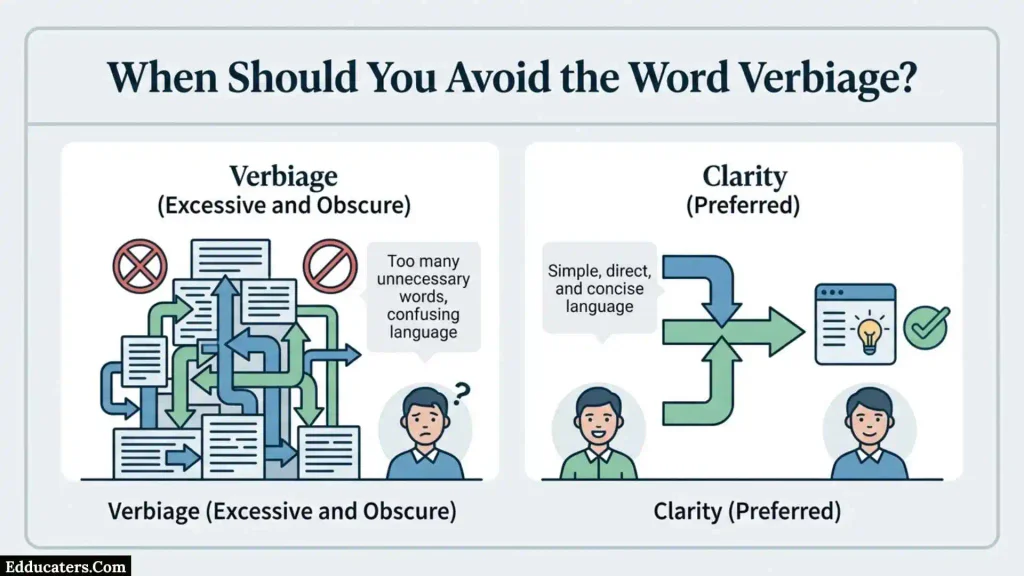
There are situations where a simpler alternative improves the sentence.
For example:
Please check the verbiage.
This is acceptable, especially in professional settings.
But:
Please check the wording.
is often more direct.
Likewise:
The verbiage is unclear.
could become:
The wording is unclear.
If the goal is plain English, wording is often preferable.
On the other hand, if you are specifically discussing excessive or overly complicated language, verbiage can express that criticism efficiently.
Frequently Asked Questions About Verbiage and Verbage
Is verbiage or verbage correct?
Verbiage is the standard spelling and the recommended choice for formal and professional writing. Verbage is encountered in usage, but you should generally choose verbiage when you want the established standard form.
Is verbage a misspelling?
In many writing contexts, verbage is treated as a misspelling or nonpreferred variant of verbiage. Because verbiage is the established standard spelling, it is the safer choice for edited and formal writing.
Does verbiage mean too many words?
Sometimes, but not always. Oxford and Cambridge emphasize the sense of excessive or unnecessarily complicated language, while Merriam-Webster also recognizes a neutral meaning referring to wording or diction.
Can verbiage be used to mean wording?
Yes. Merriam-Webster explicitly recognizes verbiage as meaning the manner of expressing oneself in words or diction.
For example:
The company changed the verbiage of the announcement.
Here, verbiage means the wording.
Is verbiage a formal word?
Yes. Major learner dictionaries classify it as formal, and Oxford and Cambridge also identify a disapproving sense.
What is a simple synonym for verbiage?
Depending on the context, useful alternatives include wording, language, phrasing, diction, terminology, and words.
If you mean excessive language specifically, verbosity or wordiness may be more precise.
Is verbiage the same as verbosity?
No. Verbiage can mean wording or language and can also suggest excessive language. Verbosity specifically refers to excessive use of words.
Is verbiage the same as jargon?
No. Jargon is specialized terminology associated with a particular profession, group, or field. Verbiage is a broader term for language or wording and can refer to excessive or complicated expression.
Is verbiage singular or plural?
Verbiage is normally an uncountable noun. You would generally say:
The verbiage is confusing.
rather than:
The verbiages are confusing.
This is consistent with dictionary treatment of verbiage as an uncountable noun.
What is the pronunciation of verbiage?
A simple pronunciation guide is VER-bee-ij. Cambridge gives British and American pronunciations using the phonetic forms /ˈvɜː.bi.ɪdʒ/ and /ˈvɝː.bi.ɪdʒ/.
How do you remember the spelling of verbiage?
Remember:
VERBIAGE has an I.
Thinking of the middle sound as “bee” can also help you remember that the spelling is verbiage, not verbage.
Can I use verbiage in a business email?
Yes. It is common in professional communication, particularly when discussing the wording of policies, contracts, announcements, marketing materials, and other documents.
However, if your audience prefers plain language, wording may be simpler.
Which is better: “verbiage” or “wording”?
It depends on what you mean. Wording is usually the clearer, more neutral choice. Verbiage can mean wording, but it can also imply excessive or complicated language.
What is the opposite of excessive verbiage?
There is no single exact opposite in every context, but phrases such as concise wording, clear language, brevity, and conciseness can express the idea.
Key Takeaways
If you only remember a few points from this guide, remember these:
- Verbiage is the standard spelling.
- Verbage is a commonly encountered alternative or misspelling and is best avoided in formal writing.
- Verbiage can mean wording or diction.
- It can also mean excessive, complicated, or unnecessary language.
- The meaning depends on context.
- Wording is often a simpler and more neutral alternative.
- Verbosity specifically refers to excessive use of words.
- Vocabulary refers to the words someone knows or uses.
- Jargon refers to specialized language used by a particular group or profession.
- Verbiage is normally an uncountable noun.
- Its spelling contains an “i”: verbiage.
- For professional, academic, and formal writing, choose verbiage, not verbage.
Conclusion
The answer to “verbiage or verbage?” is straightforward: verbiage is the standard spelling you should use.
The more interesting part is understanding what the word means. Verbiage can refer simply to the wording or diction used in a statement, document, or piece of communication. It can also criticize language for being unnecessarily long, complicated, or difficult to understand. Major dictionaries support both the broader wording sense and the more critical sense, although Oxford and Cambridge emphasize the latter.
When you are writing professionally, verbiage is the safe spelling. But when editing your own work, do not automatically choose it just because it sounds more formal. If wording is clearer, use wording. If you mean excessive language, verbosity may be more precise.
The simplest rule is:
Verbiage is the standard spelling. Verbage is the form to avoid when standard English matters.

I’m Julian Mercer, an English language writer dedicated to helping people master grammar through practical examples and clear explanations. I enjoy teaching grammar in a way that is both engaging and easy to remember.
My work focuses on grammar rules, punctuation, word usage, and writing techniques that readers can apply in everyday life. I believe learning English should be simple, enjoyable, and useful.
Books
English Grammar in Practice
Writing with Precision
 Claire Holloway