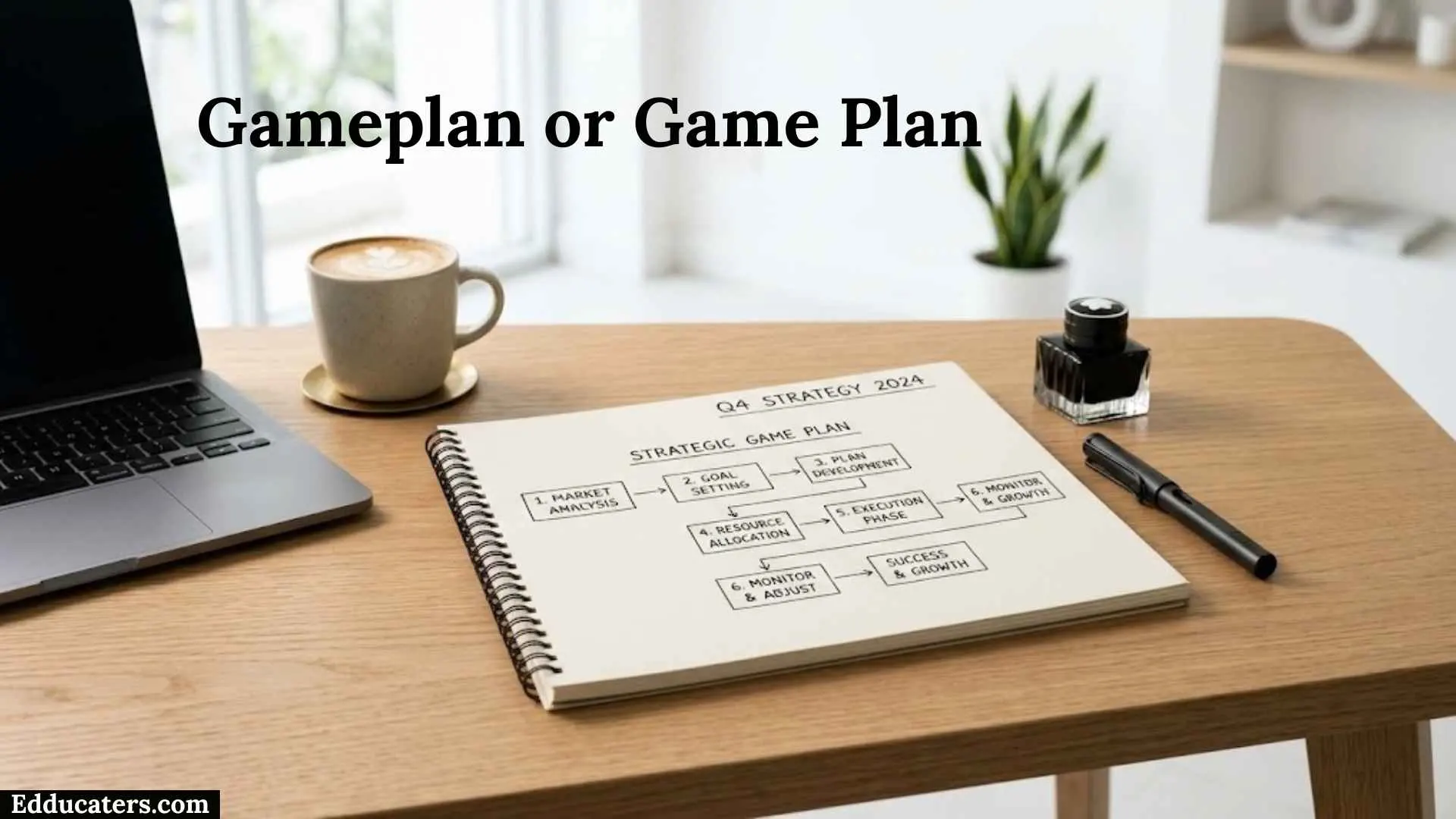
If you are wondering whether to write gameplan or game plan, the safest choice in standard English is game plan—two words. Cambridge and Oxford both list game plan as the established noun, meaning a plan or strategy for achieving success.
However, gameplan is not simply a meaningless or impossible spelling. It is recorded as an alternative form of game plan in Wiktionary-derived dictionary resources, and the closed form also appears in names, titles, and informal writing.
That distinction matters because saying that gameplan is always “wrong” is too strong. In ordinary edited English, game plan is the conventional form and the one to choose when you want the clearest standard spelling.
Quick Answer: Gameplan or Game Plan?
| Form | Usage | Best choice? |
| game plan | Conventional open spelling | Yes |
| gameplan | Alternative form found in some sources and informal usage | Usually use game plan instead |
| game-plan | Occasionally encountered with a hyphen | Not the usual form |
| gameplay | A different word with a different meaning | No, not a replacement |
The main answer is simple: Use “game plan” in normal writing.
For example:
We need a clear game plan before the meeting.
The coach changed the game plan at halftime.
Do you have a game plan for finishing the project?
Cambridge defines game plan as a plan for achieving success, while Oxford describes it as a plan for future success, especially in sports, politics, or business.
What Does Game Plan Mean?
A game plan is a strategy or organized approach for reaching a particular goal.
The expression originally fits naturally with sports. A team may have a particular plan for how it intends to play a match. Over time, the expression became common outside sports and can now describe almost any practical strategy.
For example:
- The coach explained the game plan before the match.
- We need a game plan for the new project.
- She already has a game plan for the weekend.
- The company needs a better game plan for entering the market.
- What is your game plan for preparing for the exam?
The important idea is that a game plan is more than simply having a goal. It suggests that you have thought about how you intend to achieve that goal.
Game Plan as a Strategy
A game plan can include several elements:
- a specific goal
- steps for reaching the goal
- priorities
- timing
- responsibilities
- possible problems
- ways to respond when circumstances change
For example, saying:
My goal is to pass the exam.
only tells the reader what you want.
Saying:
My game plan is to study two hours every evening and complete a practice test every Saturday.
explains how you intend to achieve it.
That is why game plan is closely related to words such as strategy, approach, plan of action, and course of action.
Why Is Game Plan Written as Two Words?
Game plan is a compound noun made from two words: game and plan.
English frequently creates compound nouns in this way. Some remain open compounds written as two words, while others eventually become hyphenated or closed compounds.
In the case of this expression, major learner dictionaries such as Cambridge and Oxford list game plan as two words.
Examples of the standard form include:
- a game plan
- the game plan
- our game plan
- your game plan
- a detailed game plan
- a new game plan
The plural is also straightforward:
game plans
For example:
The two teams had very different game plans.
Is Gameplan Wrong?
Not necessarily.
This is where the answer needs a little more nuance.
Game plan is the conventional open spelling and the safest choice for standard English. Cambridge and Oxford both use this form as their dictionary headword.
At the same time, gameplan is recorded as an alternative form of game plan in Wiktionary-derived resources.
So it would be inaccurate to say:
“Gameplan is always incorrect.”
A more accurate statement is:
Game plan is the conventional standard spelling, while gameplan is an alternative form that appears in some usage.
If you are writing an essay, business document, article, academic assignment, professional email, or other carefully edited text, game plan is the better default.
Why You May See Gameplan Online
You may encounter gameplan in:
- informal writing
- social media
- sports discussions
- titles
- product names
- project names
- company or organization names
- branding
Closed compounds can also develop through ordinary language use, so seeing gameplan does not automatically mean the writer does not know English.
The important distinction is between what people sometimes write and what major standard dictionaries use as the established headword.
For general writing, game plan remains the clearer choice.
Is Game-Plan Correct?
You may also see game-plan with a hyphen.
The hyphenated form can occur in some sources, but it is not the usual form presented by major learner dictionaries for this noun. Cambridge and Oxford list game plan without a hyphen.
Therefore, if you are deciding which form to use in ordinary modern English, there is little reason to choose the hyphenated version.
Use:
game plan
rather than:
game-plan
unless a particular title, publication, brand, or house style specifically requires the hyphen.
Game Plan Pronunciation
Game plan is pronounced with the normal pronunciation of the two words:
/ˈɡeɪm plæn/
Cambridge gives the pronunciation as /ˈɡeɪm ˌplæn/, while Oxford gives /ˈɡeɪm plæn/.
The pronunciation does not change simply because someone writes gameplan as one word.
You can think of it approximately as:
GAYM PLAN
The first word sounds like game, and the second sounds like plan.
Is Game Plan Used in British and American English?
Yes.
Game plan is used in both British and American English. Cambridge provides both UK and US entries, with the same basic spelling and pronunciation.
Oxford also lists the expression in both its standard learner and American dictionaries.
Therefore, this is not a simple case of:
- British English = game plan
- American English = gameplan
That distinction would be misleading.
The open spelling game plan is established across both varieties.
Game Plan in Sports
Sports is one of the most natural contexts for this expression.
A coach may create a game plan based on:
- the opponent’s strengths
- the opponent’s weaknesses
- the team’s own abilities
- tactics
- player positions
- expected conditions
- possible changes during the match
For example:
The coach developed a defensive game plan for the final.
The players followed the game plan throughout the first half.
The team changed its game plan after conceding an early goal.
Here, game plan refers specifically to the strategy a team intends to use during a game.
Game Plan in Business
The expression is not limited to sports.
Businesses frequently use game plan to describe a strategy for reaching a particular objective. Cambridge’s Business English Dictionary also uses the expression in this broader sense.
For example:
We need a clear game plan for launching the product.
The management team developed a new game plan for reducing costs.
What is the company’s game plan for the next three years?
In formal business documents, however, strategy, strategic plan, or plan of action may sometimes sound more formal than game plan.
That does not make game plan incorrect. It is simply a matter of tone and context.
Game Plan in Everyday Conversation
Game plan is also common in everyday English.
Someone might ask:
What’s the game plan?
This usually means:
What are we going to do?
or:
What is the plan?
For example:
Person A: What time are we leaving?
Person B: I’m not sure. What’s the game plan?
The expression makes ordinary conversation sound slightly more strategic or organized, but it does not have to involve an actual game.
You can use it for plans involving:
- travel
- studying
- shopping
- moving house
- organizing an event
- preparing for an interview
- completing a project
Game Plan and Strategy: Are They the Same?
The words are closely related, but they are not always interchangeable in tone.
A strategy is a broader term for an approach designed to achieve a goal.
A game plan often sounds more practical and action-oriented. It can suggest the specific steps or tactics someone intends to follow.
Compare these examples:
The company’s long-term strategy focuses on international expansion.
Our game plan is to enter the first three markets this year.
The first sentence sounds more formal and broad. The second sounds more immediate and practical.
In casual conversation, game plan can therefore be a natural alternative to strategy when you are talking about what you intend to do next.
Game Plan and Plan of Action
Plan of action is another close expression.
Both can describe a set of steps for achieving a goal, but they have slightly different tones.
Game plan is often more conversational:
What’s our game plan?
Plan of action can sound more formal:
The committee agreed on a detailed plan of action.
Game plan is especially natural when discussing strategy, competition, or a practical response to a situation.
Plan of action is common in professional, administrative, and formal contexts.
Neither expression is universally better; the best choice depends on the situation.
Game Plan or Gameplay Are Different
One of the most important spelling distinctions is between game plan or gameplay.
They do not mean the same thing.
Game Plan
Game plan means a strategy or plan for achieving an objective.
The coach changed the game plan.
Gameplay
Gameplay is a different noun. It generally refers to the experience, mechanics, or activity involved in playing a game, particularly in discussions of video games and other games.
Oxford lists game plan or gameplay as separate words.
Compare:
The developer improved the game’s gameplay.
with:
The developer created a new game plan for the project.
Replacing one with the other changes the meaning.
Common Mistakes With Game Plan
Several mistakes appear when people are unsure which form to use.
Writing Gameplan in Formal Writing
Because gameplan appears online, writers sometimes assume it is always the preferred spelling.
For general standard writing, game plan is the safer choice because that is the form listed by Cambridge and Oxford.
Confusing Game Plan With Gameplay
These words have different meanings.
Use game plan for a strategy.
Use gameplay for the way a game is played or the experience and mechanics of playing it.
Treating Gameplan as a British or American Spelling
There is no simple UK-versus-US rule that changes game plan into gameplan.
Both British and American dictionaries list game plan.
Assuming Every Closed Compound Is Wrong
English contains many compounds that can appear in different forms across time and contexts.
Because gameplan is recorded as an alternative form in some sources, calling it categorically “wrong” goes too far.
The practical writing advice is simply to prefer game plan in standard general-purpose English.
Common Expressions With Game Plan
The noun commonly appears with verbs that describe creating, changing, or following a strategy.
Some natural combinations include:
- develop a game plan
- create a game plan
- make a game plan
- come up with a game plan
- put together a game plan
- have a game plan
- follow a game plan
- stick to a game plan
- change the game plan
- adjust the game plan
- rethink the game plan
- execute the game plan
For example:
We need to come up with a game plan before Friday.
The team decided to change the game plan.
She already has a game plan for the presentation.
They stuck to their game plan despite the pressure.
Cambridge specifically gives examples of collocations such as come up with, develop, and put together a game plan.
Examples of Game Plan in Sentences
Here are examples across different situations:
Sports
The coach explained the game plan before kickoff.
Business
The company needs a stronger game plan for entering the international market.
Education
My game plan is to review one chapter every night.
Personal Goals
I finally have a game plan for saving enough money.
Travel
Let’s discuss the game plan before we leave tomorrow morning.
Work
We need a clear game plan for completing the project on time.
Conversation
What’s the game plan for tonight?
In every example, game plan refers to an intended approach or strategy.
How to Choose the Correct Form
If you are unsure which spelling to use, follow this simple rule:
Use “game plan” as two words in normal English writing.
Choose game plan for:
- school assignments
- essays
- professional emails
- business documents
- websites
- articles
- reports
- general correspondence
- formal or edited writing
You may encounter gameplan in informal writing or as a name, title, brand, or other specific usage. It is also recorded as an alternative form in Wiktionary-derived resources.
If you are not following a particular style guide or proper name, however, game plan is the straightforward choice.
Frequently Asked Questions About Gameplan or Game Plan
Is game plan one word or two?
The conventional spelling is game plan, written as two words. Cambridge and Oxford both list it in this form.
Is gameplan a correct word?
Gameplan is recorded as an alternative form of game plan in some dictionary resources. However, game plan is the conventional form and the safer choice for standard general writing.
Is game-plan correct?
The hyphenated form is sometimes encountered, but game plan is the usual dictionary form. Cambridge and Oxford list the noun without a hyphen.
What does game plan mean?
A game plan is a strategy or plan for achieving a particular goal. It can be used in sports, business, personal planning, and everyday conversation.
What is the plural of game plan?
The plural is game plans.
For example:
The two teams had different game plans.
Is game plan formal or informal?
It can be used in both formal and informal contexts, but it often has a conversational or practical tone. In highly formal writing, strategy, strategic plan, or plan of action may sometimes be more suitable.
Is game plan used in British English?
Yes. Game plan is used in British English as well as American English. Cambridge lists UK and US forms.
Is gameplay the same as game plan?
No. Game plan means a strategy or plan, while gameplay refers to the experience, mechanics, or activity of playing a game.
Final Takeaway
When choosing between gameplan or game plan, use game plan as your default.
It is the conventional open spelling listed by major learner dictionaries, and it works naturally in sports, business, professional writing, and everyday conversation.
Gameplan should not simply be called an incorrect spelling because it is recorded as an alternative form in some dictionary resources and appears in informal usage and proper names.
So, if you want the clearest choice for standard English:
Correct default: game plan
And remember that gameplay is a different word with a different meaning.
References
- Cambridge Dictionary — game plan
- Oxford Advanced Learner’s Dictionary — game plan
- Wiktionary — game plan and related form gameplan
- Wordnik — gameplan as an alternative form of game plan

I’m Julian Mercer, an English language writer dedicated to helping people master grammar through practical examples and clear explanations. I enjoy teaching grammar in a way that is both engaging and easy to remember.
My work focuses on grammar rules, punctuation, word usage, and writing techniques that readers can apply in everyday life. I believe learning English should be simple, enjoyable, and useful.
Books
English Grammar in Practice
Writing with Precision
 Nathan Whitmore
 Claire Holloway