English can be tricky when two words seem to mean the same thing. You have likely stared at a sentence wondering if you should write that your toast was “burned” or “burnt.” Both words derive from the verb “burn,” yet they often leave writers feeling uncertain about which one fits the context. This confusion is common, and for good reason—both forms are technically correct.
However, regional preferences, stylistic nuances, and specific grammatical roles dictate when you should reach for one over the other. In this guide, we will clear up the ambiguity so you can write with confidence, ensuring your word choice aligns with the context and the audience you are addressing.
Quick Answer: Burned or Burnt
Both burned and burnt are correct past tense and past participle forms of the verb “burn.” In American English, “burned” is the standard preference for both verb forms and adjectives. In British English, “burnt” is frequently used as both an adjective and a past tense verb.
Comparison of Usage
| Feature | Burned | Burnt |
| Primary Region | American English | British English |
| Verb Form | Past tense / Participle | Past tense / Participle |
| Adjective Usage | Often used (e.g., burned toast) | Very common (e.g., burnt toast) |
| Formal Tone | Preferred in US academic writing | Accepted in formal British contexts |
| Pronunciation | Two syllables (/ˈbɜːrnd/) | One syllable (/ˈbɜːrnt/) |
| Memory Tip | Ends in -ed (standard rule) | Ends in -t (irregular/British style) |
Understanding the Forms
To master these words, you must understand their roles as both verbs and adjectives.
Burned
“Burned” follows the standard rule for regular verbs in English. You add “-ed” to the base form to create the past tense and past participle. Because it adheres to the standard pattern, it is the safest choice in formal American English, especially in professional or academic documents. It remains the most common form in the United States across all contexts, from emails to legal contracts.
Burnt
“Burnt” is an irregular form that gained traction over time, particularly in British English. While it functions as a verb, it is also frequently used as an adjective to describe something that has been affected by fire or heat. For example, “a burnt offering” or “burnt umber” (a color) are established idioms where “burnt” is the preferred, and sometimes exclusive, choice.
Key Differences at a Glance
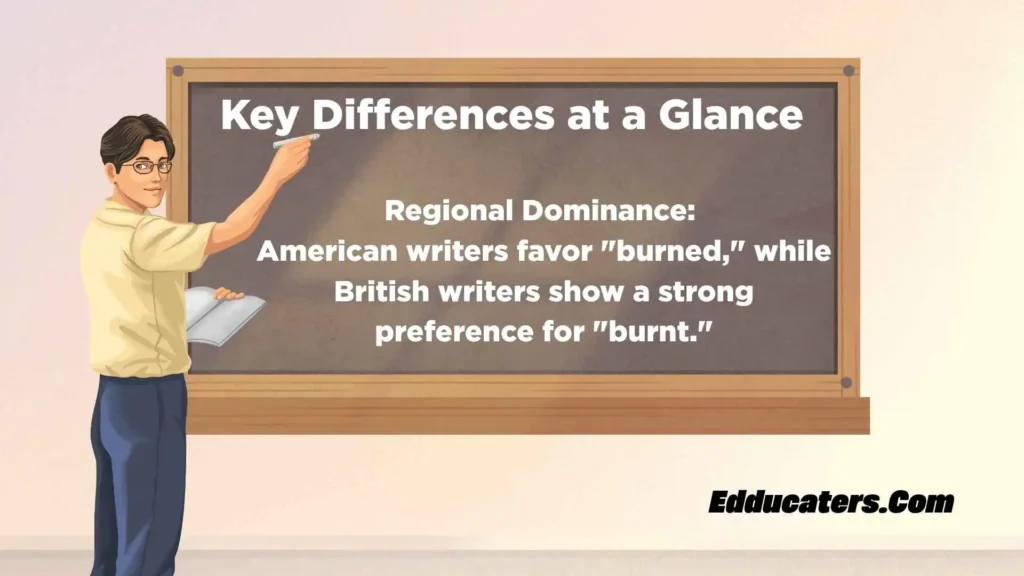
- Regional Dominance: American writers favor “burned,” while British writers show a strong preference for “burnt.”
- Adjectival Preference: Even in American English, you will occasionally see “burnt” used as an adjective (e.g., “burnt sugar”), though “burned” remains perfectly acceptable.
- Verbal Consistency: If you use “burned” as your past tense, it is best to stick with it throughout your document to maintain a consistent style.
Grammar Rules and Usage
The verb “burn” is a classic example of a “transitional” verb in English morphology. While it is technically a regular verb, it retains the older, irregular “-t” ending in certain dialects.
- In Academic and Professional Writing: Use “burned” if you are writing for an American audience. It maintains a consistent, predictable tone.
- In Creative Writing: Authors often choose “burnt” for its evocative, harsh sound, which can better convey the sensory experience of fire or destruction.
- As an Adjective: If you are describing a state—such as “burnt toast” or “burnt skin”—both words work. However, “burnt” often sounds more natural to the ear in these specific descriptive phrases, regardless of the speaker’s region.
Common Mistakes
The most common mistake is mixing the two forms within the same paragraph. If you write, “The chef burned the steak, and the burnt smell filled the room,” the inconsistency can distract the reader.
Incorrect: The fire burned the house down; it was a completely burnt building. (Style inconsistency).
Correct: The fire burned the house down; it was a completely burned building.
Tips to Avoid Mistakes:
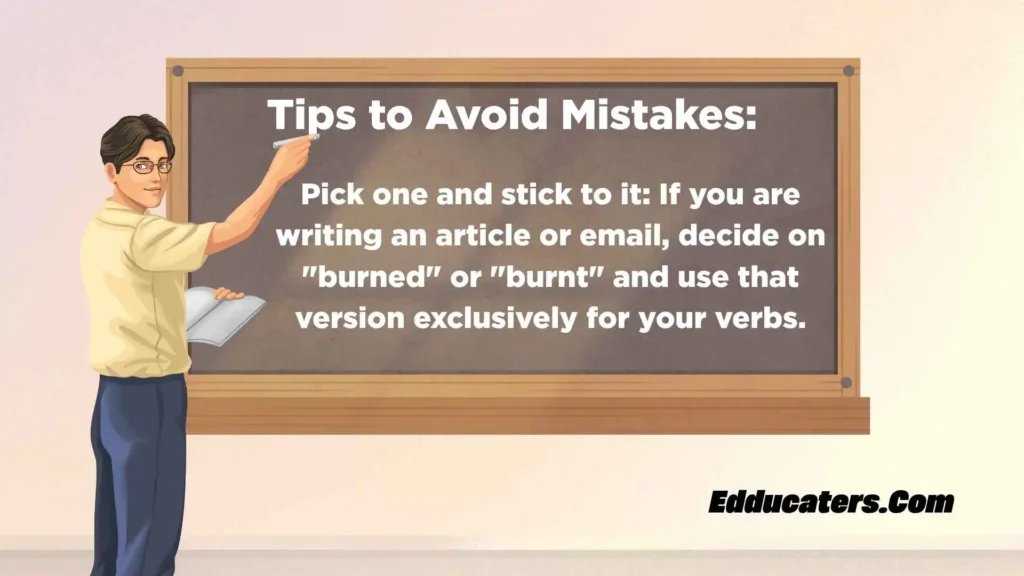
- Pick one and stick to it: If you are writing an article or email, decide on “burned” or “burnt” and use that version exclusively for your verbs.
- Know your audience: If you are writing for an international audience, “burnt” is widely understood and accepted, but “burned” is never wrong.
Original Examples
- The heavy sunlight burned the leaves on the potted fern.
- He accidentally left the oven on, and now the kitchen smells burnt.
- The wildfire burned through five hundred acres of forest land.
- She felt a sharp sting where the hot oil had burned her arm.
- After the marathon, her muscles felt burned out and exhausted.
- The report was burned onto a disc for long-term archiving.
- Do not eat that; the crust is far too burnt for my liking.
- The bridge was burned during the intense military conflict.
- He burned his bridges when he left the company without notice.
- The logs burned steadily throughout the cold winter night.
- The intense heat of the forge burned the impurities from the iron.
- I prefer my toast slightly burnt with extra butter.
- The candle burned down until only a small pool of wax remained.
- They burned the secret documents to ensure no one could read them.
- The sun-burned landscape stretched out toward the horizon.
The Memory Trick
To remember which to use, think of the “D” in “Dream” or “Data.” Since “Burned” ends in -ed, associate it with “Education” or “Document.” Use “Burned” for your formal “Documents.” If you are just having a casual “Toast” or “Tea” (typically associated with British customs), you might reach for the shorter, punchier “Burnt.”
Mini Quiz
- Which form is preferred in formal American English?
a) Burnt
b) Burned
c) Burn
d) Burnning - Can “burnt” be used as an adjective in the US?
a) No, never.
b) Yes, it is common.
c) Only in poetry.
d) Only in legal writing. - What is the best practice for consistency?
a) Use both randomly.
b) Use whichever sounds better.
c) Pick one and stay consistent.
d) Never use either. - Which word sounds more evocative in creative writing?
a) Burned
b) Burnt
c) Burn
d) Burning - Is it incorrect to use “burned” in British English?
a) Yes
b) No
c) Only in formal letters
d) Only in spoken English
Answers: 1(b), 2(b), 3(c), 4(b), 5(b)
Frequently Asked Questions
Is “burnt” grammatically incorrect in the United States?
No, “burnt” is not grammatically incorrect in the United States. While “burned” is the standard form used in most professional and academic writing, “burnt” is widely accepted and commonly used, especially as an adjective to describe things like toast, sugar, or skin.
Why do British and American English differ on this word?
The difference stems from historical language evolution. British English often retains older, irregular “-t” endings for verbs, whereas American English standardized most verbs to the “-ed” ending to simplify spelling and grammar. Both forms have evolved naturally within their respective regions over centuries.
Should I use “burned” or “burnt” in a formal email?
In a formal email to an American recipient, use “burned.” It is the most standard and professional choice. If your recipient is in the UK or another Commonwealth country, “burnt” is perfectly acceptable. When in doubt, “burned” is the universally safe choice across all English-speaking regions.
Can I use both in the same sentence?
While not technically “wrong,” it is considered poor style to use both forms in the same sentence or paragraph. Consistent writing is a hallmark of professional communication. Choosing one form and sticking to it creates a smoother, more polished reading experience for your audience.
Is there a difference in meaning between the two?
There is no difference in the literal meaning. Both refer to the process of being consumed by or damaged by fire. The choice between them is purely a matter of style, regional preference, and the specific cadence you want to achieve in your writing.
Which form should I use for creative writing?
In creative writing, you have more freedom. Many authors prefer “burnt” because it feels more descriptive and carries a specific sensory weight. “The burnt landscape” often sounds more evocative to a reader than “the burned landscape.” Choose the word that best fits the rhythm of your prose.
Key Takeaways
- Consistency is king: Choose either “burned” or “burnt” and maintain it throughout your document.
- Regional context: Use “burned” for American audiences and feel comfortable using “burnt” for British audiences.
- Adjective versatility: “Burnt” is frequently used as an adjective (e.g., burnt toast), even in American English.
- Standard rule: “Burned” is the safest choice for formal and professional writing worldwide.
Conclusion
Navigating the choice between “burned” and “burnt” does not need to be a source of stress. Both are valid expressions of the past tense of “burn.” By understanding that “burned” is the standard for formal American writing and “burnt” is a widely accepted alternative particularly in British English and as a descriptive adjective you can navigate any writing task with ease.
Focus on maintaining consistency within your work, and you will ensure your writing remains clear, professional, and grammatically sound. Whether you have burned your toast or have a burnt offering, you now have the tools to label it correctly.

I’m Julian Mercer, an English language writer dedicated to helping people master grammar through practical examples and clear explanations. I enjoy teaching grammar in a way that is both engaging and easy to remember.
My work focuses on grammar rules, punctuation, word usage, and writing techniques that readers can apply in everyday life. I believe learning English should be simple, enjoyable, and useful.
Books
English Grammar in Practice
Writing with Precision
 Nathan Whitmore
 Claire Holloway