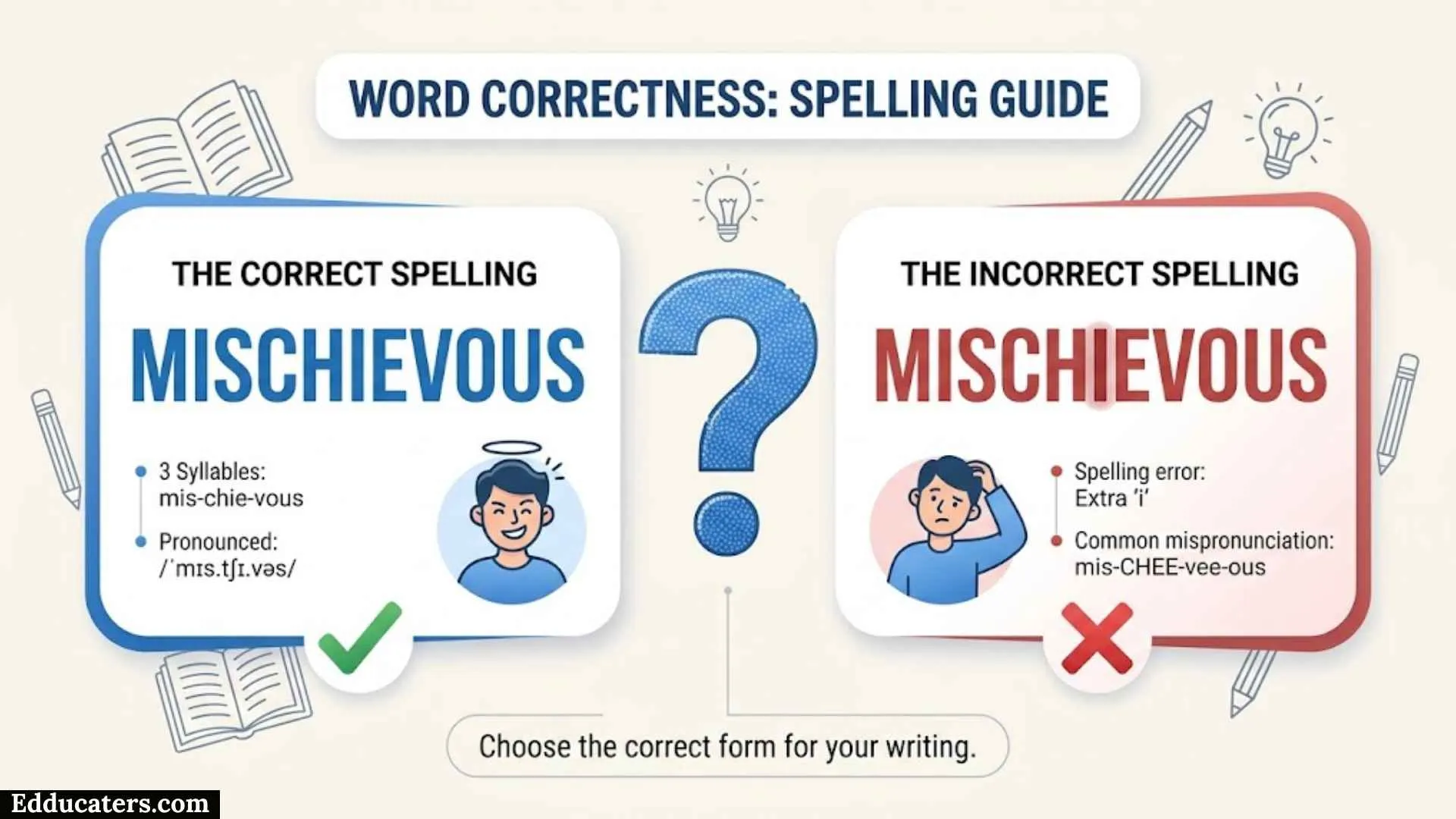
If you have ever hesitated over the spelling of mischievous or mischievious, you are not alone. The word is frequently misspelled because its pronunciation can make it seem as though there should be an extra i before the final ous.
The correct spelling is mischievous. Mischievious is a common misspelling and is not the standard spelling of the adjective.
Mischievous means playful in a way that causes minor trouble, annoyance, or mischief. You can use it to describe a child, animal, person, behavior, smile, or even an action that is deliberately playful or troublesome.
For example:
The mischievous puppy stole a sock from the laundry basket.
The important point to remember is that the correct spelling is:
m-i-s-c-h-i-e-v-o-u-s → mischievous
Not:
m-i-s-c-h-i-e-v-i-o-u-s → mischievious
Although mischievious looks plausible and is widely seen, it is considered a misspelling of mischievous.
Mischievous Is The Correct Spelling
Mischievous is the standard English spelling.
The word contains -iev- before -ous:
mischievous
A common mistake is to insert another i, producing:
mischievious
That extra i does not belong in the standard spelling.
The confusion is understandable because English spelling does not always make pronunciation easy to predict. When people hear the word spoken, they may mentally divide it in a way that suggests mischievious. The spelling can also be influenced by familiar words such as previous, obvious, or devious, which have different letter patterns.
If you are writing an essay, email, report, school assignment, article, or other formal text, use mischievous.
Correct And Incorrect Forms
| Form | Status | Meaning |
| mischievous | Correct | Playfully troublesome or causing minor trouble |
| mischievious | Incorrect spelling | Usually intended as mischievous |
So, when choosing between mischievous or mischievious, choose mischievous.
What Does Mischievous Mean?
Mischievous is an adjective used for someone or something that enjoys causing minor trouble, playing tricks, or behaving in a playful but troublesome way.
It usually describes behavior that is not seriously harmful. A mischievous child might hide someone’s keys, play a harmless prank, make a funny face, or sneak an extra cookie. A mischievous dog might run away with a shoe.
The word can describe both the person responsible for the behavior and the behavior itself.
Consider these examples:
- The mischievous boy hid his sister’s toy.
- She gave me a mischievous smile before leaving the room.
- Our cat has a mischievous habit of knocking pens off the desk.
- The children were feeling mischievous after dinner.
- He had a mischievous idea for the party.
- The puppy looked innocent despite its mischievous behavior.
The word can sometimes carry a sense of charm or affection. Calling a child mischievous often suggests that the child is playful and energetic rather than genuinely bad.
How To Use Mischievous In A Sentence
Because mischievous is an adjective, it normally appears before a noun or after a linking verb.
When it comes before a noun:
- She is a mischievous child.
- We watched the mischievous kitten chase a piece of string.
- He gave us a mischievous grin.
- The teacher noticed the students’ mischievous behavior.
When it follows a linking verb:
- The children were mischievous.
- The puppy seems mischievous today.
- He looked mischievous when he entered the room.
- Her expression was mischievous.
You can also use related forms when the sentence requires them:
- The children behaved mischievously.
- His mischief caused everyone to laugh.
- The little boy was known for his mischievous sense of humor.
The form you choose depends on the grammatical role required by the sentence.
Why Is Mischievious A Common Misspelling?
There are several reasons people write mischievious instead of mischievous.
One major reason is pronunciation. The word can be difficult to spell from sound alone, particularly for people who have heard it many times but have rarely seen it written.
Another reason is that English contains many familiar words ending in -ious, such as:
- previous
- obvious
- serious
- curious
- mysterious
This can encourage people to assume that mischievous should contain the same kind of letter sequence.
The spelling of mischievous is also visually unusual. The sequence -iev- can be easy to rearrange mentally, especially when writing quickly.
There is an additional source of confusion: some speakers pronounce the word in a way that can make it seem as though it has four syllables. That pronunciation can reinforce the spelling mischievious in a writer’s mind.
However, pronunciation does not change the standard spelling.
How Do You Pronounce Mischievous?
The standard pronunciation of mischievous is generally represented as:
MIS-chuh-vus
It is commonly pronounced with three syllables, not four.
The first syllable receives the main stress:
MIS-chuh-vus
A simplified pronunciation guide is:
/ˈmɪstʃɪvəs/
Exact vowel sounds can vary somewhat between varieties of English, but the important spelling point remains the same: the pronunciation does not require an extra i in the written word.
A common pronunciation-related mistake is to say the word as though it were spelled mischievious, giving it an additional syllable. You may hear this pronunciation in everyday speech, but for learners trying to use the standard form, it is useful to remember the three-syllable pronunciation.
Think of it as:
mis + chie + vous
rather than trying to pronounce every written letter individually.
Mischievous Or Mischievious In British And American English
This is not a British-versus-American spelling difference.
Both British English and American English use mischievous as the standard spelling.
You should therefore not assume that mischievious is an American spelling while mischievous is British, or vice versa. It is simply a common misspelling.
For example, both of these varieties use:
- a mischievous child
- a mischievous smile
- a mischievous dog
- a mischievous sense of humor
Regional pronunciation can differ slightly, as it can with many English words, but the standard spelling remains mischievous.
This distinction is important because English does have many genuine regional spelling differences. Words such as colour/color, favour/favor, and centre/center have established British and American forms. Mischievous/mischievious does not work that way.
Mischievous, Mischief, And Mischievously
Understanding the related words can make the spelling easier to remember.
Mischief
Mischief is a noun. It refers to playful trouble, annoying behavior, or actions that cause minor harm or disruption.
Examples:
- The children were up to mischief.
- The puppy got into mischief while we were away.
- His latest mischief made everyone laugh.
The adjective formed from mischief is:
mischievous
Not mischievious.
Mischievously
Mischievously is the adverbial form. It describes an action performed in a mischievous manner.
Examples:
- She smiled mischievously.
- He looked mischievously at his brother.
- The children laughed mischievously after hiding the presents.
Notice the spelling:
mischievous → mischievously
The base adjective remains mischievous.
Other Related Forms
The word family can be summarized like this:
| Word | Part Of Speech | Example |
| mischief | Noun | The children were making mischief. |
| mischievous | Adjective | He has a mischievous smile. |
| mischievously | Adverb | She smiled mischievously. |
Learning the related forms can help prevent the extra i from appearing in the adjective.
Common Phrases With Mischievous
Mischievous frequently appears with words describing facial expressions, personalities, behavior, and playful actions.
Some natural combinations include:
- mischievous child
- mischievous boy
- mischievous girl
- mischievous smile
- mischievous grin
- mischievous look
- mischievous expression
- mischievous behavior
- mischievous sense of humor
- mischievous puppy
- mischievous kitten
- mischievous idea
For example:
He gave his friend a mischievous grin before switching off the lights.
Here, mischievous suggests that the grin reveals a playful intention to cause some harmless trouble.
Another example:
The mischievous kitten jumped onto the table and knocked over a glass.
The kitten is not necessarily aggressive or dangerous. The adjective suggests playful, troublesome behavior.
Is Mischievous Always Negative?
No. Mischievous can be mildly negative, but it is often playful or affectionate.
The context determines how the word feels.
If someone says:
The mischievous child broke the vase.
the behavior has a negative consequence.
But if someone says:
She gave me a mischievous smile.
the word may sound charming, playful, or teasing rather than seriously negative.
Similarly:
The dog has a mischievous personality.
This can be an affectionate way of saying that the dog regularly gets into harmless trouble.
The word is therefore different from stronger words such as malicious, harmful, or vicious. A mischievous person may cause trouble without intending serious harm.
Mischievous Compared With Malicious
These words are sometimes confused because both can describe troublesome behavior, but they carry very different implications.
Mischievous usually suggests playful trouble, teasing, pranks, or minor wrongdoing.
Malicious suggests an intention to cause harm, damage, or distress.
Compare these sentences:
The mischievous child hid his father’s shoes.
The action is troublesome but relatively harmless.
The malicious attacker deliberately damaged the property.
The second sentence describes harmful behavior with a much more serious intention.
Using mischievous for genuinely harmful conduct can therefore make the situation sound lighter than it really is.
Mischievous Or Mischievious: Common Mistakes To Avoid
The biggest mistake is simply adding the extra i.
Incorrect:
She has a mischievious smile.
Correct:
She has a mischievous smile.
Another common mistake is assuming that the pronunciation determines the spelling. English spelling often contains patterns that cannot be predicted perfectly from pronunciation, so hearing an extra syllable does not justify inserting another letter.
Writers may also incorrectly treat mischievious as a regional spelling. It is not the standard British or American alternative.
When proofreading, look specifically for:
mischievious → mischievous
If you regularly make this mistake, checking the word family can help:
mischief → mischievous → mischievously
The spelling becomes easier to recognize once these related forms are familiar.
A Simple Way To Remember The Spelling
One useful memory trick is to start with mischief.
Write:
mischief + ous → mischievous
The exact word formation is more complicated than simply attaching -ous to the modern spelling of mischief, so this is a memory aid rather than a complete explanation of the word’s historical development. Its purpose is simply to remind you that the spelling is built around mischiev-, not mischiev i –.
Another quick visual reminder is:
mischievous = no extra i before ous
If you see:
mischievious
pause and remove the extra i.
The Origin Of Mischievous
The spelling becomes less surprising when you look at the word’s history.
Mischievous is related to mischief, and both ultimately trace back through Middle English and Anglo-French/Old French forms associated with wrongdoing, harm, or trouble.
The modern spelling developed over time rather than being created by simply combining modern English words. This is one reason it does not follow a spelling pattern that might seem obvious from the pronunciation.
The relationship between mischief and mischievous is still useful for modern English learners, however, because knowing the word family helps reinforce the spelling.
You do not need to memorize the historical development to use the word correctly. For everyday writing, the key fact is simply that the standard adjective is mischievous.
Frequently Asked Questions
Is Mischievous Or Mischievious Correct?
Mischievous is correct. Mischievious is a common misspelling.
Is Mischievious A Word?
Mischievious is not the standard spelling of the English adjective. It is generally an incorrect spelling of mischievous.
Does Mischievous Have Three Or Four Syllables?
The standard pronunciation is generally three syllables, approximately MIS-chuh-vus. Some speakers may pronounce it differently, which can contribute to the spelling confusion.
Is Mischievous British Or American?
Mischievous is standard in both British English and American English. Mischievious is not a standard regional alternative.
What Is The Meaning Of Mischievous?
Mischievous describes someone or something that enjoys playful trouble, minor wrongdoing, teasing, or behavior that causes annoyance without necessarily being seriously harmful.
What Is The Noun Form Of Mischievous?
The related noun is mischief.
For example:
The children were getting into mischief.
What Is The Adverb Form Of Mischievous?
The adverb is mischievously.
For example:
He smiled mischievously.
Why Do People Spell Mischievous As Mischievious?
The misspelling is likely influenced by the pronunciation of the word and by familiar English spelling patterns. The extra i can seem natural when people try to spell the word phonetically.
Final Answer: Mischievous Or Mischievious?
When deciding between mischievous or mischievious, use mischievous.
Mischievous is the standard adjective for someone or something that is playfully troublesome, teasing, or inclined to cause minor trouble. Mischievious is a common misspelling, not a British or American spelling variation.
Remember the correct form:
M I S C H I E V O U S
If you connect it with the related word mischief and remember that there is no extra i before -ous, the spelling becomes much easier to retain.
So write:
The mischievous puppy ran away with my shoe.
Not:
The mischievious puppy ran away with my shoe.
When accuracy matters, mischievous is the form to choose.

Hello, I’m Claire Holloway. I have always been passionate about the English language and enjoy turning complex grammar rules into simple, easy-to-follow lessons. I believe that every learner can become a confident English writer with the right guidance.
I create educational content focused on grammar, vocabulary, sentence structure, and writing improvement. Every article I publish is designed to help readers learn with confidence and accuracy.
Books
Grammar Without Confusion
Modern English Usage Guide
 Julian Mercer