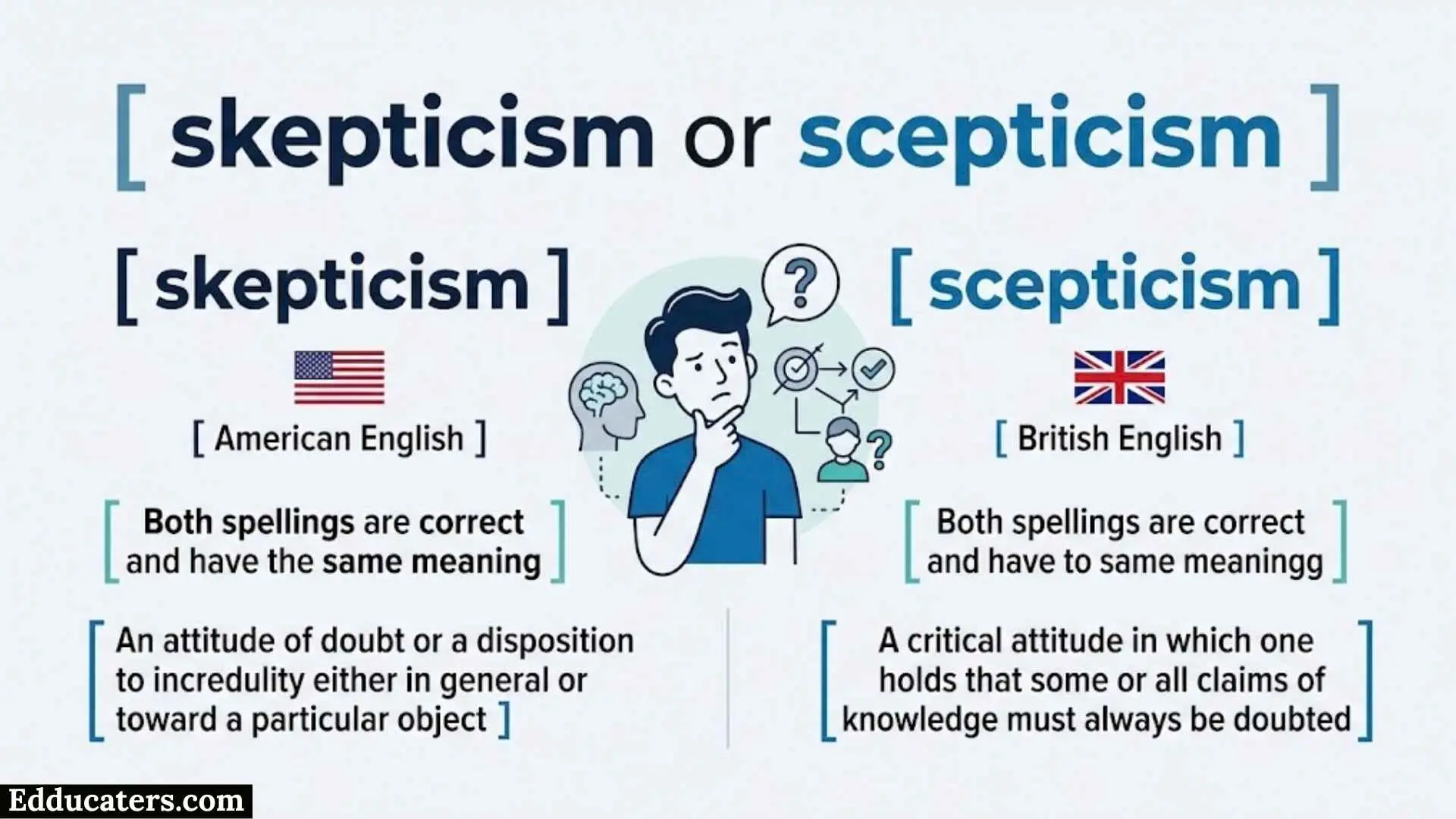
If you’re unsure whether to write skepticism or scepticism, the good news is that both spellings are correct. The difference is mainly regional rather than a difference in meaning.
Skepticism is the standard spelling in American English, while scepticism is the standard spelling in British English. Scepticism is also commonly used in Australian English, which generally follows British spelling conventions.
Both forms describe a questioning attitude toward a claim, belief, idea, or piece of information. They are also normally pronounced the same way.
So, if you’re writing for an American audience, use skepticism. If you’re following British or Australian English, scepticism is generally the appropriate spelling.
Skepticism or Scepticism: Which Is Correct?
Both “skepticism” and “scepticism” are correct. Your choice depends primarily on the variety of English you are using.
| Form | Common variety | Meaning | Part of speech |
| skepticism | American English | A questioning or doubtful attitude | Noun |
| scepticism | British English, Australian English | A questioning or doubtful attitude | Noun |
The spelling difference is easy to see:
- skepticism uses k
- scepticism uses c
This is a regional spelling distinction. It does not normally indicate a difference in meaning, grammar, or pronunciation.
Which Spelling Should You Use?
Use skepticism if your writing follows American English conventions.
Use scepticism if your writing follows British English conventions or a variety such as Australian English that generally uses British spelling.
For example:
American English: The article raises questions about skepticism in modern science.
British English: The article raises questions about scepticism in modern science.
Both sentences are grammatically correct.
What Does Skepticism or Scepticism Mean?
Skepticism or scepticism means a tendency to question whether something is true, accurate, reliable, or sufficiently supported by evidence.
A person showing skepticism does not necessarily reject a claim. They may simply want evidence before accepting it.
For example:
She viewed the advertisement with skepticism because its claims were not supported by evidence.
In British spelling:
She viewed the advertisement with scepticism because its claims were not supported by evidence.
The basic idea is questioning rather than automatically accepting.
Skepticism can occur in everyday situations, professional settings, science, journalism, philosophy, education, and many other areas.
Skepticism or Scepticism as a Noun
Both skepticism or scepticism are nouns.
They refer to an attitude or approach rather than a physical object.
Examples include:
- His skepticism encouraged him to investigate the claim.
- Her scepticism was understandable because the evidence was limited.
- The proposal was met with considerable skepticism.
- Public scepticism increased after several promises were not fulfilled.
- Healthy skepticism can encourage careful evaluation of information.
Because the word is generally an uncountable noun, you will usually say some skepticism, considerable skepticism, or a degree of skepticism rather than treating it as an ordinary countable noun.
Skepticism or Scepticism Pronunciation
Skepticism or scepticism are generally pronounced the same way.
A simple pronunciation guide is:
SKEP-tuh-siz-um
The main stress falls on the first syllable:
SKEP-tuh-siz-um
The approximate IPA pronunciation is:
/ˈskɛptɪsɪzəm/
The spelling difference between skepticism or scepticism does not normally create a different pronunciation.
How Do You Pronounce Scepticism?
Scepticism is pronounced approximately:
SKEP-tuh-siz-um
The c in scepticism represents the same initial /k/ sound that appears in skepticism.
So you should not pronounce the beginning as though it were a separate “seh” sound.
Skepticism or Scepticism in American English
Skepticism is the standard American English spelling.
American English also commonly uses the related forms:
- skeptic
- skeptical
- skepticism
Examples:
The researcher expressed skepticism about the results.
His skepticism disappeared after he examined the evidence.
Consumers showed skepticism toward the company’s new claims.
If you’re writing an American English article, report, academic paper, business document, or website, skepticism is normally the spelling to choose.
Skepticism or Scepticism in British English
Scepticism is the standard British English spelling.
British English also commonly uses:
- sceptic
- sceptical
- scepticism
Examples:
The researcher expressed scepticism about the results.
Her scepticism disappeared after she examined the evidence.
Consumers showed scepticism toward the company’s new claims.
This spelling is particularly appropriate when your publication follows British English style.
Skepticism or Scepticism in Australian English
Australian English generally follows British spelling conventions, so scepticism is the usual form.
For example:
There was considerable scepticism about the company’s announcement.
Australian readers will understand skepticism, especially because American English is widely encountered online, but scepticism fits the usual Australian spelling pattern.
The important point is not to treat one spelling as universally correct. Regional English varieties can have different standard spellings.
Skepticism or Scepticism: What Is the Difference?
The difference is primarily spelling and regional usage.
| Feature | Skepticism | Scepticism |
| Meaning | Questioning or doubtful attitude | Questioning or doubtful attitude |
| Part of speech | Noun | Noun |
| American English | Standard | Less usual |
| British English | Less usual | Standard |
| Australian English | Less usual | Standard |
| Pronunciation | Generally the same | Generally the same |
There is no major grammatical distinction between the two forms.
If you change skepticism to scepticism in a sentence, the meaning normally remains unchanged. You are changing the spelling convention rather than changing the concept.
Skepticism or Scepticism in a Sentence
Here are natural examples showing how the noun works in context:
- The journalist approached the claim with skepticism.
- Her scepticism led her to check the information independently.
- There was widespread skepticism about the unusual explanation.
- His initial scepticism disappeared after he reviewed the evidence.
- Scientific skepticism encourages careful examination of claims.
- The proposal was greeted with scepticism by several readers.
- A healthy level of skepticism can help people recognize unsupported claims.
- She listened to the announcement with considerable scepticism.
- His skepticism was based on the lack of reliable evidence.
- The report prompted renewed scepticism about the company’s promises.
Notice that the spelling can change according to the variety of English, but the meaning of the sentence remains essentially the same.
Skepticism or Scepticism Synonyms
There are several words related to the idea of skepticism or scepticism. However, they are not all exact replacements in every sentence.
Common related words include:
- doubt
- distrust
- suspicion
- disbelief
- uncertainty
- incredulity
- reservation
- questioning
- wariness
- mistrust
The best choice depends on the context.
For instance, doubt can describe uncertainty about a claim. Suspicion can suggest that you think something may be wrong or dishonest. Skepticism or scepticism often emphasizes a habit of questioning claims or requiring evidence.
Skepticism or Scepticism Antonyms
Depending on the context, possible opposites or contrasting concepts include:
- belief
- trust
- confidence
- certainty
- acceptance
- credulity
These words are not exact opposites in every situation.
For example, a person can be skeptical about one particular claim while having complete confidence in another. Skepticism therefore does not necessarily mean that someone believes the opposite of a claim.
Is Scepticism a Disease?
No, scepticism is not a disease.
Scepticism is a noun describing a questioning or doubtful attitude. It is not the name of a medical condition.
The search phrase “scepticism disease” may result from confusion about the word or from searches where scepticism is mentioned in discussions about health information.
For example:
Consumers should approach unsupported health claims with healthy scepticism.
Here, scepticism describes an approach to evaluating information. It does not refer to an illness.
It is therefore important not to confuse the word with a medical diagnosis.
Scepticism in Philosophy
Scepticism has a more specialized meaning in philosophy.
Philosophical scepticism involves questioning knowledge, certainty, justification, or the possibility of knowing particular things.
Philosophical discussions may ask questions such as:
- How do we know that something is true?
- Can our senses always provide reliable knowledge?
- What qualifies as sufficient evidence?
- Can human beings achieve certainty?
- How can we distinguish knowledge from belief?
This philosophical use goes beyond simply saying that you doubt an advertisement or question a friend’s claim.
For example, someone might say:
I have scepticism about this product’s marketing claims.
That is an everyday use of the word.
A philosopher might instead examine whether human beings can have certain knowledge at all. The underlying idea of questioning knowledge is related, but the philosophical discussion is much broader and more specialized.
Scientific Skepticism or Scepticism
Scientific skepticism or scepticism involves examining claims critically and asking whether the available evidence adequately supports them.
A skeptical approach may involve:
- Asking what evidence supports a claim.
- Checking the quality of that evidence.
- Considering alternative explanations.
- Looking for reproducible results.
- Separating established findings from speculation.
Scientific skepticism does not automatically mean rejecting new ideas.
A person can remain open to a new claim while still asking for reliable evidence before accepting it.
For example:
The researchers approached the unexpected result with healthy skepticism and conducted additional tests.
The same sentence can be written in British English as:
The researchers approached the unexpected result with healthy scepticism and conducted additional tests.
Professional Skepticism or Scepticism
Professional skepticism or professional scepticism is an important expression in professional settings, particularly auditing.
It refers to maintaining a questioning mindset and critically assessing evidence rather than accepting information without appropriate examination.
For example:
The auditor maintained professional skepticism when reviewing the financial records.
With British spelling:
The auditor maintained professional scepticism when reviewing the financial records.
The regional spelling changes, but the professional concept remains the same.
Skeptic, Skeptical, Skepticism or Sceptic, Sceptical, Scepticism
The noun skepticism does not stand alone. It belongs to a family of related words whose spelling also changes between American English or British English.
| American English | British English |
| skeptic | sceptic |
| skeptical | sceptical |
| skepticism | scepticism |
This pattern makes the spelling easier to remember.
If you use American English, the k spelling appears throughout this word family.
If you use British English, the c spelling is generally used.
Example
American English:
The skeptic was skeptical about the claim and expressed skepticism about the evidence.
British English:
The sceptic was sceptical about the claim and expressed scepticism about the evidence.
Both sentences communicate the same basic idea.
Common Mistakes With Skepticism or Scepticism
Mistake 1: Calling Scepticism a Misspelling
Some writers assume that scepticism is an incorrect spelling because they are more familiar with skepticism.
That isn’t correct.
Scepticism is a standard British English spelling.
Mistake 2: Assuming Skepticism Is Incorrect in British English
The reverse assumption can also cause confusion.
Skepticism is the standard American spelling. It is widely recognized internationally, even though British English normally prefers scepticism.
Mistake 3: Mixing the Related Spellings
A writer may unintentionally produce:
skepticism, sceptical, scepticism
This mixes spelling conventions.
For consistent American English, use:
skeptic, skeptical, skepticism
For consistent British English, use:
sceptic, sceptical, scepticism
Mistake 4: Thinking Skepticism Means Complete Disbelief
Skepticism does not necessarily mean rejecting an idea.
A skeptical person may simply want convincing evidence before accepting a claim.
For example:
I’m skeptical about the claim, but I’ll consider the evidence.
This shows doubt without completely closing the door to the possibility that the claim could be true.
Mistake 5: Assuming the Spelling Changes the Pronunciation
The spelling difference between skepticism or scepticism generally does not mean that the words should be pronounced differently.
Both are normally pronounced approximately:
SKEP-tuh-siz-um
How to Remember Skepticism or Scepticism
A simple way to remember the spelling is to connect the noun with its related forms.
For American English:
skeptic → skeptical → skepticism
For British English:
sceptic → sceptical → scepticism
Think of the k pattern as the common American form and the c pattern as the common British form.
This is particularly useful if you are writing regularly for an audience that expects one particular variety of English.
Final Answer: Skepticism or Scepticism?
If you only need the answer quickly, remember this:
Skepticism is the standard American English spelling.
Scepticism is the standard British English spelling and is also commonly used in Australian English.
Both forms have the same basic meaning. Both are nouns. Both are generally pronounced the same way.
So, neither spelling is inherently wrong. Choose the form that matches the English variety and style you are using, then keep that spelling consistent throughout your writing.
FAQs About Skepticism or Scepticism
Is it skepticism or scepticism?
Both are correct. Skepticism is the standard American English spelling, while scepticism is the standard British English spelling.
Is scepticism the British spelling?
Yes. Scepticism is the standard British English spelling. The related British forms are sceptic or sceptical.
Is skepticism the American spelling?
Yes. Skepticism is the standard American English spelling. The related American forms are skeptic or skeptical.
Are skepticism or scepticism pronounced differently?
Generally, no. Both are normally pronounced approximately SKEP-tuh-siz-um, with the primary stress on the first syllable.
What does skepticism or scepticism mean?
It means a questioning or doubtful attitude toward a claim, belief, idea, or piece of information, particularly when someone wants evidence before accepting it.
Is scepticism a disease?
No. Scepticism is not a disease. It is a noun describing a questioning or doubtful attitude.
What is the adjective form of skepticism?
The American English adjective is skeptical, while the British English adjective is sceptical.
What is the noun for a person who is skeptical?
The American English noun is skeptic, while the British English noun is sceptic.
Is skepticism always negative?
No. Skepticism can be a useful approach to evaluating claims because it can encourage careful examination of evidence. It does not necessarily mean rejecting a claim.
What is professional skepticism or scepticism?
Professional skepticism or scepticism refers to maintaining a questioning mindset and critically evaluating relevant evidence. The expression is especially common in professional auditing contexts.
Conclusion
Skepticism or scepticism are two standard spellings of the same noun. The main distinction is regional: skepticism is standard in American English, while scepticism is standard in British English and commonly used in Australian English.
The words have the same basic meaning and are generally pronounced the same way. Their related forms follow the same spelling pattern: skeptic or sceptic, skeptical or sceptical.
If you’re writing in American English, choose skepticism. If you’re following British or Australian spelling conventions, choose scepticism. Most importantly, stay consistent with the spelling system used by your audience or publication.

I’m Julian Mercer, an English language writer dedicated to helping people master grammar through practical examples and clear explanations. I enjoy teaching grammar in a way that is both engaging and easy to remember.
My work focuses on grammar rules, punctuation, word usage, and writing techniques that readers can apply in everyday life. I believe learning English should be simple, enjoyable, and useful.
Books
English Grammar in Practice
Writing with Precision
 Nathan Whitmore
 Claire Holloway