English is a language full of delightful nuances, but it also contains traps that can leave even native speakers second-guessing their spelling. The confusion between “allie” or “ally” is a classic example. Because these words sound identical to the ear, writers often struggle to determine which spelling is appropriate for their specific context. Are you referring to a friend and partner, or a person’s name?
Understanding the distinction is vital for maintaining professional clarity and ensuring your written communication remains polished. In this guide, we will clear up the confusion once and for all, providing you with the definitive rules, context-based examples, and memory tricks you need to master these terms.
Quick Answer:
Use ally when referring to a partner, supporter, or someone united with another for a common purpose. It serves as both a noun and a verb. Conversely, Allie is a proper noun, typically a nickname for names like Alison or Alexandra. If you are describing a supporter, use “ally.” If naming a person, use “Allie.”
Comparison Table
| Feature | Ally | Allie |
| Correct Word | Ally | Allie |
| Meaning | A friend, partner, or supporter | A common nickname/proper name |
| Part of Speech | Noun or Verb | Proper Noun |
| Grammar Rule | Standard vocabulary word | Capitalized as a person’s name |
| Correct Usage | They were a strong ally. | Allie went to the store. |
| Incorrect Usage | He is my Allie in business. | We need a strong allie. |
| Pronunciation | AL-eye (noun) or uh-LIE (verb) | AL-ee |
| Common Mistake | Using “Allie” as a common noun | Misspelling the name as “Ally” |
| Memory Tip | “Ally” ends in Y for “You and me.” | “Allie” ends in IE, like “Bestie.” |
| Example | She is a loyal ally. | Allie is coming over later. |
Also Check This Post: Gage or Gauge: A Simple Guide to the Difference
Meaning of Each Word
Defining “Ally”
“Ally” is a versatile word in the English language. As a noun, it refers to a person, group, or nation that is associated with another for some common cause or purpose. It implies cooperation, support, and mutual benefit. As a verb, “ally” means to join or unite with another person or group, often in a political or strategic alliance.
- Grammar Role: Noun (a person/thing) or Verb (the act of joining).
- Usage: It is standard vocabulary used in history, business, politics, and social activism.
- Examples:
- The two companies decided to ally themselves to gain market share.
- In the debate, she proved to be a powerful ally.
Defining “Allie”
“Allie” is not a standard dictionary word in the sense of a common noun or verb. It is a proper noun specifically a name. It is the diminutive form of names such as Alison, Alexandra, or Alice. Because it is a name, it must be capitalized. Using “Allie” in any context other than referring to a specific person is considered a spelling error.
- Grammar Role: Proper Noun.
- Usage: Used strictly as an identifier for individuals.
- Examples:
- Allie just finished her master’s degree.
- I am meeting Allie for coffee this afternoon.
Key Differences
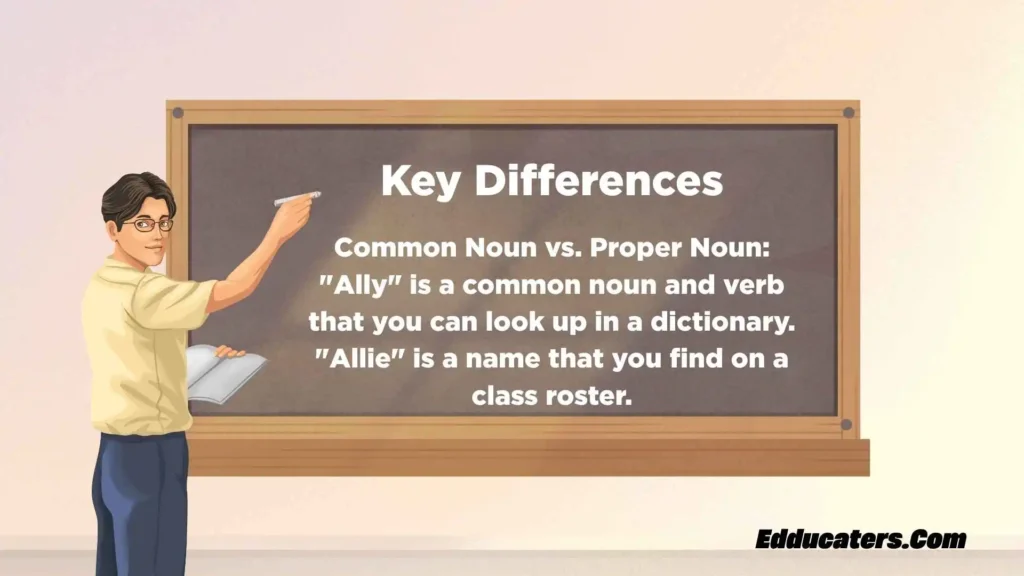
- Common Noun vs. Proper Noun: “Ally” is a common noun and verb that you can look up in a dictionary. “Allie” is a name that you find on a class roster.
- Capitalization: You should almost never capitalize “ally” unless it begins a sentence. You must always capitalize “Allie.”
- Purpose: “Ally” conveys a relationship of support. “Allie” simply denotes a person’s identity.
- The Verb Test: You can “ally” yourself with a cause. You cannot “allie” yourself with a cause.
Grammar Rules
The distinction between these two is governed by the rules of orthography and naming conventions. “Ally” follows standard English spelling patterns for nouns and verbs ending in ‘-y.’ When pluralized, it becomes “allies.”
“Allie” is a product of modern naming conventions, where the ‘-ie’ suffix is added to create a friendly, affectionate nickname. Since it is a proper noun, it is not subject to the same etymological rules as dictionary words. Never interchange them; doing so will immediately undermine the professionalism of your writing.
When to Use Each Word
In Academic and Professional Writing
In formal reports, research papers, or business contracts, “ally” is the only choice. You will often see it used in political science or strategy discussions. “Allie” should never appear in professional writing unless you are specifically referring to an individual named Allie.
In Emails and Daily Conversation
“Ally” appears frequently in work emails regarding teamwork or collaboration. “Allie” is used in social contexts when mentioning friends, family, or colleagues by their preferred names. Always double-check your recipient’s name spelling to ensure you do not accidentally refer to them as a “business ally” if you meant to type their name.
Common Mistakes
The primary reason people confuse these words is that they sound identical in speech. When typing quickly, the brain often defaults to the nickname form because “Allie” is a very common name, leading to the “Allie” vs. “ally” typo.
- Incorrect: “He is my best allie in the office.” (Using the noun ‘ally’ but spelling it like the name ‘Allie’).
- Correct: “He is my best ally in the office.”
- Incorrect: “allie is going to the park.” (Failing to capitalize the name).
- Correct: “Allie is going to the park.”
Also Check This Post: Invision or Envision: Meaning, Spelling, and Usage Guide
Original Examples
- Workplace: We need to find a strategic ally to help us expand into international markets.
- School: Allie is currently studying for her final biology exam.
- Business: The startup decided to ally with the tech giant to improve its software capabilities.
- Conversation: I consider my mentor to be my greatest ally in my career.
- Books: The protagonist found an unexpected ally in the kingdom’s secret archives.
- News: The coalition formed a new ally to combat climate change in the region.
- Social Media: Allie just posted a beautiful photo from her vacation in Italy.
- Everyday English: It is always good to have an ally when you are trying to learn a new skill.
- Business: Our legal team is working to ally our interests with those of our partners.
- Conversation: Allie promised to help me organize the event next month.
- School: History students are learning about how nations chose to ally during the Great War.
- Workplace: If you have an ally in the boardroom, your proposal has a better chance of passing.
- Books: The dragon and the knight eventually became an unlikely ally.
- Everyday English: Is Allie coming to the party tonight?
- News: The government sought an ally in the neighboring country to resolve the border dispute.
- Conversation: I am proud to be an ally to those fighting for equality.
- Business: We are proud to ally our brand with local community initiatives.
- School: Allie submitted her application to the university early this morning.
- Social Media: Does Allie know about the surprise meeting scheduled for Friday?
- Everyday English: Sometimes you need a trusted ally to help you make difficult life decisions.
Memory Trick
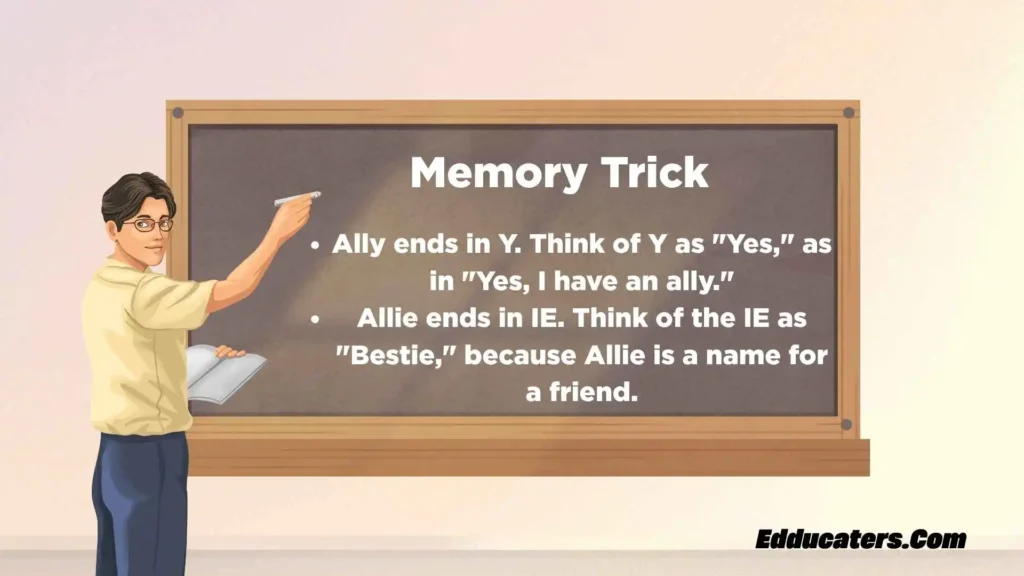
Think of the ending:
- Ally ends in Y. Think of Y as “Yes,” as in “Yes, I have an ally.”
- Allie ends in IE. Think of the IE as “Bestie,” because Allie is a name for a friend.
Whenever you are describing a supporter, look for the “Y.” Whenever you are naming a person, use the name spelling “Allie.”
Mini Quiz
- Who is the person joining us for dinner?
A) Ally
B) Allie - The nations decided to ______ themselves to ensure peace.
A) ally
B) allie - She has been loyal ______ to me for years.
A) ally
B) allie - ______ is the best photographer in town.
A) Ally
B) Allie - Every movement needs a dedicated ______ to succeed.
A) ally
B) allie
Answers: 1(B), 2(A), 3(A), 4(B), 5(A).
FAQs
Why do “ally” and “allie” sound the same?
They are homophones. In English, vowel combinations like ‘-y’ and ‘-ie’ at the end of words often produce the same “ee” sound. This phonetic overlap is exactly what causes the confusion in spelling.
Can “ally” ever be a name?
Yes, some people do use “Ally” as a name, often as a shortened version of the same names as “Allie.” However, if you are using it as a dictionary word, it must be lowercase. If you are using it as a name, it must be capitalized.
How do I know if I should capitalize the word?
If it is a person’s name (Allie), capitalize it. If it is a common noun or verb (ally), it should only be capitalized if it starts a sentence or is part of a title.
Is “allied” related to “ally”?
Yes. “Allied” is the past tense and past participle of the verb “ally.” It describes a relationship that has already been formed.
What if I mistakenly use “Allie” in a report?
It will be viewed as a spelling error or a lack of attention to detail. Always proofread your documents for proper noun capitalization and word choice to maintain professional standards.
Is there a difference between American and British English?
No. Both American and British English use “ally” as the standard spelling for the noun and verb, and “Allie” as the standard nickname. The rules remain the same across both regions.
Key Takeaways
- Ally: A partner, supporter, or friend. Use this for all dictionary definitions.
- Allie: A proper name. Use this only when referring to a specific individual.
- Capitalization: Always capitalize “Allie.” “Ally” is lowercase unless it starts a sentence.
- The “Bestie” rule: “Allie” (with an IE) is for names, like a “bestie.”
- The “Ally” rule: If you mean a partner or supporter, use “Ally.”
Conclusion
Distinguishing between “allie” or “ally” is a simple but important step toward clearer, more precise writing. While their identical pronunciation can be misleading, the grammatical usage of noun/verb versus proper name provides a clear path forward.
By remembering that “Ally” is for partnerships and “Allie” is for individuals, you will eliminate these errors from your work. Consistent attention to these details not only improves your spelling but also bolsters your credibility as a polished communicator. Whether you are writing a strategic business document or texting a friend, you can now use these words with total confidence.
Also Check This Post: Pricey or Pricy: Common Spelling Mistakes to Avoid

Hello, I’m Claire Holloway. I have always been passionate about the English language and enjoy turning complex grammar rules into simple, easy-to-follow lessons. I believe that every learner can become a confident English writer with the right guidance.
I create educational content focused on grammar, vocabulary, sentence structure, and writing improvement. Every article I publish is designed to help readers learn with confidence and accuracy.
Books
Grammar Without Confusion
Modern English Usage Guide
 Nathan Whitmore
 Julian Mercer