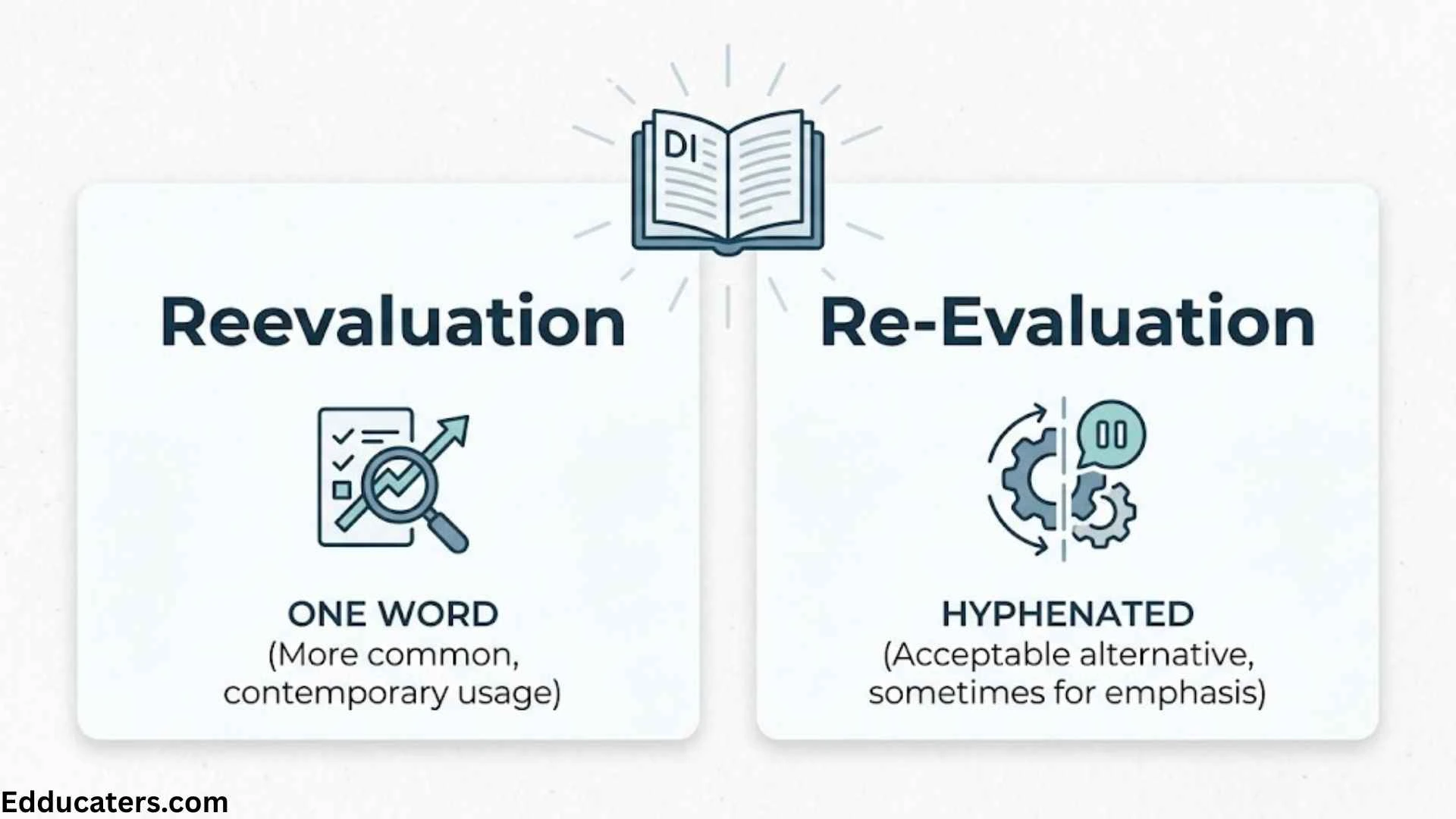
If you have ever wondered whether to write reevaluation or re-evaluation, you are dealing with a spelling difference rather than two completely different words. Both forms are accepted English spellings, and they have the same basic meaning: evaluating, examining, or considering something again. Cambridge lists re-evaluation with reevaluation as an alternative, while Oxford also recognizes the hyphenated form.
The main form you should avoid is re evaluation with a space. In standard edited English, the word is normally written either as reevaluation or re-evaluation.
So, if you are asking “Is it reevaluation or re-evaluation?”, the short answer is: both are correct. Your choice can depend on the dictionary, regional variety, or style guide you are following.
Reevaluation or Re-Evaluation: Which Is Correct?
Reevaluation or re-evaluation are both correct forms.
They are nouns that describe the process of evaluating something again. Cambridge defines re-evaluation as judging or calculating the quality, importance, amount, or value of something for a second or subsequent time. It also lists reevaluation as an alternative form.
| Form | Status | Meaning | Example |
| Reevaluation | Correct | Evaluation again | The project needs a reevaluation. |
| Re-Evaluation | Correct | Evaluation again | The project needs a re-evaluation. |
| Re Evaluation | Usually not standard | Evaluation again | Avoid this open form. |
There is therefore no need to treat reevaluation as a misspelling of re-evaluation, or the other way around.
Quick Answer
Use “reevaluation” or “re-evaluation.” Both are standard forms.
If you are following a particular publication or style guide, use the form preferred by that guide and remain consistent throughout your writing.
What Does Reevaluation or Re-Evaluation Mean?
Reevaluation or re-evaluation means evaluating, examining, judging, or considering something again.
The prefix re- carries the idea of doing something again. When it is combined with evaluation, the resulting noun refers to another evaluation.
For example:
- The company conducted a reevaluation of its business strategy.
- The evidence led to a re-evaluation of the original conclusion.
- The doctor recommended a reevaluation of the treatment plan.
- The committee requested a re-evaluation of the proposal.
The word can be used in many areas, including education, medicine, business, research, finance, personal decisions, and general discussion.
Oxford defines re-evaluation as the act of thinking about something again, particularly to form a new opinion.
Is Reevaluation One Word?
Yes. Reevaluation is one word.
It is the closed form, meaning there is no space or hyphen between re and evaluation.
Correct:
- reevaluation
- reevaluate
- reevaluated
- reevaluating
The related hyphenated forms are also accepted:
- re-evaluation
- re-evaluate
- re-evaluated
- re-evaluating
Cambridge recognizes both re-evaluate or reevaluate for the verb, just as it recognizes re-evaluation or reevaluation for the noun.
The form re evaluation, with a space, is not the usual standard spelling.
Is Re-Evaluation One Word or Two?
Re-evaluation is one hyphenated word, not two separate words.
The hyphen connects the prefix re- with evaluation.
Compare these three forms:
- Reevaluation — one closed word
- Re-Evaluation — one hyphenated word
- Re Evaluation — two separate words
For normal edited English, choose one of the first two.
The hyphen does not change the basic meaning. Reevaluation or re-evaluation both refer to evaluating something again.
This is similar to other English words that can appear in closed or hyphenated forms. English spelling conventions sometimes vary according to dictionaries, publishers, and style guides.
Reevaluation or Re-Evaluation Pronunciation
The pronunciation of reevaluation or re-evaluation is essentially the same.
A simple pronunciation guide is:
ree-ee-val-yoo-AY-shun
The IPA pronunciation given by Cambridge is:
/ˌriː.ɪ.væl.juˈeɪʃən/
You can think of the word as:
ree + evaluation
The hyphen does not create a different pronunciation.
For example:
The committee requested a re-evaluation of the results.
and:
The committee requested a reevaluation of the results.
Both sentences use the same word with the same basic pronunciation.
Is Reevaluation a Noun or a Verb?
Reevaluation is a noun.
The related verb is reevaluate or re-evaluate.
Reevaluation as a Noun
Use the noun when you are talking about the process or act of evaluating something again.
Examples:
- The patient needs a reevaluation.
- The company began a re-evaluation of its goals.
- The research requires further reevaluation.
- The committee completed its re-evaluation.
Reevaluate as a Verb
Use the verb when someone performs the action of evaluating something again.
Examples:
- We need to reevaluate the plan.
- The researchers decided to re-evaluate the evidence.
- The company will reevaluate its strategy.
- The doctor may re-evaluate the treatment.
Cambridge lists re-evaluate as a verb and reevaluate as an alternative spelling.
So the word forms are:
| Noun | Verb |
| Reevaluation | Reevaluate |
| Re-Evaluation | Re-Evaluate |
Reevaluation or Re-Evaluation in American English
Reevaluation is a common closed spelling in American English, although re-evaluation is also an accepted form.
Oxford’s American English dictionary uses reevaluate as its main verb form while recognizing re-evaluate as an alternative.
For example:
- The company needs a complete reevaluation of its expenses.
- The researchers decided to reevaluate the results.
- The doctor scheduled a reevaluation next month.
- We should reevaluate our original assumptions.
If you are writing for an American audience, reevaluation is a natural choice. However, you do not need to consider re-evaluation incorrect simply because it contains a hyphen.
Reevaluation or Re-Evaluation in British English
Re-evaluation is a well-established form in British English.
Cambridge’s English dictionary gives re-evaluation as its main entry and identifies reevaluation as another form.
Examples include:
- The committee called for a re-evaluation of the policy.
- The evidence requires careful re-evaluation.
- The company underwent a major re-evaluation.
- The results led to a re-evaluation of the theory.
However, it would be too simplistic to say that reevaluation is incorrect in British English. Dictionaries recognize both forms. The practical rule is to follow the style required by your publication or institution.
Reevaluation or Re-Evaluation in Medical English
In medical contexts, reevaluation or re-evaluation generally refers to examining a patient’s condition, symptoms, progress, treatment, or needs again.
For example:
- The patient returned for a reevaluation after two weeks.
- The doctor recommended a re-evaluation of the treatment plan.
- A follow-up reevaluation was scheduled.
- The patient’s symptoms required further re-evaluation.
The word does not necessarily describe one particular medical procedure. Its meaning depends on what is being evaluated again.
For instance, a clinician might reevaluate symptoms, treatment progress, test results, or a patient’s overall condition.
A related word is reassessment, which can also describe examining something again. The two words are closely related, but they are not necessarily interchangeable in every specialized context.
Reevaluation or Re-Evaluation in Education
Reevaluation or re-evaluation is also common in educational contexts.
A school, teacher, institution, or examination authority may use the term when work, performance, eligibility, results, or another academic matter is examined again.
Examples:
- The student’s progress required a reevaluation.
- The school requested a re-evaluation of the assessment.
- The committee conducted a reevaluation of the student’s academic needs.
- The examination result was submitted for re-evaluation.
This meaning is especially relevant to searches involving examination re-evaluation. However, the exact procedure, eligibility rules, deadlines, and fees depend on the educational authority involved.
For current examination procedures, readers should rely on the relevant official notice rather than assuming that the spelling of re-evaluation tells them anything about the procedure itself.
Reevaluation or Re-Evaluation in CBSE Context
The phrase re-evaluation is used in CBSE examination-related material.
For example, CBSE’s examination information has used re-evaluation in connection with Class XII examination processes. This reflects the same general meaning of evaluating or reviewing something again.
If you are searching for CBSE revaluation 2026, however, there is an important distinction between the language question and the examination procedure.
The spelling question is straightforward:
Re-evaluation is a standard form.
The procedural question is different. Students should check the latest official CBSE notification for the applicable year because deadlines, application procedures, fees, and other requirements can change.
Therefore, do not rely on a general article about the word to determine the current CBSE process.
Reevaluation or Re-Evaluation Examples
Here are natural examples showing how the noun works in different contexts.
Sentences With “Reevaluation”
- The company conducted a reevaluation of its long-term strategy.
- New evidence led to a reevaluation of the original conclusion.
- The doctor recommended a reevaluation after treatment.
- The committee requested a reevaluation of the proposal.
- The research team completed a reevaluation of the available data.
- The school arranged a reevaluation of the student’s academic needs.
- The unexpected results prompted a reevaluation of the study.
- The project requires a complete reevaluation before it can continue.
- The manager ordered a reevaluation of the department’s budget.
- The new information resulted in a reevaluation of the original plan.
Sentences With “Re-Evaluation”
- The committee requested a re-evaluation of the evidence.
- The company began a re-evaluation of its business plan.
- The patient returned for a re-evaluation.
- The findings prompted a re-evaluation of the original theory.
- The school arranged a re-evaluation of the student’s progress.
- The researchers called for a re-evaluation of the results.
- The new circumstances required a re-evaluation of the plan.
- The report led to a re-evaluation of existing procedures.
- The team conducted a detailed re-evaluation of the project.
- The committee completed its re-evaluation before making a decision.
These examples show that the meaning remains essentially the same regardless of whether you use the closed or hyphenated spelling.
Reevaluation or Re-Evaluation Synonyms
Several words can have a similar meaning, although the best choice depends on context.
Common alternatives include:
- Reassessment
- Reconsideration
- Reappraisal
- Review
- Reexamination
- Rethinking
- Reanalysis
For example, reassessment can describe evaluating something again, while reconsideration often emphasizes thinking about a decision or opinion again.
Reexamination can be particularly useful when something is examined again in detail. Cambridge defines re-examination as looking at or considering something carefully again.
Therefore, synonyms should be chosen according to the exact context rather than substituted mechanically.
Reevaluation or Re-Evaluation or Revaluation
Revaluation is a real English word, but it is not simply another spelling of reevaluation or re-evaluation.
This distinction is particularly important in finance, accounting, and economics.
Reevaluation or re-evaluation generally means:
evaluating, examining, or considering something again.
Revaluation can refer to:
calculating the value of something again, particularly when giving it a higher value, or increasing the value of a currency.
Cambridge specifically uses revaluation in finance, accounting, and economics.
Compare these examples:
- The doctor recommended a reevaluation of the patient’s condition.
- The company completed a revaluation of its property.
- The researchers requested a re-evaluation of the findings.
- The country announced a currency revaluation.
So, if you mean “evaluate again”, reevaluation or re-evaluation is usually the relevant word.
If you are discussing the financial value of an asset or the value of a currency, revaluation may be the appropriate term.
Is Revaluation a Word?
Yes, revaluation is a legitimate English word.
It is a noun related to revalue, which means to change the value of something or consider its value again. Cambridge particularly identifies financial and economic uses of revaluation.
Examples:
- The company announced a property revaluation.
- The accountant completed an asset revaluation.
- The currency revaluation affected international trade.
This is different from a general reevaluation of an idea, strategy, condition, or decision.
Is “Re Evaluation” Correct?
If you mean the noun reevaluation, writing it as re evaluation with a space is generally not the standard choice.
Use:
Reevaluation ✅
Re-Evaluation ✅
Avoid:
Re Evaluation ❌
The important distinction is that the prefix is either joined to the word or connected with a hyphen. It is not normally separated by a space.
This gives you a simple rule:
Use reevaluation or re-evaluation, not re evaluation.
Common Mistakes With Reevaluation
Mistake 1: Writing “Re Evaluation”
Incorrect:
The report needs a re evaluation.
Correct:
The report needs a reevaluation.
Also correct:
The report needs a re-evaluation.
The issue is the unnecessary space.
Mistake 2: Treating Re-Evaluation as a Different Word
The hyphen does not create a completely different meaning.
Reevaluation or re-evaluation both refer to evaluating something again.
Mistake 3: Confusing Reevaluation With Revaluation
These forms look similar but can have different meanings.
Reevaluation commonly concerns another assessment or consideration.
Revaluation is especially associated with value, assets, accounting, or currency.
Mistake 4: Assuming the Hyphenated Form Is Wrong
A hyphen does not automatically make re-evaluation incorrect.
Major dictionaries recognize it as a standard form. Cambridge explicitly lists reevaluation as an alternative to re-evaluation.
Mistake 5: Mixing Spellings Unnecessarily
If you choose reevaluation for an article, there is usually no reason to switch repeatedly to re-evaluation.
Choose the form that fits your preferred style and use it consistently.
Which Form Should You Use?
If you need a simple practical answer, both “reevaluation” or “re-evaluation” are correct.
Your choice can depend on the style or dictionary convention you are following.
| Situation | Useful Choice |
| General English | Reevaluation or re-evaluation |
| American English | Reevaluation is a common choice |
| British English | Re-evaluation is well established |
| Academic writing | Follow your required style guide |
| Medical writing | Either accepted form may appear |
| Examination writing | Follow the institution’s preferred style |
| Financial terminology | Check whether you actually mean revaluation |
The key is not to treat the hyphen as a difference in meaning.
If your school, employer, publisher, or style guide specifies a particular form, follow that requirement.
Reevaluation or Re-Evaluation: Quick Comparison
| Question | Answer |
| Is reevaluation correct? | Yes |
| Is re-evaluation correct? | Yes |
| Do both forms have the same basic meaning? | Yes |
| Is re evaluation standard? | Generally no |
| Is reevaluation a noun? | Yes |
| Is reevaluate a verb? | Yes |
| Does the hyphen change the pronunciation? | No |
| Is revaluation a word? | Yes |
| Does revaluation always mean the same thing as reevaluation? | No |
| Is reevaluation common in American English? | Yes |
| Is re-evaluation established in British English? | Yes |
Frequently Asked Questions
Is It Reevaluation or Re-Evaluation?
Both reevaluation or re-evaluation are correct. They have the same basic meaning and refer to evaluating or considering something again. Cambridge explicitly lists reevaluation as an alternative form.
Is Reevaluation One Word?
Yes. Reevaluation is written as one word without a hyphen or space.
Is Re-Evaluation Hyphenated?
Yes. Re-evaluation is the hyphenated form. It is a standard English spelling.
Is Re Evaluation Correct?
Re evaluation with a space is generally not the standard spelling. Use reevaluation or re-evaluation instead.
What Does Reevaluation Mean in Medical English?
It generally means examining or assessing a patient’s condition, progress, treatment, symptoms, or needs again. The exact meaning depends on the clinical context.
What Are Synonyms for Reevaluation?
Common synonyms include reassessment, reconsideration, reappraisal, review, reexamination, and reanalysis. The most suitable synonym depends on the sentence.
Is Revaluation a Word?
Yes. Revaluation is a legitimate English noun, especially common in finance, accounting, and economics. It is related to changing or reassessing value and should not automatically be substituted for reevaluation.
Is Reevaluation a Verb?
No. Reevaluation is a noun. The related verb is reevaluate or re-evaluate. Cambridge recognizes both verb forms.
How Do You Pronounce Reevaluation?
It is pronounced approximately ree-ee-val-yoo-AY-shun, with the IPA /ˌriː.ɪ.væl.juˈeɪʃən/ according to Cambridge.
Which Form Should I Use in American English?
Reevaluation is a common American English choice, although re-evaluation is also an accepted form. Oxford’s American English dictionary recognizes both related spellings.
Conclusion
When deciding between reevaluation or re-evaluation, you do not have to choose between a correct word and an incorrect word. Both forms are accepted English spellings, and both refer to the process of evaluating, examining, or considering something again. Cambridge lists re-evaluation with reevaluation as an alternative, while Oxford also recognizes the hyphenated form.
The form reevaluation is written as one word, while re-evaluation uses a hyphen. The open form re evaluation is generally not the standard choice.
Also keep revaluation separate in your mind. It is a legitimate word, particularly in finance, accounting, and economics, where it can refer to assigning a new value to an asset or changing the value of a currency.
For everyday writing, the most important rule is simple: use reevaluation or re-evaluation, choose the form that matches your preferred style, and use it consistently.

I’m Julian Mercer, an English language writer dedicated to helping people master grammar through practical examples and clear explanations. I enjoy teaching grammar in a way that is both engaging and easy to remember.
My work focuses on grammar rules, punctuation, word usage, and writing techniques that readers can apply in everyday life. I believe learning English should be simple, enjoyable, and useful.
Books
English Grammar in Practice
Writing with Precision
 Nathan Whitmore
 Claire Holloway