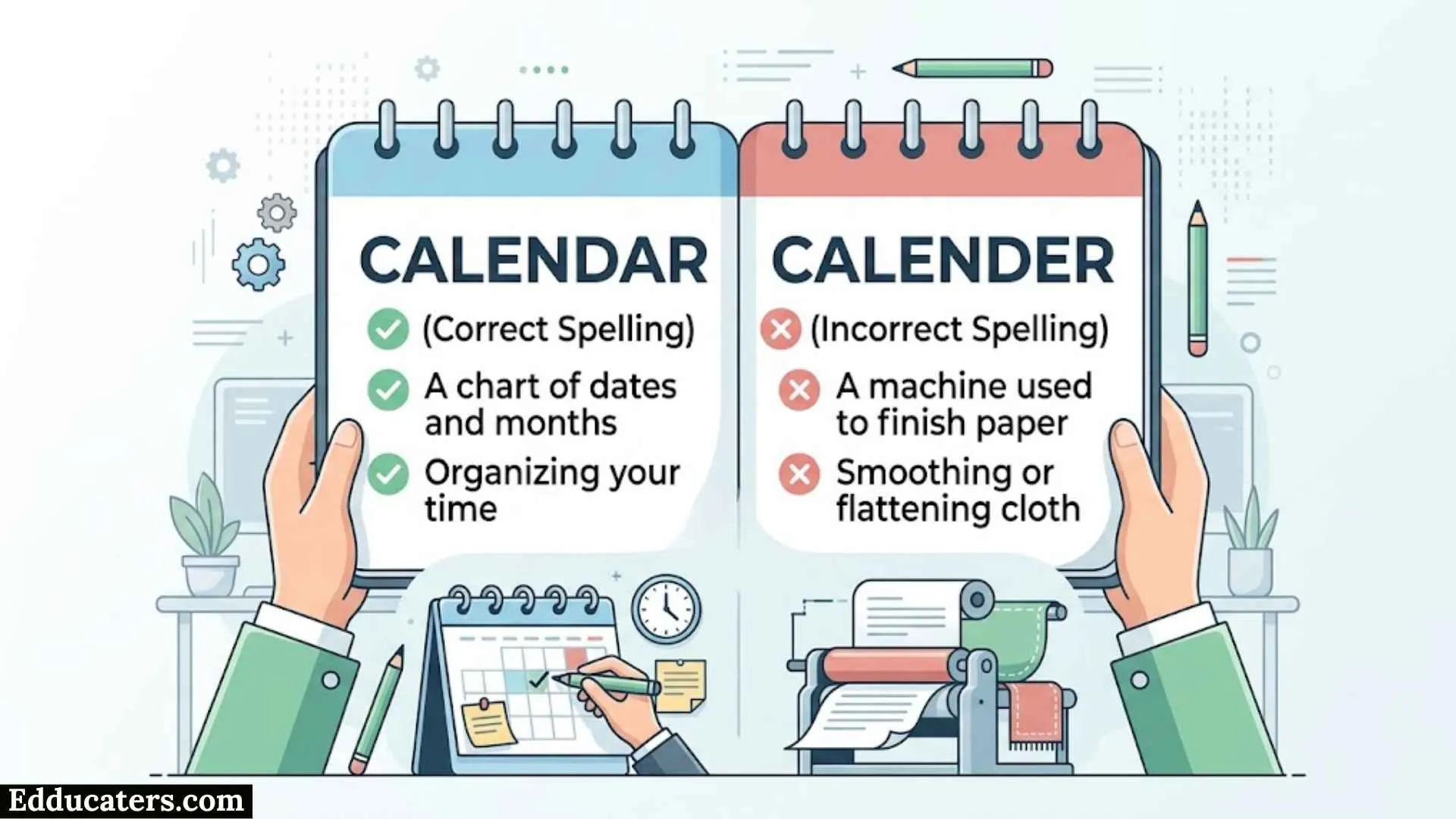
If you are talking about dates, months, appointments, schedules, or yearly events, the correct spelling is calendar. Calender is also a real English word, but it has a completely different meaning: it refers to a machine used to smooth, glaze, press, or finish materials such as paper, cloth, or rubber.
The two words are easy to confuse because they look almost identical and are pronounced very similarly. However, they are not interchangeable.
This guide explains the difference between calender or calendar, including their meanings, pronunciation, British English and American English usage, Australian English usage, the phrase “calender machine,” common spelling mistakes, example sentences, and a simple way to remember which form you need.
Quick Answer: Calender or Calendar?
For ordinary date-related writing, use calendar.
| Word | Correct? | Main meaning | Example |
| calendar | Yes | A system, chart, app, or record for dates and events | I added the meeting to my calendar. |
| calender | Yes, but specialized | A machine or process used to smooth or finish materials | The paper passed through a calender. |
The simplest rule
If you are talking about days, weeks, months, dates, appointments, holidays, meetings, or schedules, use calendar.
If you are talking about industrial rollers used to process paper, cloth, rubber, or similar materials, use calender.
So:
- Correct: Check the calendar for the appointment.
- Correct: The fabric was processed through a calender.
- Incorrect for a date-related meaning: Check the calender for the appointment.
The important point is that calender is a legitimate word, not merely a typing error. The problem occurs when it is used where calendar is required.
What Does Calendar Mean?
Calendar is the standard word used when referring to dates and the organization of time.
It can describe a physical calendar hanging on a wall, a desk calendar, a diary-like planning tool, a digital calendar, or a system for dividing the year into months and days.
Oxford Learner’s Dictionaries gives several meanings for calendar, including a page or series of pages showing the days, weeks, and months of a year, a record of daily plans, a list of important events, and a system for dividing time into fixed periods.
Calendar as a Date Reference
A calendar can show the days, weeks, and months of a particular year.
For example:
- I marked the holiday on my calendar.
- The new calendar is hanging in the kitchen.
- Please check the calendar before choosing a date.
- January is the first month on the calendar.
This is the meaning most people have in mind when they ask whether the spelling should be calender or calendar.
Calendar as a Planning Tool
A calendar can also be a place where you record appointments, meetings, deadlines, birthdays, or other plans.
For example:
- My calendar is full next week.
- She added the doctor’s appointment to her calendar.
- Check my calendar before scheduling the call.
- The team uses a shared calendar for meetings.
Digital calendars are especially common in workplaces, schools, and personal planning.
Calendar as a System of Time
The word can also describe a system for organizing time.
Examples include:
- the Gregorian calendar
- the Islamic calendar
- the academic calendar
- the lunar calendar
- the school calendar
In this sense, a calendar is not necessarily a physical object. It is a system used to divide and organize time.
What Does Calender Mean?
Calender is a separate technical word.
In manufacturing and industrial contexts, a calender is a machine containing rollers or cylinders through which material is passed to achieve a particular finish. Collins defines a calender as a machine used to glaze or smooth paper or cloth by passing the material between rollers; it also records the verb calender for subjecting material to that process.
The word can be relevant to industries involving:
- paper
- textiles
- rubber
- plastics
- coated materials
- manufacturing processes
Calender as a Machine
A calender can use pressure, heat, or controlled roller surfaces to alter the properties or finish of a material.
For example:
The manufacturer used a calender to give the fabric a smoother finish.
This is a legitimate use of calender.
Calender as a Verb
Calender can also function as a verb.
To calender a material means to process it through a calender machine.
For example:
- The factory calendered the paper before packaging it.
- The fabric was calendered to improve its surface finish.
- The production line calenders the material between heated rollers.
Therefore, calender can refer to both the machine and the industrial process.
Calender or Calendar: What Is the Difference?
The main difference is meaning, not British versus American spelling.
| Feature | Calendar | Calender |
| Everyday English | Very common | Specialized |
| Dates and months | Yes | No |
| Appointments | Yes | No |
| Schedules | Yes | No |
| Holidays and events | Yes | No |
| Time systems | Yes | No |
| Industrial rollers | No | Yes |
| Paper or fabric finishing | No | Yes |
| Manufacturing terminology | Sometimes | Yes |
| Common spelling mistake | Often intended | Sometimes accidentally written |
The distinction becomes easy once you connect each spelling with its main meaning:
calendar → dates and time
calender → rollers and material processing
This distinction is more useful than simply memorizing that one spelling is “right” and the other is “wrong.”
Is Calendar the Correct Spelling for Dates?
Yes.
When you mean the object or system used to organize dates, calendar is the correct spelling.
Examples:
- I bought a new calendar.
- The meeting is on my calendar.
- What date is it on the calendar?
- Our academic calendar starts in September.
- The event appears on the online calendar.
Cambridge Dictionary defines calendar as a noun for a printed table showing the days, weeks, and months of the year, and also records meanings connected with planning, events, and systems for organizing time.
So if you are writing an email, article, school assignment, business document, website, or personal note about dates, calendar is almost certainly the word you need.
Calendar in American English
Calendar is the standard spelling in American English for the ordinary date-related meanings.
For example:
- Check the calendar for the meeting date.
- I put the appointment on my calendar.
- The school calendar is available online.
- Our vacation is marked on the calendar.
American English does not normally replace the spelling calendar with calender for these meanings.
Oxford’s American English dictionary also defines calendar as a record of dates, a record of daily activities, a list of important events, or a system for dividing time into fixed periods.
Calendar in British English
British English also uses calendar for dates, months, schedules, and events.
Examples:
- I’ve put the appointment in my calendar.
- Check the calendar for the next meeting.
- The school calendar has been published.
- The event is already in the calendar.
One useful regional detail is that British English can use diary where American English often uses calendar for a personal record of appointments.
That does not mean British English changes the spelling to calender.
Calendar or Diary in British English
In British English, a diary can mean a book used for recording appointments and plans.
For example:
I’ll check my diary and let you know.
In American English, a person may be more likely to say:
I’ll check my calendar and let you know.
The spelling calendar remains correct when referring to the date-planning concept.
Calendar or Calender in Australian English
Australian English uses calendar for the ordinary meaning involving dates, months, appointments, events, and systems of time.
For example:
- Check the calendar for the public holiday.
- The school calendar is available online.
- I’ve added the meeting to my calendar.
Calender does not become the standard spelling simply because the writer is using Australian English. It retains its specialized industrial meaning.
This distinction matters when editing international English because a regional spelling difference should not be assumed when the real issue is a difference in meaning.
How Do You Pronounce Calendar or Calender?
One reason these words cause confusion is that their pronunciations are very similar.
Cambridge gives calendar as /ˈkæl.ən.də(r)/ in UK English and /ˈkæl.ən.dɚ/ in US English. Cambridge gives essentially the same pronunciation pattern for calender.
In simple terms, both words sound roughly like:
KAL-uhn-der
The exact final sound varies according to accent.
Because the pronunciation is so similar, hearing the word does not always tell you which spelling the speaker intends. Context usually provides the answer.
For example:
Put it on the calendar.
Clearly refers to scheduling.
But:
The cloth passed through the calender.
Clearly refers to an industrial machine.
Why Are Calendar or Calender Confused?
There are several reasons these spellings are easy to mix up.
They Differ by Only One Letter
The words look almost identical:
calendar
calender
The difference is the vowel in the second syllable.
That small spelling difference is easy to overlook when typing quickly.
Their Pronunciations Are Very Similar
As Cambridge’s pronunciation entries show, both words have closely matching pronunciations.
Someone may know the word from speech but never have seen it written. When they later type it, they may choose the wrong spelling.
Calender Is a Real Word
Another source of confusion is that spelling software cannot always treat calender as an error because it is a legitimate English word.
For example, a specialist writing about textile manufacturing could correctly write:
The fabric was processed through a calender.
A general writer discussing a meeting would need:
The meeting is on my calendar.
The context determines which word is appropriate.
Is Calender a Misspelling of Calendar?
Not always.
If someone writes calender when they mean a schedule or date system, then it is a spelling error.
However, calender itself is not an incorrect English word.
It has an established technical meaning related to rollers and material processing. Collins lists this industrial noun and its corresponding verb.
So these statements are different:
- “I wrote calender because I meant a schedule.” → The spelling is incorrect.
- “The paper went through a calender.” → The spelling can be completely correct.
This is an important distinction because calling calender “wrong” in every situation would give readers inaccurate information.
What Is a Calender Machine?
A calender machine is an industrial machine that uses rollers to process materials.
Depending on the application, calendering can be used to smooth, glaze, press, finish, coat, or otherwise modify material surfaces.
Collins specifically describes calenders in connection with materials such as paper and cloth and also records applications involving rubber.
Example of Calender Machine Usage
Consider a paper manufacturing facility.
A sheet of paper may need a particular surface finish before it is used for printing or another purpose. A calender can process the material between rollers to produce the required surface characteristics.
A textile manufacturer may use a similar process to modify the appearance or feel of fabric.
Therefore, if you search for calender machine, you are looking at manufacturing terminology, not a different spelling of a date planner.
Calendar as a Verb
There is another useful detail that many spelling guides leave out: calendar can also be a verb.
Cambridge defines the verb calendar as meaning to plan an event to take place on a particular date.
For example:
- The meeting was calendared for Monday.
- We calendared the review for next month.
- The hearing was calendared for November.
This use is especially likely in administrative, legal, organizational, or professional contexts.
So calendar is not limited to being a physical object hanging on a wall.
Calendar or Schedule: Are They the Same?
They can overlap, but they are not always interchangeable.
A calendar commonly organizes dates and may display appointments, events, or activities.
A schedule usually focuses more directly on planned times or the sequence of activities.
For example:
My calendar shows that I have a meeting on Tuesday.
The train schedule shows that the train leaves at 8:30.
A digital calendar can contain many schedules, but the words emphasize slightly different aspects of planning.
Understanding related vocabulary can help prevent mistakes when choosing calendar in professional writing.
Common Mistakes with Calendar
Writing Calender for a Date
Incorrect for the ordinary date-related meaning:
I checked my calender for the appointment.
Correct:
I checked my calendar for the appointment.
Adding an Extra Letter
Another common mistake is producing a form such as calandar.
Correct spelling:
calendar
The safest approach is to remember the sequence:
c-a-l-e-n-d-a-r
Assuming Calender Is Always Wrong
This is the opposite mistake.
The sentence:
The factory uses a calender to finish the material.
can be correct because it refers to an industrial machine.
The problem is not the existence of the word calender. The problem is using it for the wrong meaning.
Real-Life Examples of Calendar
Everyday Example
I wrote my dentist appointment on the calendar.
Here, the word refers to a planning tool.
Workplace Example
The project deadline is already on the team’s shared calendar.
This refers to a digital scheduling system.
School Example
Students should check the academic calendar for examination dates.
Here, calendar refers to a schedule of important academic dates.
Event Example
The festival has become an important event on the city’s cultural calendar.
Here, calendar refers to a collection of significant events.
Historical or Religious Example
Different cultures have used different systems for organizing the year, including the Islamic calendar and Gregorian calendar.
Here, calendar refers to a system for dividing time.
Manufacturing Example
The textile was passed through a calender to achieve the required surface finish.
Here, calender refers to industrial processing equipment.
Calender or Calendar: A Simple Decision Guide
Use this quick decision process whenever you are unsure.
Question 1: Are you talking about dates or time?
If yes, choose calendar.
Examples:
- calendar year
- calendar date
- calendar month
- calendar app
- calendar event
- academic calendar
- school calendar
Question 2: Are you talking about appointments or plans?
If yes, choose calendar.
Examples:
- Add it to my calendar.
- Check your calendar.
- The meeting is on my calendar.
Question 3: Are you talking about industrial rollers?
If yes, choose calender.
Examples:
- calender machine
- calender rollers
- calendered paper
- calendered fabric
Quick memory trick
Think:
Calendar = dates
Calender = rollers
If you can associate calender with an industrial machine, it becomes much easier to reserve calendar for dates and schedules.
Calender or Calendar Quiz
Test yourself with these sentences.
- Please add the meeting to my ______.
- The factory uses a ______ to smooth the paper.
- Check the school ______ for the examination dates.
- The fabric was ______ to produce a smoother finish.
- I marked her birthday on the ______.
- The production line contains a large ______.
- The new academic ______ has been released.
- Please check your ______ before choosing a meeting time.
- The paper was processed between the machine’s rollers.
- The company uses an industrial ______ for material finishing.
Answers
- calendar
- calender
- calendar
- calendered
- calendar
- calender
- calendar
- calendar
- The relevant machine is a calender.
- calender
The pattern is straightforward: ordinary dates and planning require calendar, while industrial roller processing requires calender.
Frequently Asked Questions
Is calender or calendar correct?
Both are correct English words, but they have different meanings. Calendar is the normal word for dates, months, appointments, schedules, and systems of time. Calender is a technical word for a machine or process involving rollers used to finish materials.
Is calendar the correct spelling?
Yes. Calendar is the correct spelling when you mean a date chart, planning tool, schedule of events, or system for organizing time. Cambridge and Oxford both recognize these meanings.
Is calender a real word?
Yes. Calender is a legitimate technical term. Collins defines it as a machine used to smooth or glaze materials such as paper or cloth by passing them between rollers, and it can also be used as a verb.
Is it calender or calendar in English?
For everyday English involving dates, the correct form is calendar. Calender is used in specialized industrial contexts.
Is it calender or calendar in American English?
For dates, appointments, schedules, and time systems, American English uses calendar. Calender remains a separate technical word.
Is it calender or calendar in British English?
British English uses calendar for dates and time-related meanings. Calender is a specialized industrial term.
Is it calender or calendar in Australian English?
For ordinary date-related meanings, use calendar. Calender has its separate technical meaning and is not an alternative Australian spelling of calendar.
How do you pronounce calendar?
Cambridge lists calendar as /ˈkæl.ən.də(r)/ in UK English and /ˈkæl.ən.dɚ/ in US English.
How do you pronounce calender?
Cambridge gives calender a very similar pronunciation: /ˈkæl.ən.də(r)/ in UK English and /ˈkæl.ən.dɚ/ in US English.
What is a calender machine?
A calender machine is an industrial roller machine used to process materials such as paper, cloth, or rubber. The rollers can smooth, glaze, press, or otherwise finish the material.
Can calendar be used as a verb?
Yes. Calendar can be used as a verb meaning to schedule or plan something for a particular date. Cambridge records this verb usage.
What is the easiest way to remember the difference?
Use this simple association:
calendar → dates and schedules
calender → industrial rollers
If you are checking an appointment, holiday, birthday, meeting, or date, choose calendar.
Key Takeaways
- Calendar is the standard word for dates, months, appointments, schedules, events, and systems of time.
- Calender is a legitimate technical word, not simply a misspelling.
- A calender is a machine used to process materials through rollers.
- Calendar is used in American English for the ordinary date-related meaning.
- Calendar is also the standard British English spelling for the same meaning.
- Australian English uses calendar for ordinary date-related contexts.
- The two words have very similar pronunciations, which helps explain the spelling confusion.
- Calendar can also be used as a verb meaning to schedule something.
- Calender machine is a valid manufacturing term.
- For everyday writing about dates, the correct choice is almost always calendar.
Conclusion
The answer to calender or calendar depends on what you mean.
For dates, months, appointments, schedules, holidays, events, or systems of time, use calendar. It is the standard spelling in ordinary English, including American English, British English, and Australian English.
Calender is different. It is a real technical term used for a machine or process involving rollers that smooth, glaze, press, or finish materials such as paper, fabric, or rubber.
The easiest way to remember the distinction is:
Calendar = dates
Calender = rollers
Once you connect each spelling with its meaning, the difference becomes much easier to remember and apply correctly.
References
- Cambridge Dictionary — calendar: definitions and usage.
- Cambridge Dictionary — calendar: pronunciation.
- Cambridge Dictionary — calender: pronunciation.
- Collins English Dictionary — calendar: definitions and usage.
- Collins English Dictionary — calender: industrial definition and verb usage.
- Oxford Advanced Learner’s Dictionary — calendar: definitions, usage, and word origin.

Hi, I’m Nathan Whitmore, and I enjoy making English grammar easy for learners of all ages. I believe grammar should be practical, not confusing. I write simple, well-researched guides that help readers improve their writing, speaking, and overall communication skills.
I spend a lot of time studying grammar patterns, sentence construction, punctuation, and modern English usage. My goal is to create lessons that anyone can understand, whether they are students, teachers, or professionals.
Books
Clear English Grammar
The Smart Writer’s Grammar Handbook
 Claire Holloway
 Julian Mercer