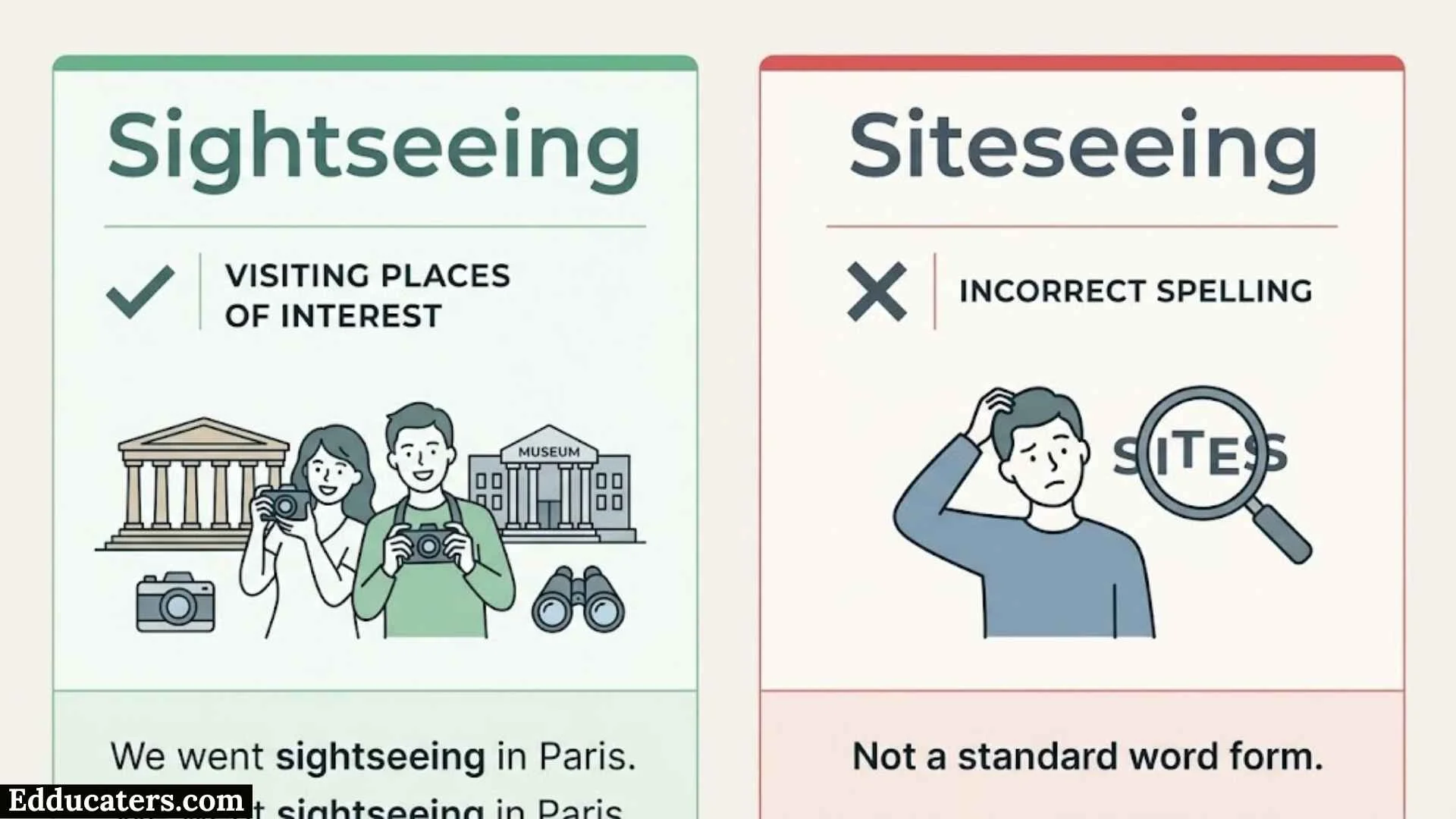
If you are unsure whether the correct spelling is sightseeing or siteseeing, the standard spelling is sightseeing.
Sightseeing means visiting interesting, famous, historical, cultural, or scenic places, especially as a tourist. Siteseeing is a common misspelling and should not be used when you mean this travel activity.
For example:
We spent the afternoon sightseeing in Rome.
The confusion is understandable because sight or site sound alike. However, they have different meanings and spellings. Sight relates to seeing or something that can be seen, while site refers to a place or location.
This distinction matters in travel writing, vacation plans, emails, school assignments, business communication, and everyday English. In this guide, you will learn the correct spelling, meaning, pronunciation, grammar, related forms, common mistakes, useful expressions, and practical ways to remember sightseeing.
Sightseeing or Siteseeing: Which Is Correct?
Sightseeing is the correct standard spelling.
Siteseeing is a misspelling when it is intended to describe the activity of visiting interesting places as a tourist.
| Spelling | Standard usage | Meaning |
| sightseeing | Correct | Visiting or viewing interesting places as a tourist |
| siteseeing | Incorrect for this meaning | Common misspelling of sightseeing |
The correct form is built around sight, not site.
Why “Sightseeing” Is Correct
The word sightseeing refers to seeing interesting sights.
A sight can be something worth seeing, such as a famous monument, beautiful landscape, historic building, or unusual landmark. When tourists travel around a destination to see such things, they are sightseeing.
The spelling therefore makes sense when you connect it with:
sightseeing = seeing sights
For example:
The city has many famous sights, so we spent the day sightseeing.
This connection is one of the easiest ways to remember the spelling.
Why “Siteseeing” Looks Reasonable
The misspelling siteseeing is easy to understand.
Tourists often visit sites, particularly historic sites, archaeological sites, religious sites, and famous locations. Because sightseeing involves visiting places, a writer may assume that site is the first part of the word.
However, the established English word is sightseeing.
The fact that sight or site sound alike makes the mistake even more likely.
What Does Sightseeing Mean?
Sightseeing is the activity of visiting interesting places, particularly while traveling as a tourist.
Oxford defines it as the activity of visiting interesting buildings and places as a tourist. Cambridge similarly defines it as visiting interesting places, especially while on holiday or vacation.
Sightseeing can involve many kinds of attractions, including:
- historical buildings
- monuments
- museums
- castles
- palaces
- famous neighborhoods
- natural landmarks
- scenic viewpoints
- cultural attractions
- architectural landmarks
For example:
We spent our first morning sightseeing around the old city.
The sentence does not necessarily identify one particular attraction. It describes the broader activity of visiting places worth seeing.
Sightseeing Does Not Require a Tour
You can go sightseeing independently.
For example:
We rented bicycles and spent the afternoon sightseeing.
You can also go sightseeing as part of an organized activity:
We booked a sightseeing tour of the historic district.
Both uses are natural.
The essential idea is visiting or viewing interesting places, not the method used to do it.
Sightseeing Pronunciation
Sightseeing is pronounced approximately SYTE-see-ing.
Cambridge gives the pronunciation as /ˈsaɪtˌsiː.ɪŋ/ for both UK and US English.
The first part sounds like sight:
sight + seeing
This creates an important spelling trap because sight or site have the same pronunciation.
Why Pronunciation Does Not Solve the Spelling Problem
If you hear someone say:
sightseeing
you cannot determine from the sound alone whether the first part should be spelled sight or site.
Both sight or site are pronounced /saɪt/.
Their meanings are different, however.
Sight relates to seeing or something seen:
The waterfall was an amazing sight.
Site means a place or location:
The hotel was built on the site of an old theater.
The travel activity is spelled sightseeing.
Sight or Site: Understanding the Key Difference
The easiest way to understand the spelling is to learn the difference between sight or site.
What Does “Sight” Mean?
A sight can refer to something that is seen, particularly something noticeable or interesting.
Examples include:
The snow-covered mountain was a beautiful sight.
The parade was an impressive sight.
The ancient temple is one of the city’s most famous sights.
The plural sights is especially important because sightseeing often involves visiting notable sights.
What Does “Site” Mean?
A site is a place or location.
For example:
The construction site is outside the city.
The museum stands on the site of an ancient settlement.
The company chose a new site for its headquarters.
A site can certainly be a tourist attraction, but that does not change the spelling of sightseeing.
The Memory Connection
A useful distinction is:
- sight → something you see
- site → a place
- sights → notable things worth seeing
- sightseeing → the activity of seeing interesting sights
This four-part connection makes the spelling easier to remember.
Sightseeing as a Noun
Sightseeing is a noun and is normally treated as an uncountable noun. Oxford and Cambridge both identify it as uncountable.
This affects how you use it in sentences.
Natural examples include:
We did some sightseeing in Paris.
There was not enough time for sightseeing.
We spent the morning sightseeing.
Sightseeing is included in the itinerary.
You would not normally count the activity by saying:
three sightseeings
Instead, use a countable expression such as:
three sightseeing tours
or:
three sightseeing trips
“Do Some Sightseeing”
Do some sightseeing is a common expression.
For example:
We did some sightseeing before dinner.
This means the travelers spent some time visiting interesting places.
Cambridge specifically gives do some sightseeing as a common usage pattern.
“Go Sightseeing”
Go sightseeing is another very common expression.
Examples:
We are going sightseeing tomorrow.
They went sightseeing after breakfast.
She wants to go sightseeing before the conference begins.
Oxford and Cambridge both provide go sightseeing as a standard collocation.
Sightsee, Sightseeing, or Sightseer
The word belongs to a small family of related terms.
Sightsee
Sightsee is a verb meaning to visit interesting buildings or places as a tourist.
For example:
We spent the afternoon sightseeing.
Oxford lists sightseeing as the -ing form of the verb sightsee and gives the meaning of visiting interesting buildings and places as a tourist.
The verb is normally used in progressive forms.
Examples:
We are sightseeing in London.
They were sightseeing when the rain started.
I was sightseeing near the harbor.
Sightseeing
Sightseeing can function as a noun describing the activity.
Sightseeing was the highlight of our trip.
We planned a full day of sightseeing.
Sightseer
A sightseer is a person who goes sightseeing.
For example:
The city attracts thousands of sightseers.
Oxford defines a sightseer as a person visiting interesting buildings and places as a tourist.
This gives you a useful word family:
sightsee → sightseeing → sightseer
Sightseeing or Sightseeing Tour: What Is the Difference?
Sightseeing is the general activity.
A sightseeing tour is an organized tour designed to show visitors interesting places.
For example:
We spent the afternoon sightseeing.
This tells us what we did.
We booked a sightseeing tour.
This tells us that we booked an organized tour.
Sightseeing can happen without a tour, while a sightseeing tour is specifically organized around showing attractions.
Common types include:
- walking sightseeing tours
- bus sightseeing tours
- boat sightseeing tours
- bicycle sightseeing tours
- private sightseeing tours
- guided sightseeing tours
Oxford lists a sightseeing tour as a standard collocation.
Sightseeing or Tourism: What Is the Difference?
Tourism is the broader concept.
It can involve traveling for leisure, visiting attractions, staying in hotels, dining, shopping, attending cultural events, or participating in many other activities.
Sightseeing is one activity that tourists may do.
For example:
Tourism is an important part of the city’s economy.
This refers to the wider travel industry.
But:
We spent Saturday sightseeing.
This refers specifically to visiting interesting places.
A traveler can participate in tourism without spending the entire trip sightseeing.
Sightseeing or Visiting: What Is the Difference?
Visiting has a much broader meaning.
You can visit:
- a friend
- a relative
- a doctor
- a museum
- a city
- a country
- a company
- a historical landmark
Sightseeing is more specific. It usually involves visiting places because they are interesting, notable, beautiful, famous, or historically important.
Compare these examples:
I visited my cousin in London.
This does not necessarily involve sightseeing.
I went sightseeing in London.
This suggests that I visited attractions or notable places.
The two activities can happen during the same trip, but they do not have the same meaning.
Sightseeing or Exploring: What Is the Difference?
Exploring is a broader and sometimes more informal concept.
When people explore a city, they may walk through neighborhoods, discover restaurants, browse local stores, visit attractions, or simply see what they find.
Sightseeing often has a stronger focus on notable attractions.
For example:
We spent the morning sightseeing around the city’s famous landmarks.
The emphasis is on attractions.
We spent the afternoon exploring the old neighborhood.
The emphasis is on discovering the area.
There is considerable overlap between the two activities, but the words can create different impressions.
Sightseeing or Touring: What Is the Difference?
Touring can mean traveling through an area or visiting several places.
For example:
We spent two weeks touring Italy.
This suggests movement from place to place.
Sightseeing focuses more specifically on seeing interesting attractions.
For example:
We spent the morning sightseeing in Florence.
A traveler can be touring a country while also going sightseeing in individual cities.
Common Sightseeing Expressions
Learning common combinations makes the word easier to use naturally.
Go Sightseeing
We are going sightseeing after lunch.
Do Some Sightseeing
We did some sightseeing before returning to the hotel.
A Sightseeing Tour
The hotel arranged a sightseeing tour.
A Sightseeing Trip
They planned a sightseeing trip to the pyramids.
Sightseeing Attractions
The city has many popular sightseeing attractions.
A Sightseeing Bus
We took a sightseeing bus around the city center.
Sightseeing Cruise
The family booked a sightseeing cruise along the river.
These expressions are common in travel guides, itineraries, hotel information, vacation planning, and everyday conversations.
Real-World Examples of Sightseeing
The word appears naturally in many different situations.
Vacation Planning
We have three days in Rome, so we want to spend one day sightseeing.
Here, sightseeing is one part of the vacation plan.
Hotel Conversation
Is the hotel within walking distance of the main sightseeing attractions?
The speaker is asking about access to tourist attractions.
Business Travel
I have a free afternoon after the conference, so I might go sightseeing.
Sightseeing is not limited to long vacations. A business traveler can also use the word when visiting attractions during free time.
Travel Itinerary
Day 1: Arrival and sightseeing in the historic district.
Here, the word functions naturally in a schedule.
Casual Conversation
What did you do in Paris?
We did some sightseeing, tried local food, and visited a museum.
The word works naturally in everyday conversation.
Common Mistakes With Sightseeing
Understanding the most common errors can help you avoid them.
Mistake 1: “Siteseeing”
Incorrect:
We spent the weekend siteseeing.
Correct:
We spent the weekend sightseeing.
The correct spelling contains sight.
Mistake 2: “Sight Seeing”
Incorrect:
We went sight seeing in London.
Correct:
We went sightseeing in London.
The travel activity is normally written as one word.
Mistake 3: Confusing “Site” With “Sight”
Incorrect reasoning:
Tourists visit sites, so the word must be siteseeing.
The logic is understandable, but the standard word is sightseeing.
A tourist may visit a site, but the activity is sightseeing.
Mistake 4: Assuming Pronunciation Reveals the Spelling
Because sight or site sound alike, pronunciation does not tell you which spelling is correct.
You need to remember the meaning and established spelling.
Mistake 5: Treating “Sightseeing” as a Countable Noun
Avoid constructions such as:
We did three sightseeings.
Instead, say:
We went on three sightseeing tours.
or:
We took three sightseeing trips.
Is Sightseeing One Word?
Yes.
The standard spelling is:
sightseeing
It is normally written as one word when referring to the travel activity.
Avoid:
- sight seeing
- sight-seeing
- siteseeing
For modern standard English, sightseeing is the form to use.
Is Sightseeing Used in British or American English?
Sightseeing is standard in both British English and American English.
The spelling does not change between these varieties.
Cambridge lists the word in both UK and US English and gives the same basic meaning in each variety.
There are some travel vocabulary differences between British English and American English, such as holiday or vacation, but sightseeing itself does not require a different spelling.
For example:
We went sightseeing during our holiday.
British English commonly uses holiday in this context.
We went sightseeing during our vacation.
American English commonly uses vacation.
The word sightseeing remains unchanged.
How to Remember the Correct Spelling
The most useful memory trick is:
Sightseeing = seeing sights.
Imagine a traveler looking at famous sights:
see sights → sightseeing
This is more reliable than trying to remember whether the first part sounds like site.
You can also remember:
Sight = something you see.
Site = a place.
Then connect the travel activity with sights, not merely with locations.
A Quick Spelling Test
When you are about to type siteseeing, ask yourself:
Am I talking about seeing interesting sights?
If the answer is yes, write:
sightseeing
If you are talking about a physical location, site may be the word you need.
For example:
The construction site is closed.
But:
We spent the afternoon sightseeing.
A Practical Editing Checklist
If you are proofreading travel content, use this checklist.
- Is the word describing tourist activity? → sightseeing
- Is it written as one word? → sightseeing
- Does the sentence describe visiting interesting places? → sightseeing
- Did you accidentally type siteseeing? → Correct it to sightseeing
- Did you write sight seeing? → Use sightseeing
- Are you talking about a physical location? → Consider whether site is the correct separate noun
- Are you counting activities? → Use sightseeing tours, sightseeing trips, or another countable expression
This checklist is useful for travel bloggers, students, editors, hotel staff, tourism businesses, and anyone writing about vacations.
Quick Decision Guide
Use this simple decision tree when you are unsure.
Are you talking about visiting interesting places as a tourist?
↓
Yes
↓
Use sightseeing.
Are you talking about a physical location?
↓
Yes
↓
Use site when that meaning fits the sentence.
For example:
We went sightseeing around the historic district.
But:
The museum was built on the site of an old palace.
This distinction resolves most spelling questions involving these words.
Sightseeing or Siteseeing: Quick Answer
Sightseeing is the correct spelling.
Siteseeing is a common misspelling when referring to the activity of visiting interesting places as a tourist.
The correct word is connected to sight or sights:
sightseeing = seeing sights
Remember these examples:
- We went sightseeing in Paris.
- They spent the afternoon sightseeing.
- We booked a sightseeing tour.
- She enjoys sightseeing when she travels.
- The city has many famous sights.
The spelling siteseeing should be avoided in standard English when you mean tourist sightseeing.
Frequently Asked Questions
Is sightseeing or siteseeing correct?
Sightseeing is correct. Siteseeing is a common misspelling of the standard travel term.
Why is sightseeing spelled with “sight”?
The word refers to seeing interesting sights. The connection can be remembered as seeing sights → sightseeing.
Is sightseeing one word?
Yes. Sightseeing is normally written as one word.
Is sightseeing hyphenated?
No. The standard modern form is sightseeing, not sight-seeing.
What does sightseeing mean?
Sightseeing means visiting interesting, famous, historical, cultural, or scenic places, particularly as a tourist.
How do you pronounce sightseeing?
Cambridge gives /ˈsaɪtˌsiː.ɪŋ/ for both UK and US English. It sounds approximately like SYTE-see-ing.
Is sightseeing a noun?
Yes. Sightseeing is a noun and is normally uncountable.
For example:
We did some sightseeing.
Can sightseeing be used as a verb?
The related verb is sightsee. Its -ing form is sightseeing.
For example:
We are sightseeing in Rome.
Oxford identifies sightsee as an intransitive verb and lists sightseeing as its -ing form.
What is a person who goes sightseeing called?
A person who goes sightseeing can be called a sightseer. Oxford defines a sightseer as someone visiting interesting buildings and places as a tourist.
Can you say “go sightseeing”?
Yes. Go sightseeing is a standard and very common expression.
We are going sightseeing tomorrow.
Can you say “do sightseeing”?
The more natural expression is do some sightseeing.
We did some sightseeing in Paris.
This pattern is listed by both Oxford and Cambridge.
What is the difference between sight or site?
Sight relates to seeing or something seen, while site means a place or location. They sound alike but have different meanings and spellings.
What is the plural of sightseeing?
Sightseeing is normally uncountable, so you would not usually make it plural. To count experiences, use expressions such as sightseeing tours or sightseeing trips.
Is sightseeing used in British English?
Yes. Sightseeing is standard in British English.
Is sightseeing used in American English?
Yes. Sightseeing is also standard in American English.
Can “siteseeing” ever be used?
If you mean the standard travel activity, use sightseeing. The spelling siteseeing is not the standard form for that meaning.
Final Takeaway
When you mean visiting interesting places while traveling, the correct spelling is sightseeing.
The spelling siteseeing is a common mistake caused largely by the fact that sight and site sound identical. The meanings are different, however. Sight relates to seeing, while site refers to a location.
The easiest memory rule is:
Sightseeing = seeing sights.
Use sightseeing in travel plans, vacation writing, hotel information, school assignments, business communication, and everyday conversation.
If you are describing the activity, write sightseeing. If you are describing a physical location, site may be the appropriate word.
References
- Oxford Advanced Learner’s Dictionary — sightseeing
- Oxford Advanced Learner’s Dictionary — sightsee
- Oxford Advanced Learner’s Dictionary — sightseer
- Cambridge Dictionary — sightseeing
- Cambridge Dictionary — sightseeing pronunciation
- Merriam-Webster Dictionary — sightseeing

Hello, I’m Claire Holloway. I have always been passionate about the English language and enjoy turning complex grammar rules into simple, easy-to-follow lessons. I believe that every learner can become a confident English writer with the right guidance.
I create educational content focused on grammar, vocabulary, sentence structure, and writing improvement. Every article I publish is designed to help readers learn with confidence and accuracy.
Books
Grammar Without Confusion
Modern English Usage Guide
 Nathan Whitmore
 Julian Mercer