Language often presents us with words that look similar, sound nearly identical, and leave even the most diligent writers questioning their spelling. The debate between “invision” or “envision” is a classic example of this confusion. You might have seen “invision” used in company names or informal digital contexts, but is it a standard English word?
If you are aiming for precision in your professional emails, academic papers, or creative storytelling, choosing the correct term is essential. In this guide, we will clear up the mystery surrounding these two words, explore their origins, and provide you with clear rules so you never have to double-check their usage again.
Invision or Envision:(Quick Answer)
Envision is the correct standard English verb, meaning to visualize or imagine a future possibility. Invision is not a standard dictionary-recognized word; it is a common misspelling of “envision” or a brand name. Always use “envision” when you want to describe the act of picturing something in your mind.
Comparison Table
| Feature | Envision | Invision |
| Status | Standard English | Non-standard / Misspelling |
| Meaning | To imagine or visualize | None (usually a mistake) |
| Part of Speech | Verb | None |
| Grammar Rule | Transitive verb | N/A |
| Correct Usage | “I envision a bright future.” | Avoid using it in writing. |
| Incorrect Usage | N/A | “I can invision the plan.” |
| Pronunciation | /ɛnˈvɪʒ.ən/ | /ɪnˈvɪʒ.ən/ |
| Memory Tip | Starts with ‘E’ for “Eyes” | Common misspelling |
| Example | “They envision great success.” | “I can’t invision it.” (Wrong) |
Also Check This Post: Baptised or Baptized: A Simple Guide to the Correct Spelling
Meaning of Each Word
Defining “Envision”
“Envision” is a formal verb that means to contemplate or conceive of a possibility, typically in the future. It involves the act of forming a mental picture of something that does not yet exist. It comes from the prefix “en-” (meaning “to put into”) and “vision” (the ability to see).
- Grammar Role: It functions as a transitive verb, meaning it requires a direct object to be complete.
- Examples:
- The architect must envision the final design before building.
- She could envision a time when her business would flourish globally.
Defining “Invision”
“Invision” does not exist as a legitimate verb in the English language. When you encounter it, it is either a misspelling of “envision” or, more frequently, a trademarked name for a software or design platform. Because it is not a recognized word, it should never be used in professional, academic, or creative writing to describe the act of imagining.
- Grammar Role: None (non-standard).
- Examples:
- The software company is called InVision. (Correct as a brand name)
- I invision a better world. (Incorrect usage)
Key Differences
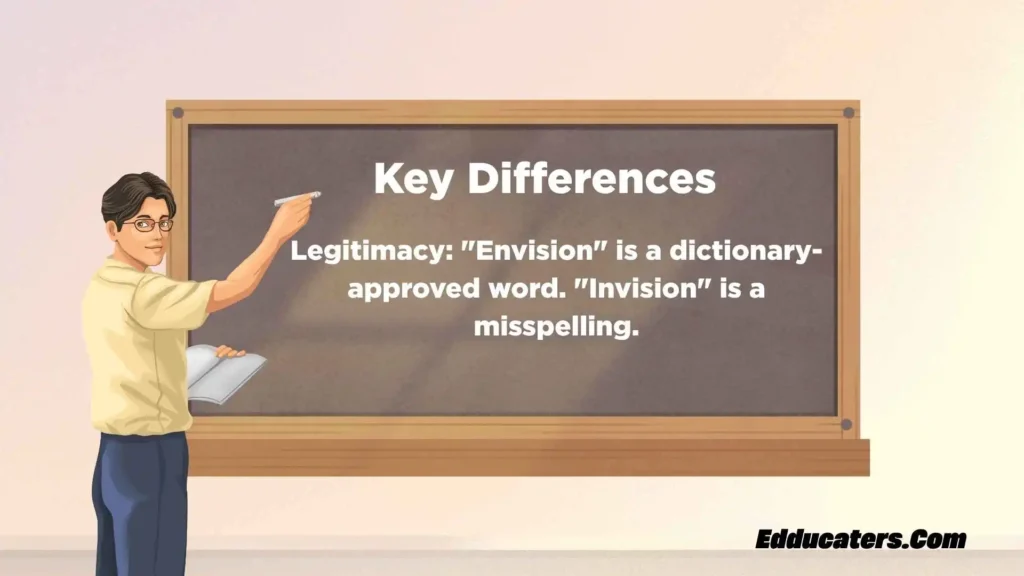
- Legitimacy: “Envision” is a dictionary-approved word. “Invision” is a misspelling.
- Context: Use “envision” when talking about imagination or future foresight. Use “InVision” only when referring to the specific design software brand.
- The ‘E’ vs. ‘I’ Rule: When describing the action of seeing mentally, “E” (for eyes, for envision) is the correct path.
Grammar Rules
The rule is straightforward: “Envision” follows standard English morphology. English frequently uses the prefix “en-” to turn nouns into verbs (like “enlarge” or “enrich”). There is no standard grammatical precedent for “invision” as a verb. Using it in a sentence is considered a spelling error by editors, professors, and automated proofreaders alike. There are no exceptions to this rule in standard professional or formal English.
When to Use Each Word
- Academic Writing: Stick strictly to “envision.” Using “invision” will negatively affect your credibility and clarity.
- Professional/Business Writing: Always use “envision” when describing project goals or future states. Only use “InVision” if you are specifically naming the software tool.
- Formal/Informal English: In both contexts, “envision” is the only correct choice for the act of imagining.
- Emails: Use “envision” to maintain a professional tone.
Also Check This Post: Fourth or Forth: Expert Tips for Choosing the Right Word
Common Mistakes
The confusion stems from the fact that many English words begin with the prefix “in-.” People assume “invision” follows the same pattern as “imagine” or “inspect.” Because “envision” and “invision” sound nearly identical in casual speech, the error is easily propagated through social media and casual texting.
- Incorrect: “I can easily invision our team hitting these goals.”
- Correct: “I can easily envision our team hitting these goals.”
- Tips to avoid: Remember that we use our Eyes to Envision.
Original Examples
- The CEO tried to envision the company’s growth over the next decade.
- Can you envision living in a completely different city?
- The planners could not envision a successful outcome under these conditions.
- She liked to envision her future home by the ocean.
- Experts envision significant changes in transportation technology soon.
- He began to envision a world where clean energy was the standard.
- The artist could envision the sculpture before touching the clay.
- Management wants to envision a more inclusive workplace culture.
- We must envision potential obstacles to plan for them effectively.
- The scouts envision a difficult trek through the mountains.
- Many people envision retirement as a time for travel.
- The scientist envisioned a breakthrough in her latest research.
- He could envision the relief on his family’s faces.
- The screenplay helps the audience envision a historical setting.
- I can envision this project becoming a major success.
- The developers envision a future with seamless integration.
- She had to envision the steps clearly before taking action.
- Can you envision a society without digital distractions?
- The team is trying to envision a new marketing strategy.
- They envision a world where everyone has access to healthcare.
Memory Trick
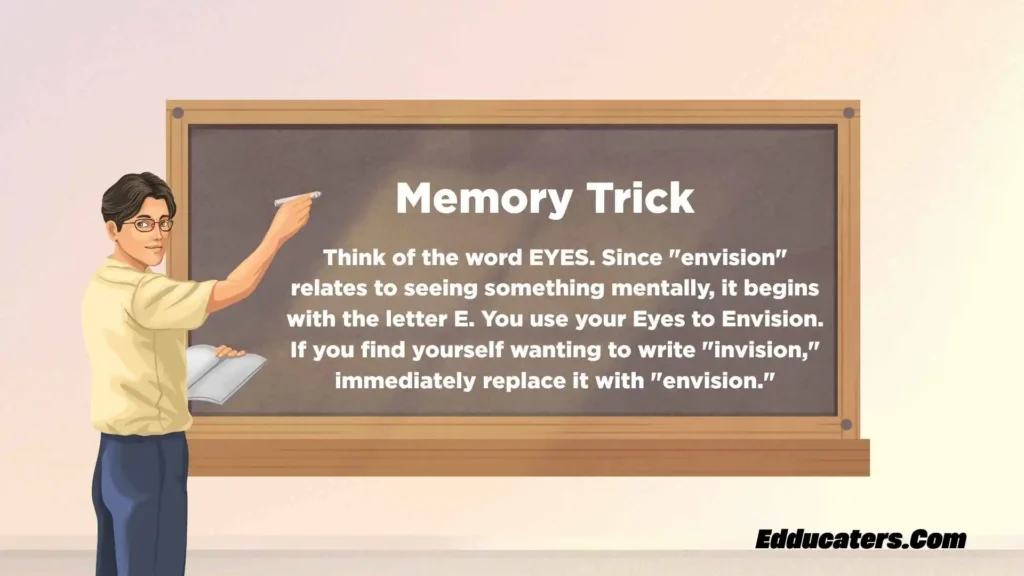
Think of the word EYES. Since “envision” relates to seeing something mentally, it begins with the letter E. You use your Eyes to Envision. If you find yourself wanting to write “invision,” immediately replace it with “envision.”
Mini Quiz
- Which is the correct verb for “imagining the future”?
A) Invision
B) Envision - What part of speech is “envision”?
A) Noun
B) Transitive Verb - Which of the following is correct?
A) I can invision a better life.
B) I can envision a better life. - “InVision” is typically used as:
A) A verb
B) A brand/proper name - What does the “en-” prefix in “envision” generally mean?
A) To put into
B) To take away
Answers: 1(B), 2(B), 3(B), 4(B), 5(A).
FAQs
Is “invision” a word?
In standard English, no. It is not listed in major dictionaries as a verb. It is a common misspelling of “envision.” However, it exists as a proper noun, specifically as the name of a popular design software. If you see it written, it is either a mistake or a brand reference.
Can I use “envision” for something I already see?
No. “Envision” specifically refers to picturing something in your mind, usually something that is not currently present or that is projected for the future. You “see” things that are currently in front of you, but you “envision” possibilities, plans, or future states.
Why do people keep writing “invision”?
The prefix “in-” is incredibly common in English (like “imagine,” “invent,” or “inform”). Because of this, our brains intuitively want to attach “in-” to “vision.” It is a phonetic error encouraged by the abundance of “in-” words in our daily vocabulary.
Is there a difference between American vs. British English?
No. Both American and British English recognize “envision” as the correct spelling. “Invision” is considered an error in all standard English dialects.
What is a synonym for “envision”?
Excellent synonyms include “visualize,” “conceive,” “imagine,” “foresee,” and “picture.” All of these are standard, professional alternatives that you can use if you want to avoid “envision” for stylistic reasons.
What should I do if my document uses “invision”?
If you are writing a document, you should immediately change all instances of “invision” to “envision.” If the word is referring to the InVision design software, ensure that it is capitalized correctly as “InVision” to show that it is a proper noun/brand name.
Key Takeaways
- Envision is the only correct standard verb for imagining or visualizing.
- Invision is not a verb; it is a misspelling of “envision.”
- Only capitalize “InVision” when referring to the specific software brand.
- Use the “Eyes to Envision” trick to remember the correct spelling.
- “Envision” is a transitive verb, meaning it requires an object to be grammatically complete.
Conclusion
The choice between “invision” or “envision” is a simple one once you know the rules. Because “envision” is the only standard verb used to describe the act of mental visualization, it should be your go-to word in every professional and formal context. By remembering that you use your Eyes to Envision, you can eliminate this common spelling error from your writing permanently.
If you are crafting a business strategy or telling a story about the future, choosing “envision” ensures your message remains clear, professional, and grammatically correct.
Also Check This Post: Peoples’ or People’s: The Complete Grammar Guide

I’m Julian Mercer, an English language writer dedicated to helping people master grammar through practical examples and clear explanations. I enjoy teaching grammar in a way that is both engaging and easy to remember.
My work focuses on grammar rules, punctuation, word usage, and writing techniques that readers can apply in everyday life. I believe learning English should be simple, enjoyable, and useful.
Books
English Grammar in Practice
Writing with Precision
 Claire Holloway
 Nathan Whitmore