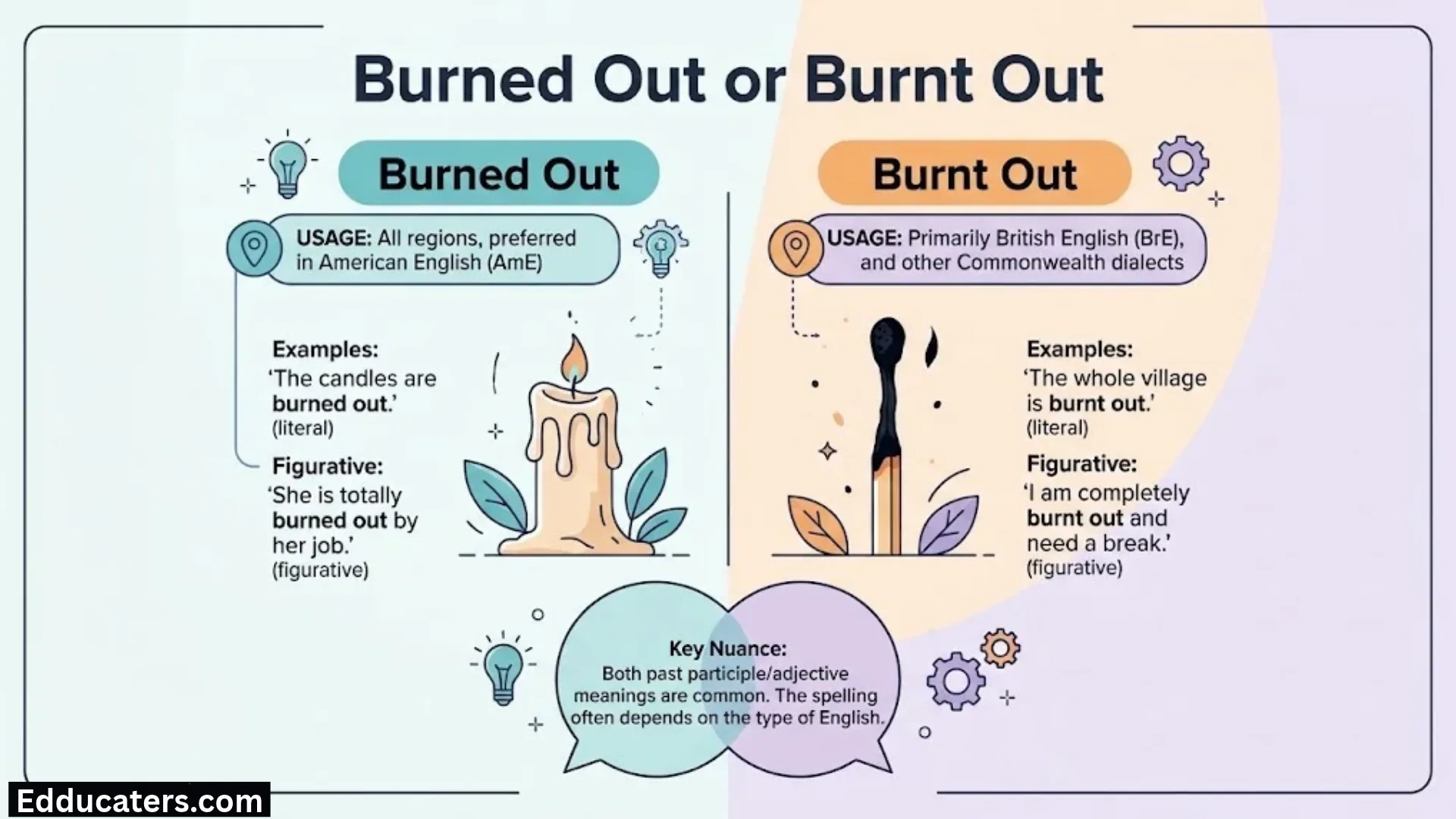
If you’re unsure whether to write burned out or burnt out, both forms are correct. However, your choice may depend on the type of English you’re writing. Burned out is generally preferred in American English, while burnt out is especially common in British English.
Both expressions can describe someone who feels mentally or emotionally exhausted after prolonged work or stress. They can also describe physical objects that fire has damaged or that have stopped working because of excessive heat.
For example, an American writer might say, “I’m burned out after working all weekend.” A British writer might express the same feeling by saying, “I’m burnt out after working all weekend.” Neither sentence is inherently wrong.
The main challenge is knowing when to use each spelling, whether to add a hyphen, and how to distinguish these expressions from burn out and burnout.
Here’s a quick guide:
- Burned out: The preferred general form in American English.
- Burnt out: A common alternative, particularly in British English.
- Burned-out: A hyphenated adjective used before a noun.
- Burnt-out: The corresponding hyphenated British-style form.
- Burn out: A two-word phrasal verb.
- Burnout: A one-word noun describing a state of exhaustion or depletion.
Let’s explore their meanings, grammatical roles, regional differences, and everyday uses so you can choose the right expression confidently.
Burned Out or Burnt Out: Which Is Correct?
Both burned out and burnt out are correct English expressions. The difference mainly involves regional spelling preferences rather than meaning.
In American English, writers generally favor burned out. In British English, burnt out is particularly common, although British writers also use burned out.
Both forms can describe a person who has become exhausted from working too hard. They can also describe a building damaged by fire, a light bulb that no longer works, or another object affected by heat.
Consider these examples:
- American English: “I’m completely burned out after the product launch.”
- British English: “I’m completely burnt out after the product launch.”
- Physical object: “The burned-out light bulb needs replacing.”
- Another acceptable form: “The burnt-out light bulb needs replacing.”
The meaning remains essentially the same in each comparison.
| Expression | Grammatical role | Typical use |
| Burned out | Verb form or adjective | Common in American English |
| Burnt out | Verb form or adjective | Particularly common in British English |
| Burned-out | Compound adjective | Describes a noun that follows |
| Burnt-out | Compound adjective | Same meaning with the alternative spelling |
| Burn out | Phrasal verb | Describes an action or process |
| Burnout | Noun | Names a state of exhaustion or depletion |
Which form should you choose? If you’re writing for an American audience, burned out is usually the safest option. For British readers, burnt out may sound more familiar.
However, neither spelling is universally correct in every regional context. Both have established uses in standard English.
Burned Out Meaning and Burnt Out Meaning
The burned out meaning and burnt out meaning are essentially identical. The expression has two main uses: figurative exhaustion and literal damage.
Burned Out Meaning at Work
When you describe a person as burned out at work, you mean that the person feels extremely tired, mentally drained, or emotionally exhausted after sustained work demands.
This feeling may develop after weeks or months of heavy workloads, repeated overtime, demanding deadlines, or limited opportunities to rest.
For example:
“I’m burned out from managing three major projects at once.”
The speaker isn’t necessarily saying that one difficult day caused the problem. Instead, the sentence suggests that ongoing demands have depleted the person’s energy or enthusiasm.
Other examples include:
- “The teacher felt burned out after a demanding school year.”
- “Several employees became burnt out during the company’s busiest season.”
- “She was mentally burned out after months of overtime.”
- “The manager noticed that his team seemed exhausted and less motivated.”
In these sentences, both spellings communicate the same basic idea.
Burned Out as a Description of Physical Damage
The expression also has a literal meaning. A burned-out object has been damaged by fire or heat, or has stopped functioning because of heat-related damage.
For example:
- “The firefighters inspected the burned-out building.”
- “We replaced the burned-out fuse.”
- “The mechanic discovered that the starter motor had burned out.”
- “They found a burnt-out vehicle beside the road.”
A burned-out light bulb is another familiar example. People often use the phrase to describe a bulb that no longer produces light.
However, a bulb can stop working for reasons other than burning. In everyday conversation, burned-out bulb remains a conventional expression even when the precise technical failure is unknown.
Does Burned Out Always Mean Exhausted?
No. Context determines the meaning.
Compare these two sentences:
- “The employee felt burned out after months of overtime.”
- “The building was burned out after the fire.”
The first describes exhaustion. The second describes physical destruction.
The same expression can therefore communicate very different ideas without changing its basic spelling.
Burned Out or Burnt Out in American, British, and Australian English
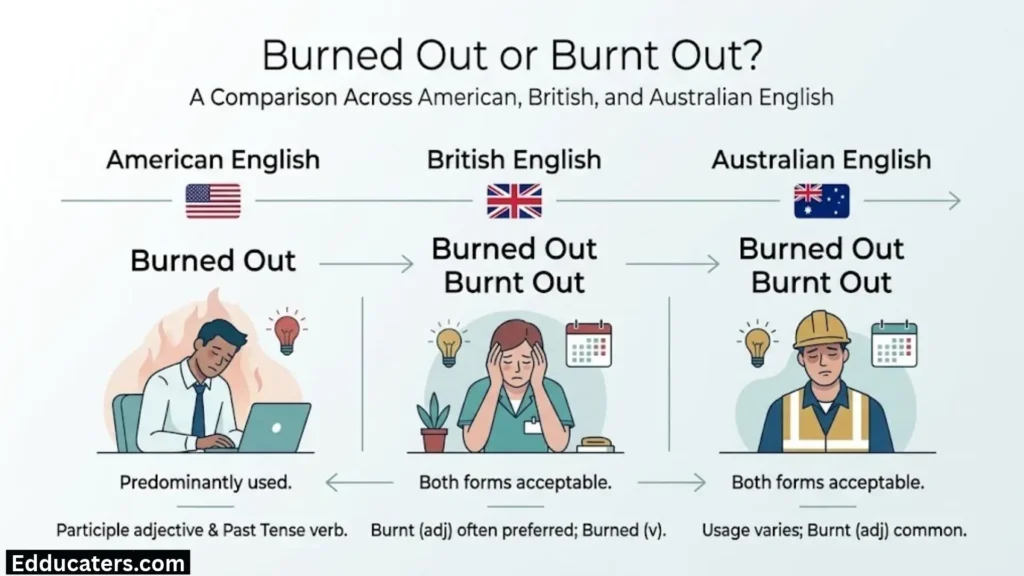
English spelling varies across regions, and burned versus burnt is a good example.
Unlike a simple spelling rule that makes one form universally right and the other wrong, this distinction reflects established patterns of usage.
Burned Out in American English
Burned out is the usual choice in American English, particularly in professional writing, educational material, workplace communication, and general online content.
American English commonly uses burned as the past tense and past participle of burn.
For example:
- “I burned the toast this morning.”
- “The candle burned for several hours.”
- “The employee burned out after months of excessive overtime.”
- “The electrical equipment had burned out.”
American writers also use burnt, especially in certain established expressions and descriptive contexts. Therefore, it would be inaccurate to claim that burnt is always wrong in the United States.
Nevertheless, if you’re writing for a broad American audience, burned out is a reliable default.
Burnt Out in British English
Burnt out is particularly common in British English. British writers frequently use burnt as the past tense or past participle of burn.
For example:
- “The toast was burnt.”
- “The candle burnt throughout the evening.”
- “I’m feeling burnt out after a difficult week.”
- “The firefighters examined the burnt-out building.”
British English also accepts burned. The distinction is a matter of preference and convention, not a strict grammatical boundary.
What About Australian English?
Australian English shares several spelling conventions with British English, and burnt is familiar in Australian usage. However, burned is also correct and widely understood.
The best choice depends on your publication’s editorial style, your audience, and the surrounding wording.
| Variety of English | Common preference | Is the alternative acceptable? |
| American English | Burned out | Yes |
| British English | Burnt out | Yes |
| Australian English | Both forms occur; burnt is familiar | Yes |
These are general tendencies, not absolute rules. If you follow a publication’s house style, use its preferred form consistently.
Burned or Burnt: Understanding the Difference
To understand burned out or burnt out, it helps to look at the verb burn.
Unlike many regular English verbs, burn has two accepted past-tense and past-participle forms: burned and burnt.
The regular form adds -ed to the base verb:
- Burn → burned
- Learn → learned
- Turn → turned
The alternative form uses -t:
- Burn → burnt
This pattern also appears in some other English verbs, including learned/learnt and dreamed/dreamt. Regional preferences can differ, and not every verb follows precisely the same pattern.
Burned as a Verb
The word burned can describe an action that happened in the past or an action completed before another event.
Examples:
- “I burned the pizza because I forgot to set a timer.”
- “The workers burned the old documents.”
- “The motor burned out during the test.”
- “She has burned her hand on the hot pan.”
In the third example, burned out is part of a phrasal verb. The motor stopped working because of damage.
Burnt as a Verb
The form burnt can perform the same grammatical function, particularly in British English.
Examples:
- “I burnt the pizza while answering a phone call.”
- “The candle burnt down to its base.”
- “The motor burnt out during the test.”
- “She has burnt her hand on the hot pan.”
The examples generally communicate the same actions as their burned counterparts.
Burned or Burnt as an Adjective
Both forms can also describe a condition or result.
For example:
- “The burned toast tasted bitter.”
- “The burnt toast tasted bitter.”
- “The burned paper crumbled easily.”
- “The burnt paper crumbled easily.”
In these sentences, the words describe the condition of the toast or paper.
Remember that the form of burn does not always determine the grammatical role by itself. The sentence structure tells you whether you’re looking at a verb or an adjective.
Burn Out or Burnout: What Is the Difference?
One of the most common mistakes is confusing burn out with burnout.
Although the expressions share a meaning, they serve different grammatical purposes.
Burn out is a two-word phrasal verb. Burnout is a one-word noun.
Understanding this distinction makes it easier to write about exhaustion, workplace pressure, and physical damage.
Burn Out as a Phrasal Verb
A phrasal verb combines a verb with another word, often a particle such as out. Together, the words create a meaning that may differ from the meaning of the main verb alone.
Burn out can describe several processes:
- A person becoming exhausted through excessive work or sustained stress.
- A fire gradually stopping because it has no fuel left.
- A motor or electrical component stopping because heat has damaged it.
Examples:
- “You could burn out if you keep working seven days a week.”
- “The fire eventually burned out.”
- “The starter motor burned out during the journey.”
- “She doesn’t want to burn herself out before the project ends.”
Notice how the verb form changes with tense:
| Tense or construction | Example |
| Present | Some employees burn out under sustained pressure. |
| Past | Several employees burned out last year. |
| Present perfect | He has burned out before reaching his goal. |
| Future | She may burn out without enough rest. |
| Infinitive | They need to avoid burning out. |
You can also use burn out transitively, meaning that someone or something causes another person or thing to become depleted.
For example, “The relentless schedule burned out the entire team.”
Burnout as a Noun
Burnout names the condition or process of becoming depleted, particularly through prolonged work-related stress.
Examples:
- “Workplace burnout has become a concern for the organization.”
- “The company introduced measures to address employee burnout.”
- “Her burnout affected her motivation and concentration.”
- “The report discusses burnout in high-pressure professions.”
A simple test can help you choose the right spelling.
If you’re naming a condition, burnout is generally the correct choice. If you’re describing an action or process, burn out is usually appropriate.
Compare:
- Correct: “Heavy workloads can cause burnout.”
- Correct: “Heavy workloads can cause employees to burn out.”
Both sentences are grammatical, but the first uses a noun while the second uses a verb.
Is Burnout One Word or Two Words?
The standard modern spelling of the noun is burnout, written as one word.
For example:
- “Burnout can affect workplace morale.”
- “The company offers resources to help prevent burnout.”
- “She took time off to recover from burnout.”
The hyphenated form burn-out also appears in some writing, but burnout is the usual modern choice.
For a consistent American English article, use burn out for the phrasal verb and burnout for the noun.
Burned-Out or Burnt-Out: When Should You Use a Hyphen?
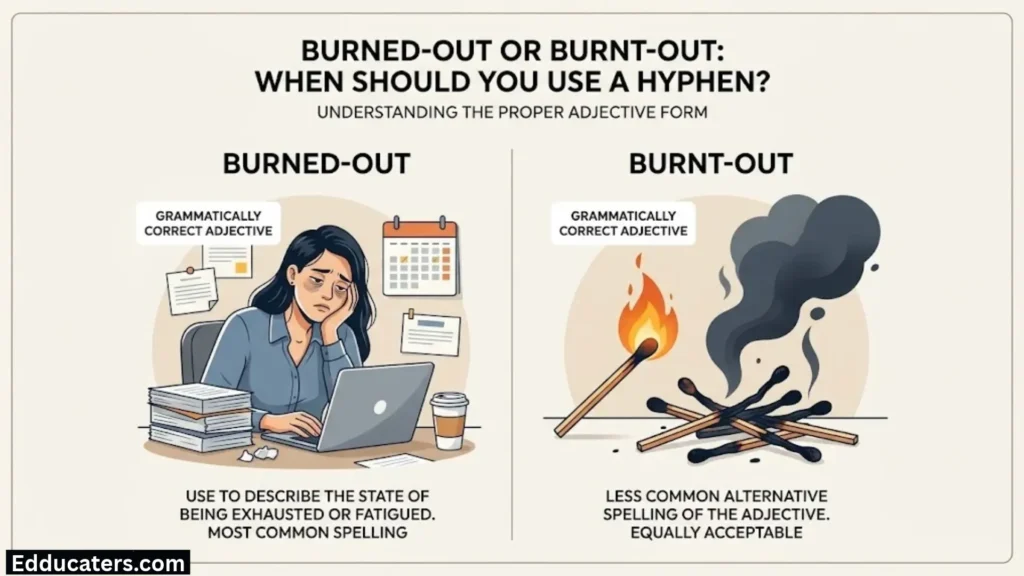
The difference between burned out and burned-out often comes down to grammatical position.
When the expression appears before a noun and works as a compound adjective, writers commonly use a hyphen. When it follows a linking verb, the open form is generally preferred.
The same principle applies to burnt out and burnt-out.
Use Burned-Out Before a Noun
A hyphen helps show that the two words work together to describe the noun.
Examples:
- A burned-out employee struggled to concentrate.
- The electrician replaced the burned-out light bulb.
- The firefighters examined the burned-out building.
- A burned-out motor caused the machine to stop.
- The manager supported the burned-out team.
In each example, the compound adjective comes directly before the noun it modifies.
The hyphen makes the relationship between the words easier to follow.
Use Burned Out After a Linking Verb
When the phrase follows a linking verb such as be, feel, seem, or become, the open form is generally appropriate.
Examples:
- “The employee feels burned out.”
- “The light bulb is burned out.”
- “The team became burned out after the launch.”
- “She seems burned out by the workload.”
Here, the phrase describes the subject rather than appearing immediately before a noun.
Compare the two structures:
| Before a noun | After a linking verb |
| A burned-out worker | The worker is burned out. |
| A burnt-out fuse | The fuse is burnt out. |
| A burned-out employee | The employee feels burned out. |
| A burnt-out team | The team seems burnt out. |
This is a useful general convention, but hyphenation can vary by editorial style and sentence structure. When in doubt, follow your chosen style guide.
Burned Out or Burnt Out Examples in Sentences
Sentence examples help show how both expressions work in everyday English. The following examples cover workplace exhaustion, mental fatigue, physical damage, and common grammatical patterns.
Burned Out in a Sentence
Use these examples to understand the common American English form.
- “I’m burned out after working late every night this week.”
- “The teacher felt burned out by the end of the semester.”
- “Our team became burned out during the product launch.”
- “The electrician replaced the burned-out bulb in the hallway.”
- “The mechanic discovered that the starter motor had burned out.”
- “Several employees reported feeling burned out after months of overtime.”
- “She worried that taking on another project would make her burn out.”
- “The firefighters inspected the burned-out building the next morning.”
- “He has felt burned out since the company changed its schedule.”
- “The organization introduced new policies to reduce employee burnout.”
Notice that these examples include different grammatical forms. Some describe a person’s state, others describe physical damage, and one uses the noun burnout.
Burnt Out in a Sentence
The following examples use the alternative form, which is particularly familiar in British English.
- “I’m burnt out after working long hours all month.”
- “She felt burnt out after managing several demanding projects.”
- “The team became burnt out during the busy season.”
- “They replaced the burnt-out fuse before restarting the machine.”
- “The mechanic found that the motor had burnt out.”
- “He was mentally burnt out after weeks of pressure.”
- “The company wants to prevent its staff from burning out.”
- “A burnt-out vehicle blocked the narrow road.”
- “The teacher admitted that she was feeling burnt out.”
- “The organization discussed employee burnout at its annual meeting.”
These sentences demonstrate that the spelling can change without changing the basic meaning.
Burned-Out Employee or Burnt-Out Employee?
Both expressions are acceptable.
Use burned-out employee when you prefer American English conventions. Use burnt-out employee when it better suits your British English audience or editorial style.
For example:
- “The manager arranged additional support for the burned-out employee.”
- “The manager arranged additional support for the burnt-out employee.”
Both sentences describe an employee experiencing exhaustion.
The hyphen appears because the compound adjective comes before the noun employee.
Burned-Out Light Bulb or Burnt-Out Light Bulb?
Both forms can describe a light bulb that has stopped working.
Examples:
- “Please replace the burned-out light bulb in the kitchen.”
- “Please replace the burnt-out light bulb in the kitchen.”
- “The light bulb is burned out.”
- “The light bulb is burnt out.”
The first two examples use a hyphenated adjective before a noun. The last two use the open form after a linking verb.
This distinction applies to other objects, including motors, fuses, and lamps.
Burned Out at Work: Meaning and Usage
The phrase burned out at work describes a state of exhaustion associated with sustained professional demands.
Someone may feel drained after repeatedly working late, handling an unreasonable workload, dealing with ongoing pressure, or struggling to separate work from personal life.
For example:
“After months of overtime and back-to-back deadlines, Jordan felt burned out and struggled to stay focused.”
The sentence describes more than ordinary tiredness after one demanding afternoon. It suggests that the strain has continued long enough to affect the person’s energy and ability to work comfortably.
Workplace Burnout and Chronic Workplace Stress
Workplace burnout is commonly associated with prolonged work-related stress that has not been successfully managed.
The World Health Organization describes burnout in the context of employment as an occupational phenomenon, rather than classifying it as a medical condition in its own right.
Its description highlights three main dimensions:
- Energy depletion or exhaustion: Feeling physically or emotionally drained.
- Mental distance or cynicism: Developing negative feelings or detachment toward one’s job.
- Reduced professional effectiveness: Feeling less capable of performing work effectively.
These concepts help explain why someone might describe themselves as burned out.
However, the phrase is also used casually. A person who says “I’m burned out” might mean they’re exhausted after a busy week rather than experiencing ongoing occupational burnout.
Context matters when interpreting the expression.
Feeling Burned Out or Burnt Out
Both phrases can describe a person’s experience without making a formal medical claim.
For example:
- “I’m feeling burned out after several difficult weeks.”
- “She’s feeling burnt out from balancing work and family responsibilities.”
- “The team feels burned out because deadlines keep changing.”
- “He felt mentally burned out after months of intense concentration.”
The adjective mentally emphasizes cognitive or emotional exhaustion. It doesn’t change the spelling rule.
If the phrase appears before a noun, use the compound adjective where appropriate:
- A mentally burned-out employee
- A mentally burnt-out worker
If it follows a linking verb, the open form usually works better:
- “The employee feels mentally burned out.”
- “The worker seems mentally burnt out.”
Burned-Out Worker or Burned-Out Team
The phrase can describe an individual, several people, or a group.
For example:
- “The burned-out worker requested a more manageable schedule.”
- “The manager listened to concerns from the burned-out staff.”
- “A burned-out team may struggle to maintain its usual pace.”
- “The report discussed the effects of chronic workplace stress.”
These expressions are useful in workplace writing because they describe a perceived state without requiring a long explanation.
However, avoid treating a person’s temporary tiredness as proof of burnout. A careful writer distinguishes a casual description from a more serious, persistent problem.
Common Mistakes When Using Burned Out or Burnt Out
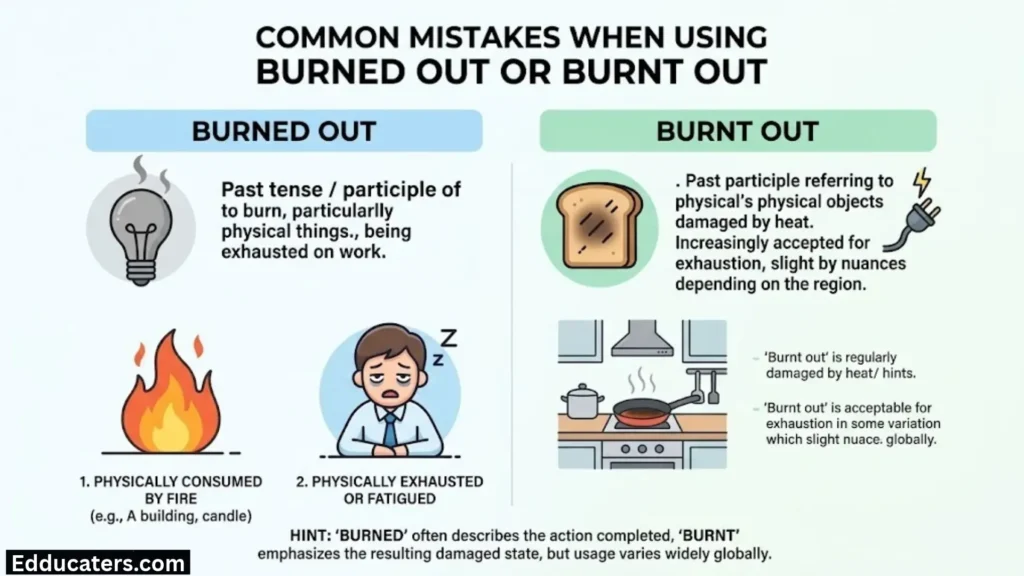
Even experienced writers sometimes mix up these expressions. Most errors involve spelling consistency, word formation, or hyphenation.
Here are the mistakes worth avoiding.
Treating Burnt Out as Incorrect American English
Although burned out is the usual American preference, burnt out is also an accepted form.
Better approach: Use burned out as your default in American-focused content, but don’t label every instance of burnt out incorrect.
Confusing Burn Out With Burnout
These forms have different grammatical functions.
- Incorrect for the intended noun: “The company wants to prevent employee burn out.”
- Preferred standard form: “The company wants to prevent employee burnout.”
- Correct verb construction: “The company wants to prevent employees from burning out.”
The hyphenated noun burn-out also occurs, but burnout is the standard modern choice.
Forgetting the Hyphen Before a Noun
When the expression functions as a compound adjective before a noun, the hyphen often improves clarity.
- Preferred: “The burned-out employee requested assistance.”
- Preferred: “The burnt-out light bulb needs replacing.”
After a linking verb, the open form is generally preferred:
- “The employee feels burned out.”
- “The light bulb is burnt out.”
Assuming Burned and Burnt Have Different Meanings
In most relevant contexts, these are alternative forms of the same verb.
“The toast burned” and “The toast burnt” describe the same basic event. Regional preference may make one form more natural to a particular audience.
Using Burnout as an Adjective Without Considering the Sentence
Burnout is primarily a noun, while burned out and burnt out commonly describe a state.
Compare:
- “Employee burnout affects morale.”
- “The employee feels burned out.”
- “The burned-out employee needs support.”
Each sentence uses a different grammatical structure.
Confusing Burnout With Ordinary Tiredness
The phrase burned out can describe everyday exhaustion, but workplace burnout usually refers to a more persistent pattern associated with prolonged work-related stress.
If you’re writing a report, article, or workplace document, be precise about what you mean. Don’t assume that one tired afternoon establishes a lasting condition.
Frequently Asked Questions About Burned Out or Burnt Out
Is it burnt out or burned out?
Both forms are correct. Burned out is generally preferred in American English, while burnt out is particularly common in British English. Both can describe exhaustion or physical damage caused by fire or heat.
Is burnt out correct in American English?
Yes. American English generally favors burned out, but burnt out is also recognized and understood. Choose the form that best fits your audience and keep it consistent.
Is burned out more common in American English?
Yes, burned out is the usual preference in American English. The form follows the common American tendency to use -ed in the past tense and past participle of burn.
What does it mean to feel burned out?
Feeling burned out usually means feeling exhausted, drained, or depleted after sustained effort or stress. At work, it can describe a more persistent pattern of exhaustion, mental distance, and reduced professional effectiveness.
Can I say I am burnt out at work?
Yes. “I am burnt out at work” is grammatically correct, particularly in British English. American writers often prefer “I am burned out at work,” but both sentences communicate the same basic idea.
Is burnout one word or two words?
Burnout is the standard modern spelling of the noun. The two-word form burn out is a phrasal verb. For example, “She experienced burnout” uses the noun, while “She may burn out” uses the verb.
Should burned-out have a hyphen before a noun?
Generally, yes. Use a hyphen when the expression works as a compound adjective before a noun, as in “a burned-out employee.” After a linking verb, the open form is usually preferred: “The employee is burned out.”
Is a light bulb burned out or burnt out?
Both forms are correct. In American English, burned-out light bulb is the usual choice. Burnt-out light bulb is also acceptable, particularly in British English.
Are burned and burnt both correct?
Yes. Both are accepted past-tense and past-participle forms of burn. American English generally favors burned, while British English commonly uses burnt as well as burned.
What is the difference between burn out and burnout?
Burn out is a two-word phrasal verb describing an action or process. Burnout is a one-word noun naming a state of exhaustion or depletion. For example, “Heavy workloads can cause employees to burn out” and “Heavy workloads can contribute to employee burnout.”
Conclusion: Burned Out or Burnt Out?
When choosing between burned out or burnt out, remember that both expressions are correct. The main difference is regional preference: burned out is generally preferred in American English, while burnt out is especially common in British English.
Both forms can describe someone who feels exhausted after prolonged work or stress. They can also describe objects damaged by fire or heat, including light bulbs, motors, and buildings.
Keep these four distinctions in mind:
- Burned out: The usual American English form.
- Burnt out: A common alternative, especially in British English.
- Burn out: A phrasal verb describing an action or process.
- Burnout: A noun describing exhaustion or depletion.
Finally, use burned-out or burnt-out before a noun when a hyphen helps show that the words work together as a compound adjective.
For most American English writing, burned out is the simplest default. Choose the form that suits your audience, follow your preferred style guide, and keep your spelling consistent throughout the article.

Hi, I’m Nathan Whitmore, and I enjoy making English grammar easy for learners of all ages. I believe grammar should be practical, not confusing. I write simple, well-researched guides that help readers improve their writing, speaking, and overall communication skills.
I spend a lot of time studying grammar patterns, sentence construction, punctuation, and modern English usage. My goal is to create lessons that anyone can understand, whether they are students, teachers, or professionals.
Books
Clear English Grammar
The Smart Writer’s Grammar Handbook
 Claire Holloway