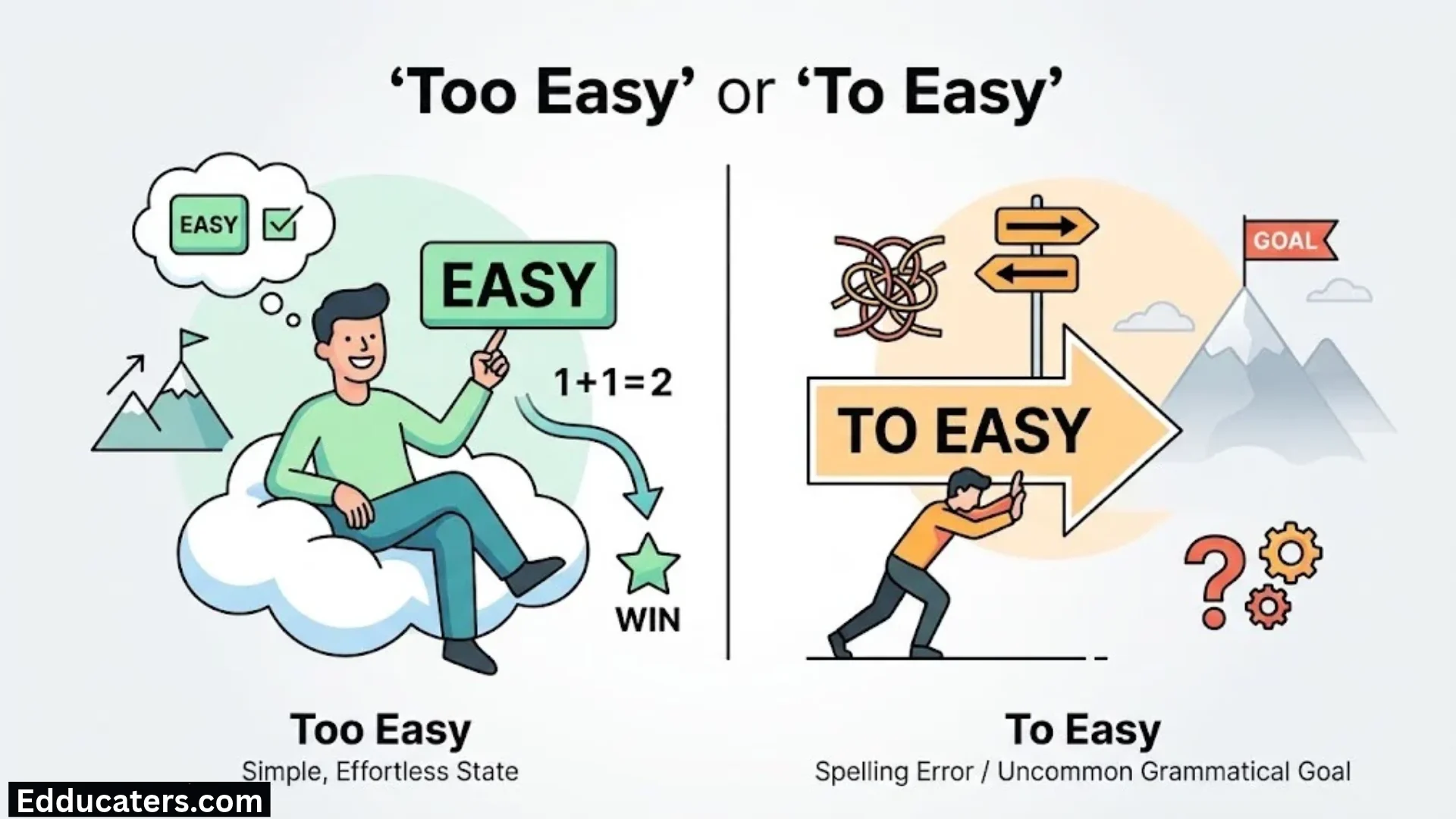
Have you ever wondered whether to write to easy or too easy? You’re not alone. These expressions can confuse English learners and native speakers because to and too sound alike in everyday speech. However, they serve different purposes in English grammar.
The correct spelling is too easy when you want to describe something as very easy or easier than necessary or desirable. The phrase to easy is incorrect when you intend to express that meaning.
For example:
- Correct: The exam was too easy.
- Incorrect: The exam was to easy.
- Correct: The exam was easy to complete.
Notice the difference between the last two sentences. In the second correct example, to introduces the verb complete. It doesn’t describe how easy the exam was.
Understanding this simple distinction can help you avoid common spelling mistakes in emails, school assignments, social media posts, and professional writing. Let’s explore the meaning of too easy, the difference between to and too, and the rules that help you use both words correctly.
To Easy or Too Easy: Which Spelling Is Correct?
Too easy is the correct spelling when you mean that something is very easy or excessively easy. The word too functions as an adverb that modifies the adjective easy.
The expression describes something that requires little effort, presents minimal difficulty, or lacks an appropriate level of challenge.
For example, imagine taking a beginner’s quiz after studying the subject for several years. You might say, “The quiz was too easy.” Your experience suggests that the questions didn’t challenge your existing knowledge.
On the other hand, to easy doesn’t work when you want to describe a task’s level of difficulty. Although to is a correctly spelled English word, it cannot replace too in this expression.
Here’s a quick comparison:
| Expression | Correct or Incorrect? | Explanation |
| The test was too easy. | Correct | Too modifies the adjective easy. |
| This game is too easy. | Correct | The sentence describes the game’s difficulty. |
| It was too easy to understand. | Correct | Too easy describes the level of difficulty. |
| The test was to easy. | Incorrect | To doesn’t express the intended degree. |
| This game is to easy. | Incorrect | Use too to describe the game’s difficulty. |
| It was easy to understand. | Correct | To introduces the infinitive to understand. |
The important point is that to easy or too easy isn’t a choice between two equally correct spellings when you mean something is very easy. Only too easy expresses that meaning.
Is Too Easy Grammatically Correct?
Yes, too easy is grammatically correct. The expression combines two words with different grammatical functions.
- Too: An adverb that indicates degree.
- Easy: An adjective that describes something requiring little effort or difficulty.
Together, they form an adjective phrase that can describe a person, activity, task, situation, or experience.
Consider these examples:
- The instructions are too easy.
- This exercise is too easy for advanced students.
- The recipe was too easy to follow.
- That puzzle seems too easy for the competition.
Each sentence uses the phrase correctly. The expression can appear after a linking verb such as is, was, or seems. It can also appear before an infinitive phrase that explains what makes an activity easy.
Is To Easy Ever Correct?
The expression to easy is generally incorrect when you want to describe something as very easy. However, the words to and easy can appear next to each other in a longer sentence when they serve different grammatical functions.
For example:
- I want to make the instructions easy to follow.
- She tried to make the assignment easy for everyone.
- We need to find a way to make this process easy.
In the first sentence, to belongs to the infinitive to make. The word easy describes the instructions later in the sentence.
These examples don’t establish to easy as a correct substitute for too easy. They simply show that the two words can occur near each other in a sentence without forming the same expression.
Too Easy Meaning and Definition
The phrase too easy describes something that requires very little effort or presents less difficulty than expected, needed, or desired.
Its precise meaning depends on context. Sometimes the phrase communicates a simple observation. In other situations, it suggests that something lacks enough challenge.
For example, a person learning to cook might say, “This recipe is too easy!” because they appreciate how simple it is. A professional chef might use the same phrase to express disappointment because the recipe doesn’t require much skill.
The words remain the same, but the speaker’s purpose changes.
Here are the main interpretations of too easy:
- Very easy: Something requires little effort.
- Excessively easy: Something is easier than necessary or desirable.
- Not challenging enough: An activity doesn’t test someone’s abilities.
- Easy to accomplish: A task can be completed without much difficulty.
Although people sometimes use too easy informally to mean simply very easy, the word too often carries a sense of excess. That’s an important difference to remember when choosing your words.
Does Too Easy Mean Very Easy or Excessively Easy?
The distinction between very easy or too easy can change the message you communicate.
Very easy emphasizes the degree of ease without necessarily suggesting a problem. Too easy often implies that the level of difficulty exceeds what someone considers appropriate.
Compare these sentences:
| Sentence | Meaning |
| The homework was very easy. | The homework required little effort. |
| The homework was too easy. | The homework may have lacked sufficient challenge. |
| The homework was extremely easy. | The homework required very little effort. |
| The homework was far too easy. | The homework was excessively easy. |
| The homework wasn’t too easy. | The homework wasn’t especially easy or wasn’t excessively easy. |
Imagine a teacher preparing an examination for advanced students. If the questions test only basic facts, the teacher might describe the exam as too easy. The concern isn’t that students struggled. It’s that the exam failed to measure their advanced knowledge.
However, a parent helping a young child read might call a beginner’s book too easy simply because the child has already mastered the material.
Context determines whether the phrase communicates satisfaction, criticism, surprise, or a neutral observation.
Is Too Easy a Phrase, Expression, or Idiom?
Too easy is an ordinary English phrase, not a standalone idiom.
An idiom is an expression whose meaning isn’t always predictable from the individual words. For example, a piece of cake means something is very easy, not that someone is literally eating dessert.
The phrase too easy works more directly:
- Too expresses degree.
- Easy describes a lack of difficulty.
You can understand its basic meaning from the words themselves.
Compare the expressions below:
- Too easy: The test was too easy.
- A piece of cake: The test was a piece of cake.
- A breeze: The test was a breeze.
- Effortless: The test felt effortless.
All four expressions can describe a task that requires little effort. However, a piece of cake and a breeze are informal idiomatic expressions, while too easy is a straightforward description.
Too Easy Grammar: Understanding Too and To
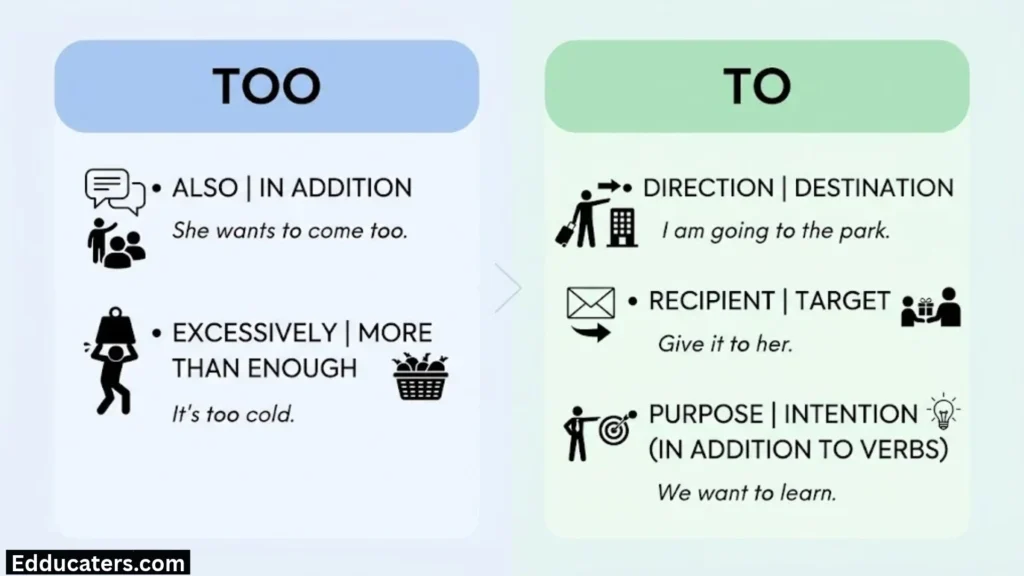
The easiest way to understand too easy grammar is to learn what each word does in a sentence.
Although to and too sound alike in standard American English, their meanings and grammatical roles differ. Choosing the right word depends on the message you want to communicate.
The word to commonly introduces a destination, recipient, or infinitive verb. The word too can indicate excess or addition. In the phrase too easy, it indicates degree.
Let’s examine each word more closely.
When to Use Too
Too is an adverb that can modify an adjective or another adverb. When it appears before easy, it describes the degree of difficulty.
For example:
- The question is too easy.
- The room is too small.
- The coffee is too hot.
- The instructions are too complicated.
- She finished the assignment too quickly.
In each sentence, too indicates that something exceeds an expected, suitable, or desirable level.
The word too has another common meaning: also or in addition.
For example:
- I want to come too.
- She enjoys reading too.
- He invited his brother too.
In these sentences, too doesn’t describe excess. It adds another person or activity to the statement.
This distinction matters because too easy uses the degree-related meaning of too, not its meaning of also.
When to Use To
The word to has several important grammatical uses. Understanding them will help you avoid replacing to with too in the wrong places.
To as a preposition
A preposition can express direction, destination, or a relationship between words.
Examples:
- We drove to the airport.
- She handed the letter to her teacher.
- He walked to the store.
- They traveled to California.
In each sentence, to connects the action or relationship to a destination or recipient.
To as an infinitive marker
English also uses to before the base form of a verb to create an infinitive.
Examples:
- I want to learn.
- She needs to study.
- They decided to leave.
- He hopes to succeed.
Here, to introduces the verbs learn, study, leave, and succeed.
The same structure appears in sentences containing easy:
- This book is easy to read.
- The problem is difficult to solve.
- The instructions are simple to follow.
- The assignment is easy to complete.
Notice that to introduces the action in each example. It doesn’t modify the adjective.
Why Too Easy Is Grammatically Correct
The phrase too easy follows a common English grammatical pattern:
Too + adjective
The adverb too modifies the adjective that follows it. This structure appears throughout English.
Examples include:
- Too easy
- Too difficult
- Too expensive
- Too complicated
- Too difficult
- Too demanding
- Too simple
You can also extend the structure with an infinitive phrase.
For example:
- The instructions are too difficult to understand.
- The box is too heavy to lift.
- The water is too cold to swim in.
- The assignment was too easy to finish.
In these sentences, too modifies the adjective. The infinitive phrase explains the action affected by that degree.
Consider the final example. The assignment was so easy that finishing it required little effort. The phrase to finish identifies the action, while too easy describes the assignment’s level of difficulty.
This is why too easy to do is correct, but to easy to do isn’t correct when you intend to describe excessive ease.
Too Easy in a Sentence: Correct Examples
Examples make grammar rules easier to remember because they show how people use expressions in everyday situations.
The phrase too easy works in casual conversation, educational writing, workplace communication, and discussions about games or technology.
Below are examples organized by context.
Everyday Examples of Too Easy
These sentences show how to use the expression in ordinary conversations.
- Making breakfast is too easy for him.
- The directions were too easy to follow.
- That puzzle was too easy.
- This recipe is too easy to prepare.
- The instructions made the process too easy.
- Learning the basic rules was too easy.
- The exercise was too easy for the group.
- Fixing the loose handle was too easy to worry about.
For example, imagine a friend asking you how you prepared a simple meal. You might reply, “The recipe was too easy. I finished everything in fifteen minutes.”
The sentence communicates that the recipe required little effort. Depending on your tone, it might express satisfaction or suggest that the recipe wasn’t challenging enough.
Too Easy Examples for School and Work
The expression also fits naturally into educational and professional contexts.
- The practice test was too easy for the students.
- The assignment was too easy to complete in one afternoon.
- The task seemed too easy for an experienced employee.
- The questions were too easy to answer without studying.
- The training exercise was too easy for the new managers.
- The report was too easy to prepare with the available data.
- The project was too easy to finish ahead of schedule.
- The interview questions were too easy for a senior candidate.
Consider a university professor preparing a final examination. If the exam includes only introductory questions, the professor might say, “The test was too easy for students at this level.”
The statement suggests a mismatch between the difficulty of the test and the students’ expected abilities.
In a different situation, a manager might say, “The software made the task too easy.” That comment could be positive if the manager appreciates the efficiency or negative if the task needs more careful review.
Too Easy Examples in Gaming and Technology
Games, apps, and digital tools often make useful examples because people regularly compare their difficulty.
- The first level was too easy for experienced players.
- This app makes editing photos too easy.
- The tutorial was too easy to understand.
- The challenge was too easy to keep players interested.
- The new software makes organizing files too easy.
- The puzzle game became too easy after the update.
- The instructions were too easy to follow on my phone.
- The final challenge was too easy for the competition.
In gaming, too easy often suggests that a challenge fails to match the player’s skill level.
For instance, an experienced player might finish a beginner’s level in seconds. They could say, “That level was too easy. It needs a harder challenge.”
In technology, the same phrase may describe convenience. A user might say, “This app makes editing photos too easy,” as a compliment rather than a complaint.
Negative Sentences With Too Easy
Negative sentences add another useful layer to the phrase’s meaning.
Consider these examples:
- The exam wasn’t too easy.
- The instructions weren’t too easy to follow.
- The task was not as easy as I expected.
- The final level wasn’t too easy for experienced players.
- The assignment wasn’t too easy to finish without help.
The sentence “The exam wasn’t too easy” doesn’t necessarily mean that the exam was extremely difficult. It simply denies that the exam was excessively easy.
Compare these statements:
| Sentence | Meaning |
| The exam was too easy. | The exam lacked enough difficulty or challenge. |
| The exam wasn’t too easy. | The exam wasn’t excessively easy. |
| The exam wasn’t easy. | The exam presented difficulty. |
| The exam was not very easy. | The exam wasn’t especially easy. |
The distinction is important. Negating too easy doesn’t always produce the same meaning as saying difficult.
Common Mistakes When Using To Easy or Too Easy
The spelling mistake usually happens because to and too sound alike. Writers may select the wrong word while typing quickly or composing a message without checking it.
However, pronunciation isn’t the only source of confusion. Some writers also mix up too easy, easy to do, and too easily.
Understanding these differences helps you correct errors before they appear in your final writing.
Writing To Easy Instead of Too Easy
The most common mistake is writing to easy when the intended meaning is very easy or excessively easy.
Here are some incorrect examples and their corrections:
| Incorrect Sentence | Correct Sentence |
| The homework is to easy. | The homework is too easy. |
| This game is to easy. | This game is too easy. |
| The test was to easy to pass. | The test was too easy to pass. |
| That question looks to easy. | That question looks too easy. |
| The process is to easy to follow. | The process is too easy to follow. |
Why does this mistake happen so often?
First, both words have the same usual pronunciation in American English. Second, to appears frequently in everyday writing, so people may type it automatically. Finally, a spelling checker might miss the error because to is a legitimate English word.
For example, a program may recognize to easy as two correctly spelled words without understanding that the sentence requires too.
The solution is to check meaning, not just spelling. Ask yourself whether you are describing a degree of ease or introducing a destination or verb.
Confusing Too Easy With Easy to Do
Although these expressions share the word easy, they serve different purposes.
Too easy emphasizes the degree of ease. Easy to do describes an action that requires little difficulty.
Compare these examples:
- The task is too easy.
- The task is easy to do.
- The task is too easy to do without making mistakes.
The first sentence describes the task’s difficulty. The second says that completing the task doesn’t require much effort. The third combines both structures and adds an unusual but possible meaning: the task is so easy that doing it without mistakes becomes almost inevitable.
Here are more examples:
| Expression | Explanation |
| This book is too easy. | The book may not provide enough challenge. |
| This book is easy to read. | The book is simple to understand or read. |
| The game is too easy to win. | Winning requires too little effort. |
| The game is easy to play. | The controls or rules are simple to understand. |
Both constructions are grammatically correct. The right choice depends on what you want to emphasize.
Using Too Easy When You Mean Too Easily
Another common mistake involves confusing the adjective easy with the adverb easily.
Easy is an adjective. It describes a person, thing, activity, or situation.
Examples:
- The test was easy.
- The instructions are easy.
- The task looks easy.
Easily is an adverb. It describes how someone performs an action.
Examples:
- She solved the problem easily.
- He completed the task easily.
- They understood the instructions easily.
The word too can modify both adjectives and adverbs, so both too easy and too easily can be correct.
Compare:
- The test was too easy.
- She solved the test too easily.
- The task was too easy to complete.
- He completed the task too easily.
The first and third sentences describe the task’s level of difficulty. The second and fourth focus on how effortlessly someone performed an action.
Remember that easy and easily aren’t interchangeable simply because they share a root word.
How to Remember Too or To
You don’t need to memorize dozens of complicated grammar rules to choose between to and too. A few practical memory tricks can help you identify the correct word quickly.
The Two O’s Rule
A useful memory aid is that too has two o’s.
You can associate those extra letters with the idea of an added degree or an excessive amount. This isn’t a formal grammar rule, but it makes the spelling easier to remember.
For example:
- The coffee is too hot.
- The room is too small.
- The assignment is too easy.
- The price is too high.
The word to, with one o, commonly introduces a destination or an infinitive verb.
Examples:
- We went to school.
- I want to learn.
- She needs to study.
- He decided to leave.
When you write too easy, remember that the word describes the degree of difficulty. It needs two o’s.
Replace Too With Very
Another useful trick is to test whether very fits your intended meaning.
For example:
- The test was too easy.
- The test was very easy.
Both sentences can describe a test that required little effort. However, they don’t always communicate exactly the same thing.
Very easy emphasizes the level of ease without necessarily suggesting a problem. Too easy can imply that the test lacked sufficient challenge.
Use this substitution as a quick memory aid rather than a rule that guarantees the meaning will remain unchanged.
Consider another example:
- The room is too small.
- The room is very small.
The first sentence often suggests that the room is smaller than desirable for a particular purpose. The second simply emphasizes its small size.
Ask Whether To Introduces a Verb
When you’re unsure which word to use, look at the surrounding sentence.
If to introduces a base-form verb, it may be the correct choice.
Examples:
- I need to finish the assignment.
- She wants to learn English.
- They decided to leave early.
- The book is easy to understand.
However, when you want to describe something as very easy or excessively easy, use too.
Examples:
- The assignment is too easy.
- English grammar isn’t too difficult.
- The book is too easy for advanced readers.
This simple check can prevent many common to or too spelling mistakes.
Synonyms for Too Easy
Sometimes, repeating too easy makes your writing sound dull. Choosing a suitable synonym can add variety and help you express the exact degree of difficulty.
However, not every synonym carries the same meaning. Some describe simplicity, while others emphasize minimal effort or a lack of challenge.
| Synonym | Meaning | Example |
| Simple | Not complicated | The instructions were simple. |
| Straightforward | Easy to understand or complete | The process was straightforward. |
| Effortless | Requiring almost no effort | The movement looked effortless. |
| Painless | Causing little difficulty or discomfort | The transition was painless. |
| Undemanding | Requiring little effort or skill | The assignment was undemanding. |
| Uncomplicated | Free from unnecessary complexity | The solution was uncomplicated. |
| Basic | At an elementary level | The course covered basic concepts. |
| Elementary | Involving simple or introductory principles | The exercise was elementary. |
| Manageable | Possible to handle successfully | The workload was manageable. |
| Trouble-free | Occurring without problems | The installation was trouble-free. |
| Unchallenging | Not demanding much skill or effort | The final round was unchallenging. |
| A breeze | Informal expression for something easy | The interview was a breeze. |
The best word depends on your context.
For example, straightforward works well when describing instructions. Effortless emphasizes how little work someone needed to do. Undemanding can suggest that a task doesn’t require much skill or concentration.
One important distinction: quick and convenient aren’t exact synonyms for too easy. A task can be quick without being easy, and a convenient process can still be challenging.
Other Ways to Say Too Easy
If you want a more conversational expression, try one of these alternatives:
- It was a breeze.
- It was a piece of cake.
- I had no trouble with it.
- It required very little effort.
- It was simple and straightforward.
- I found it almost effortless.
- It wasn’t much of a challenge.
- I finished it without breaking a sweat.
- It was easier than I expected.
- I completed it with minimal effort.
Each expression carries a slightly different tone.
For example, “I finished it without breaking a sweat” is informal and emphasizes how little effort the task required. “The process was straightforward” sounds more neutral and professional.
Choose the expression that fits your audience and purpose.
Too Easy or Easy as Pie?
Easy as pie is an idiom that means very easy. It communicates a similar general idea to too easy, but the two expressions aren’t always interchangeable.
Consider these examples:
- The quiz was too easy.
- The quiz was easy as pie.
The first sentence may suggest that the quiz lacked sufficient challenge. The second simply emphasizes how easy the quiz was.
Other common expressions include:
- A piece of cake: Something very easy to accomplish.
- A breeze: Something that requires little effort.
- No sweat: An informal way to say something presents no problem.
- Easy peasy: A playful expression for something simple.
- A walk in the park: An activity that requires little effort or difficulty.
These alternatives work especially well in casual conversation. In formal reports or academic writing, straightforward, simple, and uncomplicated may sound more appropriate.
Antonyms of Too Easy
Antonyms help you describe the opposite level of difficulty. If something isn’t easy, you might call it difficult, challenging, complicated, or demanding.
However, the best antonym depends on the situation.
| Antonym | Meaning | Example |
| Difficult | Requiring effort or skill | The exam was difficult. |
| Challenging | Testing someone’s abilities | The final round was challenging. |
| Complicated | Involving many connected details | The instructions were complicated. |
| Demanding | Requiring considerable effort | The project was demanding. |
| Strenuous | Requiring significant physical or mental effort | The workout was strenuous. |
| Laborious | Requiring prolonged, tiring work | The process was laborious. |
| Arduous | Involving considerable difficulty | The journey was arduous. |
| Troublesome | Causing problems or inconvenience | The repair was troublesome. |
| Complex | Having many related parts or details | The problem was complex. |
These words don’t all mean the same thing.
A difficult exam may require advanced knowledge. A complicated process may involve many steps. A strenuous workout demands physical effort, while a laborious task may take a long time to complete.
Too Easy or Too Difficult?
The expressions too easy and too difficult can describe opposite problems.
Something is too easy when it lacks an appropriate level of challenge. Something is too difficult when it exceeds a suitable or manageable level of difficulty.
For example:
- The test was too easy for advanced students.
- The test was too difficult for beginners.
- The game was too easy to keep experienced players interested.
- The instructions were too difficult for new employees to follow.
Notice that too works with both positive and negative adjectives. It indicates that a particular quality exceeds a suitable level.
The word itself doesn’t mean easy or difficult. The adjective that follows determines the quality being described.
Frequently Asked Questions About To Easy or Too Easy
Is too easy grammatically correct?
Yes. Too easy is grammatically correct because too functions as an adverb that modifies the adjective easy. For example, “The test was too easy” describes a test that required very little effort or lacked sufficient challenge.
Is to easy ever correct?
Not when you intend to mean very easy or excessively easy. However, the words to and easy can appear in the same sentence when they serve different grammatical functions, as in “I want to make the process easy.”
What does too easy mean?
Too easy means very easy or easier than necessary or desirable. Depending on context, it can express satisfaction, surprise, or disappointment about a lack of challenge.
Is too easy one word or two words?
Too easy consists of two separate words. Write too with two o’s and easy with one e at the beginning, followed by asy.
How do you spell too easy correctly?
The correct spelling is too easy. Use too when describing something as very easy or excessively easy. Don’t write to easy when you intend that meaning.
Is too easy an idiom?
No. Too easy is an ordinary phrase consisting of an adverb and an adjective. Expressions such as a piece of cake and a breeze are idiomatic alternatives.
What is the difference between too easy and very easy?
Very easy emphasizes how little difficulty something presents. Too easy can communicate the same general idea while also suggesting that something is easier than desirable or appropriate.
Can you say it wasn’t too easy?
Yes. “It wasn’t too easy” is grammatically correct. It means that something wasn’t excessively easy, although it doesn’t necessarily mean that the activity was extremely difficult.
What is another way to say too easy?
Common alternatives include simple, straightforward, effortless, a breeze, and a piece of cake. Choose the expression that best fits the context and tone of your sentence.
Why do people write to easy instead of too easy?
People often confuse the words because they sound alike in American English. Typing quickly, relying on automatic spelling suggestions, or overlooking a sentence during proofreading can lead to the mistake.
Should I use too easy or easy to do?
Use too easy when you want to emphasize the degree of ease. Use easy to do when you want to describe an action that requires little effort.
For example, “The task is too easy” describes its difficulty, while “The task is easy to do” explains how simple it is to complete.
Is too easy formal or informal English?
Too easy works in both formal and informal English. The phrase itself isn’t slang, although its tone depends on context. In professional writing, you might choose straightforward or undemanding when those words express your meaning more precisely.
Can too easy describe a person?
Yes. You can use too easy to describe a person’s behavior or approach when the context supports that meaning. For example, “The coach was too easy on the team” means the coach wasn’t strict enough. Here, too easy on someone is a different expression from simply describing a task as easy.
Conclusion: To Easy or Too Easy
When choosing between to easy or too easy, remember that too easy is the correct expression when you mean very easy or excessively easy.
The difference comes down to grammar:
- Too is an adverb that can modify an adjective to express degree.
- To commonly introduces a destination, relationship, or infinitive verb.
- Too easy describes something that requires little effort or lacks sufficient challenge.
- To easy is incorrect when used to express that meaning.
For example, write “The assignment was too easy” when describing its difficulty. Write “The assignment was easy to complete” when describing how simple it was to finish.
A quick memory trick can help you avoid the mistake: too has two o’s and adds a degree of meaning.
Once you understand this distinction, you’ll find it much easier to choose the right word in everyday conversations, schoolwork, emails, and professional writing.

Hello, I’m Claire Holloway. I have always been passionate about the English language and enjoy turning complex grammar rules into simple, easy-to-follow lessons. I believe that every learner can become a confident English writer with the right guidance.
I create educational content focused on grammar, vocabulary, sentence structure, and writing improvement. Every article I publish is designed to help readers learn with confidence and accuracy.
Books
Grammar Without Confusion
Modern English Usage Guide
 Nathan Whitmore
 Julian Mercer