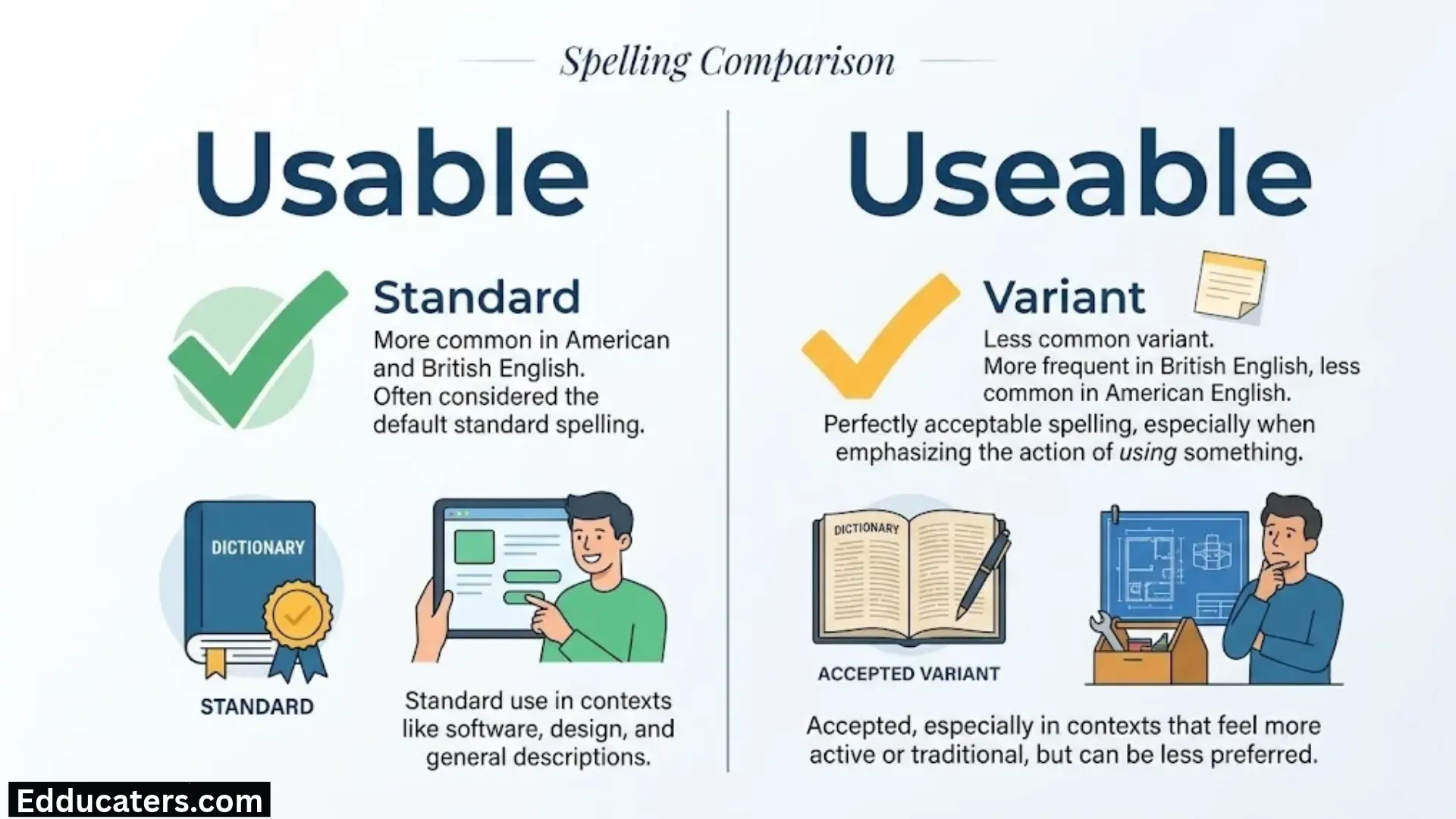
When you’re deciding between usable or useable, the good news is that both spellings are correct. However, usable is the preferred spelling for most modern English writing, especially in American English. The alternative spelling, useable, has the same meaning and is recognized by major dictionaries.
Both words describe something that can be used or is in good enough condition for a particular purpose. For example, you might describe a repaired laptop as usable, a document as usable, or a room as having enough usable space.
The difference comes down to spelling preference rather than meaning, pronunciation, or grammar. If you’re writing an email, completing a school assignment, preparing a business report, or publishing website content, usable is generally the safest choice.
Here’s what you need to know:
- Usable: The preferred spelling for most everyday, academic, professional, and technical writing.
- Useable: An accepted alternative spelling with the same basic meaning.
- Usable meaning: Capable of being used or suitable for use.
- Usable opposite: Unusable, meaning not fit for use or unable to serve its intended purpose.
- Related noun: Usability, which describes how easily or effectively something can be used.
Let’s explore the spelling difference, meaning, grammar, examples, and related words so you can choose the right form confidently.
What Does Usable Mean?
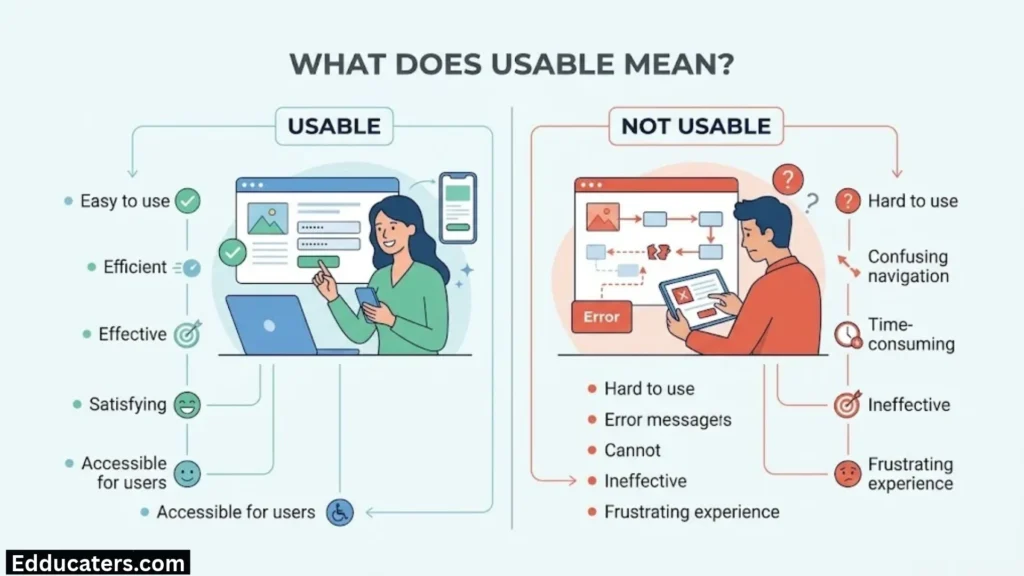
Usable is an adjective that describes something capable of being used or in sufficiently good condition for a particular purpose. It can refer to physical objects, digital products, information, available space, or practical solutions.
Something doesn’t have to be perfect to be usable. A scratched phone might still make calls, an old bicycle might still be safe to ride after repairs, and a rough draft might contain enough information to help a writer develop a finished report.
The main idea is that something remains suitable for its intended use.
Consider these examples:
- The old computer is still usable despite its slow performance.
- We need to organize the information into a usable format.
- The damaged bicycle became usable after the mechanic replaced its brakes.
- The apartment has very little usable storage space.
- The team developed a usable solution to the problem.
In each sentence, usable describes an object’s condition, availability, or practical value for a particular task.
However, usable doesn’t always mean useful, convenient, or easy to use. A complicated software program might technically work but still frustrate its users. Similarly, a chair with a loose cushion might remain usable even though it isn’t comfortable.
Context determines exactly what the word means in a particular sentence.
Usable Definition and Meaning
A straightforward usable definition is capable of being used or in good enough condition to be used.
The word generally expresses two closely related ideas.
1. Capable of being used
Something is usable when a person can put it to a particular purpose.
For example:
- The file is usable on both Windows and macOS.
- This information is usable for the research project.
- The application provides a usable interface for new customers.
2. In good enough condition for use
Something may have damage, limitations, or imperfections while remaining usable.
For example:
- The mechanic confirmed that the engine was still usable.
- We found several usable parts in the damaged machine.
- The storm destroyed most of the road, leaving only one usable lane.
The word can also describe something available or suitable for practical use. A building might contain 2,000 square feet of usable office space, for instance. That figure refers to the space available for the intended purpose rather than necessarily describing the building’s entire area.
The central idea remains the same: the item or resource can serve a particular purpose.
Is Usable an Adjective?
Yes. Usable is an adjective, so it describes a noun or provides information about a subject through a linking verb.
It can appear before a noun:
- We need a usable computer.
- The team created a usable report.
- She found a usable parking space.
It can also appear after a linking verb such as is, seems, looks, or remains:
- The computer is usable.
- The report seems usable.
- The parking space remains usable.
These constructions show how the adjective works in ordinary English sentences.
Usable or Useable: Which Is Correct?
Both usable and useable are accepted spelling variants. They share the same basic meaning and pronunciation, so choosing one doesn’t change the message you’re trying to communicate.
Nevertheless, the two spellings aren’t equally preferred in every writing context. Usable is the more conventional default and appears as the main spelling in major learner’s dictionaries.
For example, Oxford Learner’s Dictionaries lists usable with the definition “that can be used; in good enough condition to be used.” Collins also recognizes useable as an alternative spelling.
This distinction matters because an accepted variant isn’t necessarily the best default for every document.
Here’s a quick comparison:
| Feature | Usable | Useable |
| Correct English spelling | Yes | Yes |
| Basic meaning | Capable of being used | Capable of being used |
| Part of speech | Adjective | Adjective |
| Pronunciation | Same | Same |
| Preferred default | Yes | Alternative |
| Suitable for professional writing | Yes | Yes, though less conventional as a default |
| Changes the meaning | No | No |
The practical rule is simple: choose usable unless you have a specific reason to use useable.
For example, if you’re writing a report about a new software product, “The software is usable” is a natural and conventional choice. Writing “The software is useable” communicates the same thing, but the first spelling is the safer editorial option.
Consistency also matters. If a publication or organization follows a house style, use the spelling that its guidelines recommend.
Is Useable a Word?
Yes, useable is a real English word. Major dictionary references recognize it as an alternative spelling of usable.
It’s therefore inaccurate to say that useable is always a misspelling. The word follows a recognizable pattern of English word formation, and readers generally understand it without difficulty.
For example:
- The old equipment is still useable.
- We need a useable copy of the document.
- The repaired machine is useable for basic tasks.
All three sentences communicate the same ideas they would with usable.
However, dictionary recognition doesn’t mean that every spelling variant is equally common or equally suitable for every publication. If you’re unsure which form to choose, usable is the better general recommendation.
Is Usable the Correct Spelling?
Yes. Usable is the preferred spelling for most modern English writing.
Use it in school assignments, professional emails, reports, website content, technical documents, and everyday communication. It offers a conventional spelling that readers readily recognize.
For example:
- The team needs a usable version of the software.
- Please provide a usable copy of the spreadsheet.
- The new design creates more usable space.
- We found a practical and usable solution.
You can use useable when a particular style guide, publication, or established document consistently uses that variant. Otherwise, there’s little reason to choose it over usable.
Why Is Usable Spelled Without the Final E?
The spelling difference makes more sense when you look at the base word and the suffix.
The base word is use, and the suffix is -able. Together, they form an adjective describing something that can be used.
The conventional spelling is:
Use + -able = usable
Although the base word ends in a silent e, the standard spelling drops that letter when forming usable.
However, English spelling rules don’t follow one simple pattern for every word ending in silent e. Some words retain the final letter when a suffix begins with a vowel, while others drop it. Conventional usage and established word forms also influence the result.
The existence of useable reflects an alternative spelling that retains the e. It doesn’t create a different meaning or pronunciation.
The Role of the -Able Suffix
The suffix -able commonly forms adjectives that mean capable of, suitable for, or fit for a particular action or purpose.
Here are some examples:
| Base word | Adjective | Meaning |
| Read | Readable | Easy enough or possible to read |
| Adapt | Adaptable | Able to adjust to different conditions |
| Wash | Washable | Suitable for washing |
| Manage | Manageable | Possible to manage |
| Use | Usable | Capable of being used |
These examples illustrate how suffixes help create adjectives with related meanings.
However, don’t assume that adding -able always produces a predictable spelling. English contains established forms and exceptions, so checking a dictionary is sensible when a word looks unfamiliar.
For usable, the conventional spelling without the extra e is the form to learn.
Why Do People Spell It Useable?
People write useable for several understandable reasons.
First, the spelling makes the connection to the base word use more visible. Someone might reasonably assume that adding -able should preserve the entire base word.
Second, English contains many spelling variations, and dictionaries don’t always treat one form as the only acceptable option.
Third, writers may encounter useable in books, websites, technical documents, or other published material. Seeing an established word in print can reinforce the belief that the spelling is acceptable.
In this case, that belief is justified: useable is a recognized alternative.
Still, the existence of a valid variant doesn’t remove the need to choose a consistent spelling. When writing for a broad audience, usable remains the straightforward choice.
Usable or Useable in American English and British English
The distinction between usable and useable isn’t a simple case of American English using one spelling while British English uses another.
Both forms occur in British and American English. Major dictionaries recognize usable in both varieties, and useable also appears as an alternative form.
This differs from familiar regional pairs such as color and colour or organize and organise, where regional conventions often guide the choice more directly.
For usable, you don’t need to choose useable merely because you’re writing for British readers.
Usable in American English
In American English, usable is the preferred default spelling.
It’s appropriate for everyday writing, business communication, academic assignments, product descriptions, software documentation, and technical reports.
Examples include:
- The laptop is still usable after the repair.
- We converted the figures into a usable format.
- The company needs a more usable website.
- The research produced usable results.
You may encounter useable in American publications, and the spelling isn’t automatically wrong. Nevertheless, choosing usable helps maintain consistency with conventional American usage.
If you’re writing for a company or publication, follow its established style guide whenever one exists.
Usable in British English
In British English, usable is also a standard spelling. Useable is recognized as an alternative, rather than a form that exclusively belongs to the United Kingdom.
Consider these examples:
- The damaged road is still usable.
- The report contains usable information.
- The office has enough usable space for another desk.
- The software is usable on several devices.
These sentences work naturally in British English as well as American English.
The key takeaway is that regional spelling conventions don’t require a different choice here. If you want a dependable spelling for either audience, use usable.
Usable or Useable: Examples in Everyday Writing
The meaning of usable becomes clearer when you see how it works in different situations. It can describe anything from a damaged household item to a digital service or a collection of research data.
The following examples also show how the adjective fits naturally into different sentence structures.
Usable in Professional and Academic Writing
Professional and academic writing often uses usable to describe information, evidence, documents, and resources that people can put to work.
Examples:
- The researchers organized their findings into a usable dataset.
- Please send a usable draft before the meeting.
- The report provides usable evidence for the proposed solution.
- We converted the survey responses into a usable format.
- The student submitted a usable outline for the research paper.
- The team needs clearer instructions and more usable reference materials.
In these examples, usable doesn’t necessarily mean perfect or complete. A usable draft may still need editing, and usable data may still require analysis.
The word simply indicates that the material is suitable for its current purpose.
For instance, a spreadsheet might contain a few formatting errors but still provide enough accurate information for a preliminary review. You could describe it as usable without claiming that it’s ready for publication.
Usable in Technology and Web Design
In technology, usable can describe software, applications, websites, digital files, and user interfaces.
However, the word deserves careful interpretation in this context. A program might run without errors yet remain difficult for people to operate.
Examples:
- The application needs a more usable interface.
- The website looks attractive but isn’t particularly usable.
- Developers created a usable version for older devices.
- The software offers a usable way to organize large files.
- Clear labels make the navigation system more usable.
- The updated design makes essential settings easier to find.
This context often connects to usability, a term used to discuss how effectively people can interact with a product or system.
For example, a website with confusing menus may technically work. Yet visitors might struggle to find its contact page or complete a purchase.
Improving usability means addressing those practical difficulties. Designers might simplify navigation, improve button labels, reduce unnecessary steps, or make instructions easier to understand.
A usable product doesn’t need to be visually impressive. It needs to help people accomplish their intended tasks.
Usable for Physical Objects and Spaces
The word also describes physical objects that remain suitable for use despite damage, age, or other limitations.
Examples:
- The old desk remains usable after the repair.
- The mechanic returned the bicycle in usable condition.
- The storm left only one usable road into town.
- The garage has very little usable storage space.
- We recovered several usable parts from the broken machine.
- The spare phone is usable for calls and basic messages.
Notice that usable depends on the intended purpose.
A bicycle with a scratched frame might remain usable if its essential parts work properly and it is safe to ride. However, a bicycle with unreliable brakes shouldn’t be described as usable for riding simply because it can move.
Likewise, a damaged phone might still be usable for calls even if its camera no longer works.
The word doesn’t guarantee perfect condition. It describes whether something can adequately serve its intended purpose.
Usable vs. Useful: What’s the Difference?
Usable and useful have related but different meanings.
Usable describes whether something can be used or is suitable for a particular purpose. Useful describes whether something provides help, value, or a practical benefit.
An item can be usable without being especially useful. A spare computer might work perfectly but offer little value if you already have a better one.
Likewise, something can be useful in principle but difficult to use in practice. A powerful software program might provide valuable features while confusing new users.
Compare the words below:
| Word | Meaning | Example |
| Usable | Capable of being used | The backup computer is usable. |
| Useful | Helpful or valuable | The backup computer is useful during outages. |
| User-friendly | Easy for people to operate | The software has a user-friendly interface. |
| Functional | Working or performing its intended role | The device is functional but outdated. |
| Practical | Suitable for real-world needs | This is a practical solution for small offices. |
These distinctions help you select the most accurate word.
For example, imagine that a company develops a new scheduling application. The application may be functional because it runs correctly. It may be usable because employees can complete basic tasks. It becomes user-friendly when its controls and instructions make those tasks easy to understand.
Whether the application is useful depends on whether it actually helps employees manage their schedules.
The terms overlap, but they don’t mean exactly the same thing.
What Is Another Word for Usable?
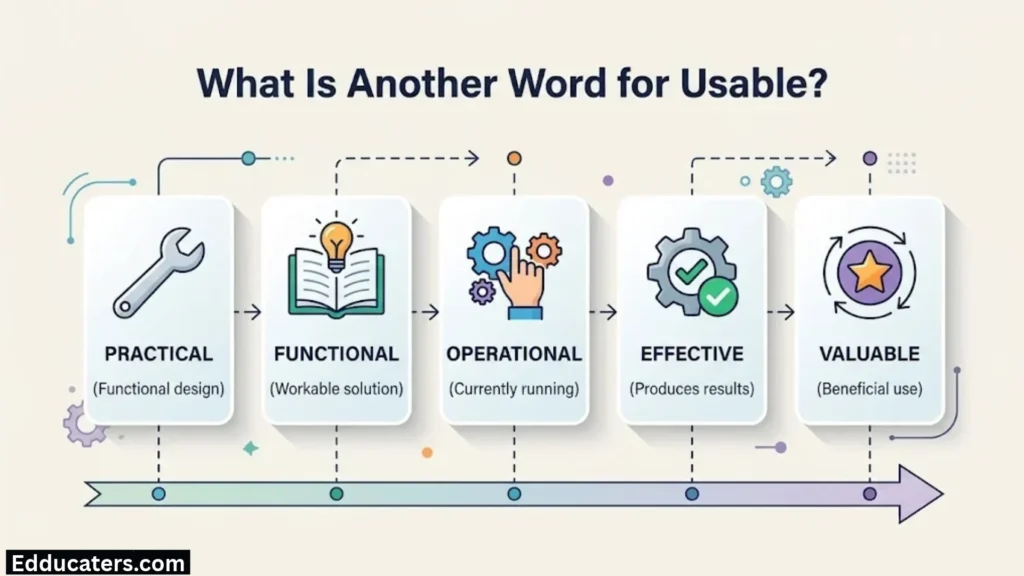
The best synonym for usable depends on what you want to emphasize.
If you mean that something works, functional might be appropriate. If you mean that someone can put a plan into practice, workable may be more precise. If you mean that a product is easy to operate, user-friendly could communicate your point better.
Here are several useful alternatives.
| Synonym | Meaning | Example |
| Functional | Working or performing its intended role | The printer is functional again. |
| Serviceable | In adequate working condition | The old equipment remains serviceable. |
| Workable | Capable of being implemented or succeeding | We found a workable solution. |
| Practical | Suitable for real-world use | The team proposed a practical design. |
| Suitable | Appropriate for a particular purpose | This room is suitable for meetings. |
| Accessible | Available to reach or use | The documents are accessible to all employees. |
| User-friendly | Easy for people to operate | The application has a user-friendly interface. |
| Intuitive | Easy to understand or operate without much instruction | The controls are intuitive. |
| Convenient | Easy or suitable to use in a situation | Online booking is convenient for customers. |
| Effective | Producing the intended result | The new system is effective at reducing errors. |
These words aren’t interchangeable in every sentence. Choose the one that conveys the meaning you intend.
For example, functional focuses on whether something works. User-friendly focuses on the experience of using it. Effective focuses on the result it produces.
What Is Another Word for Easily Usable?
When you want to describe something that’s easy to operate, several expressions may communicate your meaning more precisely than usable.
User-friendly is a good choice for products, software, websites, and devices that people can operate without unnecessary difficulty.
For example: “The company introduced a user-friendly mobile application.”
Intuitive works when people can understand how something operates without needing extensive instructions.
For example: “The website has an intuitive navigation system.”
Straightforward describes something simple to understand or complete.
For example: “The installation process is straightforward.”
Easy to use is a clear, everyday expression that works in almost any context.
For example: “The new printer is easy to use.”
Although easily usable is understandable, these alternatives often sound more natural when ease of operation is the main point.
What Is Another Word for More Usable?
The phrase more usable compares two things or two versions of something. The best replacement depends on the specific improvement.
Consider these examples:
- Easier to use: The redesigned app is easier to use.
- More practical: The new storage system is more practical.
- More accessible: The revised website is more accessible to visitors.
- More user-friendly: The updated interface is more user-friendly.
- More functional: The replacement device is more functional.
- More convenient: The new payment method is more convenient.
These expressions highlight different qualities.
A website might become more usable because its navigation is clearer. A storage system might become more practical because it saves space. A payment method might become more convenient because it takes fewer steps.
Use more useful when you mean that something provides greater value or benefit, rather than simply being easier to operate.
What Is the Opposite of Usable?
The most direct and natural opposite of usable is unusable.
Unusable describes something that cannot be used effectively or isn’t suitable for its intended purpose.
Examples:
- The broken screen made the phone unusable.
- The flood left the basement unusable.
- The corrupted file became unusable.
- The damaged brakes made the bicycle unusable for riding.
- The outdated software is now unusable on the company’s computers.
The word doesn’t always mean that an object has been completely destroyed. Something can be unusable for one purpose while remaining useful for another.
For example, a laptop with a broken screen might be unusable in its current state for ordinary work. However, a technician may be able to repair it or connect it to an external monitor.
The intended purpose determines whether the object is usable.
Unusable or Non-Usable?
Both unusable and non-usable can communicate a negative meaning, but unusable is the more natural choice in ordinary English.
The prefix un- commonly forms adjectives with meanings opposite to the original word. In this case, unusable means not usable.
The expression non-usable may appear in specialized classifications, technical documents, or contexts where a writer distinguishes between categories. However, it often sounds unnecessarily formal in everyday sentences.
Compare these examples:
- Natural: The damaged parts are unusable.
- Less natural in ordinary writing: The damaged parts are non-usable.
- Natural: The file became unusable after the system crash.
- Less natural in ordinary writing: The file became non-usable after the system crash.
Unless a technical standard or specific classification requires non-usable, choose unusable.
Is It a Usable or an Usable?
The correct expression is a usable, not an usable.
Although usable begins with the letter u, the word starts with a consonant sound, commonly represented as /j/ in pronunciation notation. This sound is similar to the initial sound in yes.
English indefinite articles depend on the opening sound of a word, not simply its first written letter.
Consider these examples:
- A usable solution
- A usable file
- A usable computer
- A user-friendly design
- An unusual solution
- An available file
The first four expressions begin with a consonant sound, so they take a. The final two begin with a vowel sound, so they take an.
The same rule applies to useable because it has the same pronunciation as usable.
You would therefore write:
- We need a useable tool.
- She found a useable copy of the report.
However, usable remains the preferred spelling even though both forms follow the same article rule.
Is Usability or Useability Correct?
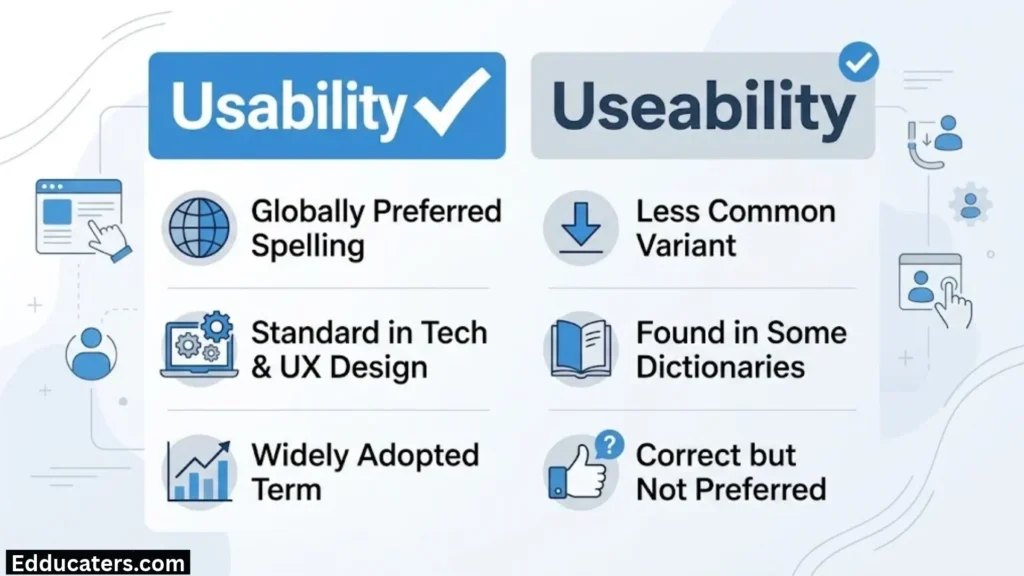
Usability is the preferred noun form in general English and technical writing. Useability is also recorded as an alternative in some dictionary references.
Both nouns relate to the idea of being usable. However, usability is especially common when discussing software, websites, digital services, products, and systems.
For example:
- The website’s usability needs improvement.
- The team tested the usability of the new application.
- Better navigation can improve website usability.
- The product combines strong functionality with good usability.
When writing about the ease or effectiveness of using a product, usability is the conventional choice.
Usable vs. Usability
The difference between usable and usability is grammatical.
Usable is an adjective. Usability is a noun.
An adjective describes something, while a noun names a quality or concept.
Compare these sentences:
- The website is usable.
- The website’s usability has improved.
- The software is usable on older devices.
- The software’s usability depends partly on its interface.
In the first sentence of each pair, usable describes the website or software. In the second, usability names a quality that people can assess or improve.
This distinction is particularly important in technology and web design. A developer might describe an application as usable, while a research team measures its usability through user testing and task completion.
The words are related, but you shouldn’t substitute one for the other without considering the sentence’s grammar.
Common Mistakes When Using Usable or Useable
Even though the spelling difference is straightforward, several mistakes can create confusion.
Here are the most common ones to avoid.
Assuming useable is always incorrect. Dictionaries recognize useable as an alternative spelling. Although usable is the better default, the variant isn’t automatically a spelling error.
Treating usable and useable as words with different meanings. Both forms share the same basic definition and pronunciation. Choose based on spelling preference, not meaning.
Confusing usable with useful. Something usable can be put to use, while something useful provides value or help. The concepts overlap, but they aren’t identical.
Writing an usable instead of a usable. The opening sound determines the article. Since usable begins with a consonant sound, a usable is correct.
Choosing non-usable when unusable is more natural. Use unusable in ordinary writing unless a technical context calls for a different term.
Using useability when usability is the expected form. Some references recognize useability, but usability is the conventional choice for general and technical writing.
Assuming useable is exclusively British. Both spellings occur in British and American English. Neither region requires you to use useable.
Replacing usable with user-friendly in every context. A product can be usable without being especially easy to operate. Choose user-friendly when ease of use is the point.
These distinctions will help you write more precisely without making simple spelling decisions unnecessarily complicated.
Frequently Asked Questions
Which is correct, usable or useable?
Both are accepted spellings, but usable is the preferred choice for most modern English writing. Both forms have the same basic meaning and pronunciation.
What does usable mean?
Usable means capable of being used or in good enough condition for a particular purpose. For example, a repaired laptop may be usable even if it has scratches or an outdated design.
Is useable a correct English word?
Yes. Useable is a recognized alternative spelling of usable. It isn’t automatically incorrect, although usable is the more conventional choice for most writing.
Is useable a British spelling?
Useable occurs in British English, but it isn’t exclusively British. Usable is also standard in the UK and is a dependable choice for both British and American audiences.
Why do people spell usable without an e?
The conventional spelling drops the final e from use before adding the suffix -able. This produces usable. The alternative spelling useable retains the e but has the same meaning.
How do you spell usable?
The preferred spelling is usable, without an e between the s and a. Although useable is an accepted variant, usable is the safer default.
Is it a usable or an usable?
The correct phrase is a usable. The word begins with a consonant sound even though its first letter is a vowel. English articles depend on pronunciation rather than spelling alone.
What is another word for usable?
Common alternatives include functional, serviceable, workable, practical, and suitable. If you mean easy to operate, user-friendly or easy to use may be more precise.
What is the opposite of usable?
Unusable is the most common opposite of usable. It describes something that cannot serve its intended purpose or isn’t fit for use.
Is usability or useability correct?
Usability is the preferred noun form, especially in technical writing and discussions about websites, software, and products. Some dictionaries also recognize useability as an alternative.
What is the difference between usable and useful?
Usable describes something that can be used or is fit for use. Useful describes something that provides help, value, or a practical benefit.
Conclusion: Choose Usable for Most Writing
When deciding between usable or useable, remember that both are recognized English spellings. The difference is a matter of spelling preference rather than meaning or pronunciation.
Usable is the preferred choice for most modern English writing, including American English, British English, academic work, professional documents, and everyday communication. Useable remains an acceptable alternative, but you generally don’t need the extra e.
The word itself means capable of being used or suitable for a particular purpose. Its noun form is usually usability, and its most natural opposite is unusable.
If you want a simple rule to remember, use usable by default and keep your spelling consistent throughout the document. That choice will serve you well in almost any writing situation.

Hi, I’m Nathan Whitmore, and I enjoy making English grammar easy for learners of all ages. I believe grammar should be practical, not confusing. I write simple, well-researched guides that help readers improve their writing, speaking, and overall communication skills.
I spend a lot of time studying grammar patterns, sentence construction, punctuation, and modern English usage. My goal is to create lessons that anyone can understand, whether they are students, teachers, or professionals.
Books
Clear English Grammar
The Smart Writer’s Grammar Handbook
 Julian Mercer