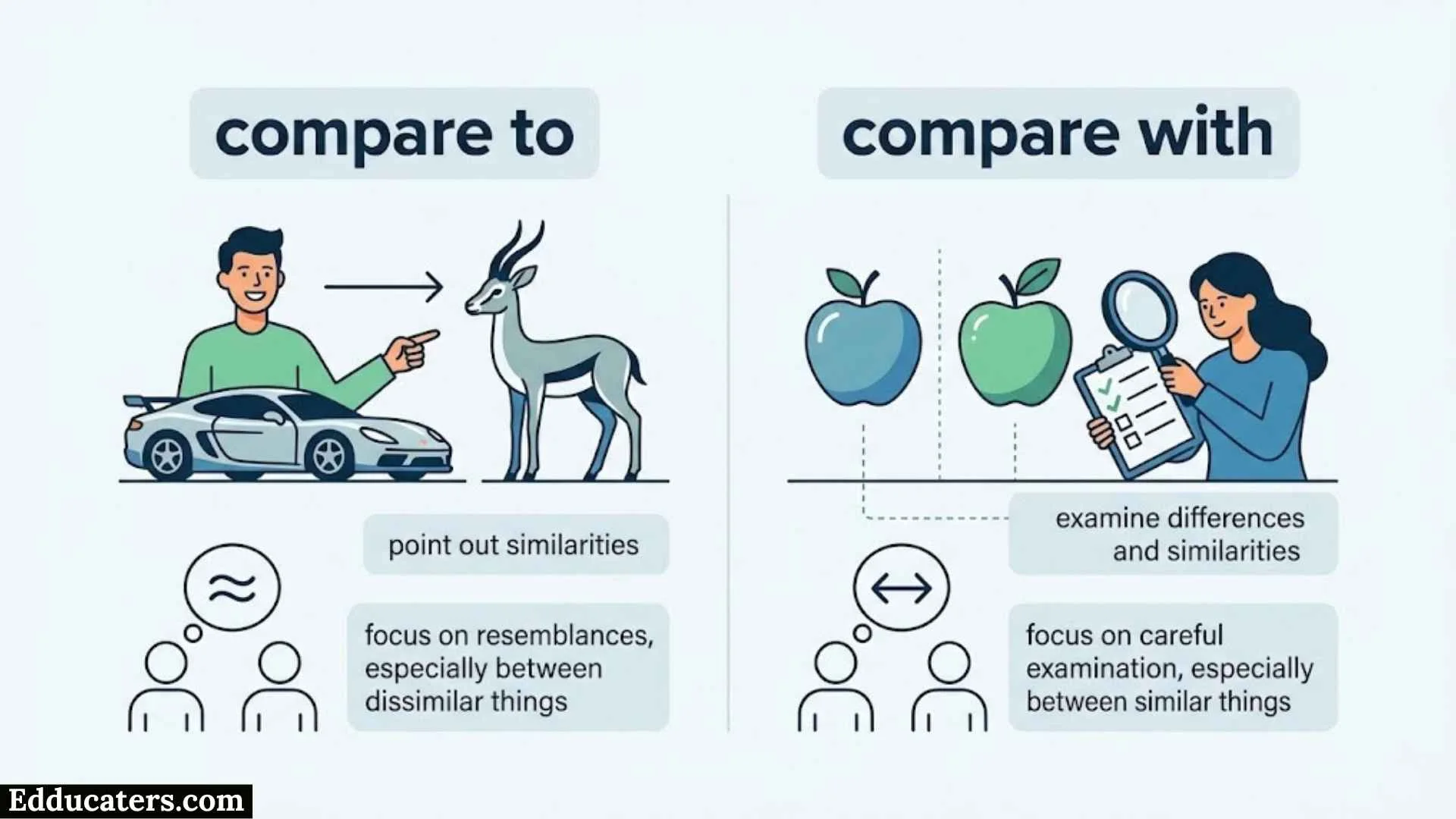
If you’ve ever paused over compare to or with, you’re not alone. Both compare to or compare with are standard English constructions, but they can carry slightly different meanings depending on what you’re trying to say.
The traditional distinction is useful: compare to often means to liken one thing to another, especially when emphasizing a resemblance, while compare with commonly means to examine two things closely for similarities or differences. Cambridge Dictionary gives essentially this distinction, using compare with for examining things of the same type and compare to for pointing out a similarity between different things.
However, modern English is not always rigid about this distinction. In many ordinary sentences, either preposition can be understood, and some style guides allow them to be used interchangeably.
So, which should you use? It depends on the kind of comparison you mean.
Compare To or With: The Quick Answer
Compare to is generally preferred when you are likening one thing to another or emphasizing a resemblance.
- Her voice was compared to a nightingale.
- The city was compared to a living organism.
- He compared the child to a little bird.
Compare with is generally preferred when you are examining two things to identify similarities or differences, especially in formal, analytical, or scientific writing.
- Compare this result with the previous result.
- The study compared the new treatment with the standard treatment.
- Compare the two models with each other before making a decision.
This traditional distinction is also reflected in guidance from Cambridge Dictionary and the University of Connecticut’s scientific-writing resources.
The important point is that neither “compare to” nor “compare with” is inherently incorrect. The intended meaning and context determine the better choice.
What Does Compare Mean?
The verb compare means to examine two or more things in relation to each other to determine how they are similar or different.
For example:
Compare the two phones before you buy one.
Here, the speaker wants you to examine the phones and consider their characteristics.
Compare can also mean to describe one thing as being similar to another:
She compared his voice to a famous singer’s voice.
Cambridge Dictionary recognizes these related uses of compare, including examining things for similarities or differences and describing something as similar to something else.
That difference in meaning helps explain why English uses to or with after compare.
When to Use Compare To
Use compare to when you want to liken one thing to another.
This use is particularly natural when the two things are different in category but share a noticeable quality.
Examples of Compare To
- The poet compared the moon to a silver coin.
- She compared his smile to sunshine.
- The teacher compared the nervous student to a frightened bird.
- Critics compared the new building to a giant ship.
- He compared her determination to that of a professional athlete.
- The author compared life to a journey.
- The children were compared to little explorers.
- The musician compared the sound to thunder.
In each example, the purpose is mainly to create an image or point out a resemblance.
One famous literary example is Shakespeare’s “Shall I compare thee to a summer’s day?”, which is a classic example of compare to being used to liken one thing to another. The Chicago Manual of Style also discusses this traditional distinction, describing compare to as useful when likening things or emphasizing similarities.
Compare To in Everyday English
You’ll often see compare to in ordinary descriptions, especially when someone wants to make an analogy.
For example:
The new smartphone’s camera can be compared to a professional camera.
The speaker is highlighting a resemblance in quality or performance.
Another example:
Her memory was compared to a computer.
This does not mean that the person’s memory and a computer are literally the same thing. The sentence draws attention to a similarity.
When to Use Compare With
Use compare with when you are examining things systematically to determine how they relate to one another.
This is especially useful when the things belong to the same general category.
For example:
Compare this year’s sales with last year’s sales.
The speaker wants someone to examine the two sets of sales figures and identify what changed.
Other examples include:
- Compare the two reports with each other.
- Researchers compared the new drug with the existing treatment.
- Compare your answer with the answer in the textbook.
- The editor compared the original manuscript with the revised version.
- We compared the two prices before choosing a supplier.
- The scientist compared the experimental results with previous results.
Here, the emphasis is not simply on saying that one thing resembles another. The purpose is to examine the relationship between the items.
Cambridge specifically describes compare with as a construction used to bring out similarities or differences between things of the same type.
Compare To or With in Scientific Writing
Scientific writing is one area where choosing compare with can often make your meaning clearer.
Researchers frequently compare measurements, experimental groups, treatments, samples, results, or previous studies. Because these comparisons involve analytical examination, compared with is often preferred in formal scientific prose.
For example:
The treatment group showed a lower average response compared with the control group.
Or:
The new material had greater strength compared with the original material.
The University of Connecticut’s scientific-writing guidance recommends compared with when similar items are being examined, while compared to can be appropriate when the comparison emphasizes similarities between different types of things.
The American Physiological Society likewise gives compared with for examining similarities or differences in scientific writing and contrasts that use with the resemblance-focused use of compared to.
However, you should not assume that compared to is grammatically wrong in academic writing. Different style guides handle the distinction differently, and some scientific style guidance explicitly accepts either form depending on the sentence.
Examples in Scientific Writing
Compare with:
Researchers compared the results with data from the previous experiment.
Compare with:
The researchers compared the treatment group with the control group.
Compare to:
The structure was compared to a biological system because of its similar organization.
The first examples involve analytical examination. The last one emphasizes resemblance.
Compare To or With in Formal Writing
For formal writing, the safest approach is to consider what you are trying to communicate, rather than memorizing a rule that says one preposition is always correct.
Use compare to when your sentence means:
“This resembles that.”
Use compare with when your sentence means:
“Examine this alongside that.”
For example:
The dancer was compared to a swan.
This creates an analogy.
But:
The dancer’s performance was compared with her performance from last year.
This asks the reader to examine the two performances.
This distinction can be particularly useful in essays, reports, academic writing, technical writing, and professional communication.
Is Compare To or With More Correct?
Neither is universally more correct.
Compare to is correct when you are likening something to something else.
Compare with is correct when you are examining two things for similarities or differences.
The distinction is supported by major English-language references, including Cambridge Dictionary.
At the same time, modern usage has become more flexible. The Chicago Manual of Style notes that the traditional distinction exists but also observes that the difference between compare to or compare with has weakened over time.
Cochrane’s style guidance goes even further for its own publications, stating that compared to or compared with may be used interchangeably in its reviews.
So it would be inaccurate to tell English learners that one form is always wrong.
Compare To or With Examples
Here are practical examples showing the usual distinction.
Examples With Compare To
- The clouds were compared to mountains.
- She compared his voice to a deep bell.
- The author compared childhood to a long adventure.
- The athlete’s speed was compared to that of a cheetah.
- The new design was compared to a work of art.
These sentences primarily emphasize resemblance or analogy.
Examples With Compare With
- Compare this report with last month’s report.
- The doctor compared the new results with the earlier results.
- We compared the two products with each other.
- Researchers compared the experimental group with the control group.
- Compare your draft with the final version.
These sentences involve examination or evaluation.
Compare To or With Sentences
The following pairs make the difference especially clear.
1. Analogy
The child’s courage was compared to that of a lion.
The sentence emphasizes a similarity.
2. Analysis
The child’s test results were compared with the previous results.
The sentence asks the reader to examine the results.
3. Figurative Description
The singer’s voice was compared to velvet.
This is a figurative comparison that highlights a quality.
4. Research
The researchers compared the new method with the traditional method.
This describes an analytical process.
5. Performance
The athlete was compared to a machine because of his incredible stamina.
The focus is on resemblance.
The athlete’s current performance was compared with his performance last season.
The focus is on examining two sets of information.
Compare To or With Others
You may also encounter phrases such as compare yourself to others or compare yourself with others.
Both are used in English, but the intended emphasis can differ.
Don’t compare yourself to others.
Here, to is natural because the speaker is talking about seeing yourself as similar or measuring yourself against an ideal represented by other people.
The researcher compared the participants with others in the same age group.
Here, with fits an analytical examination of groups.
In everyday English, however, compare yourself to others is extremely natural.
The important thing is not to treat the preposition as a simple mechanical rule. Context matters.
Compare To or With in Questions
Questions such as “How does it compare to or with?” are common.
For example:
How does this model compare to the previous model?
This is completely natural English.
You can also say:
How does this model compare with the previous model?
This is also grammatical.
Cambridge Dictionary specifically gives “How does it compare with …?” as a standard construction used to ask whether something is better or worse than something else.
In practical everyday writing, either construction may be understood naturally. If you’re writing formal analytical material, compare with is often a comfortable choice when you are asking someone to evaluate two similar items.
Compare To or With in a Sentence: Common Patterns
Here are several useful sentence patterns.
Compare A to B
The poet compared the river to a ribbon.
Meaning: A is being likened to B.
Compare A with B
The editor compared the two versions with each other.
Meaning: A detailed examination is taking place.
Compared to A
Compared to last year, sales have increased.
This construction is common in everyday and formal English.
Compared with A
Compared with last year, sales have increased.
This is also standard and is particularly common in analytical writing.
Compare A an
d B?
When the instruction is to examine two items, English can also use a structure without either preposition:
Compare the two reports.
There is no need to force to or with into every sentence.
Compare To or With or Against
Another related expression is compare against.
Compare against is grammatical when the meaning involves measuring something against a reference point, standard, target, benchmark, or expected value.
For example:
Compare the results against the target.
The company’s performance was compared against industry benchmarks.
This construction is especially common in business, analytics, testing, and technical contexts.
However, compare against does not simply replace compare to or compare with in every sentence. The intended relationship determines the appropriate expression.
For example:
Compare the new results with the old results.
asks for an examination of the results.
Compare the results against the target.
asks you to measure the results against a particular standard.
A Common Mistake With Compared To
One important issue appears in scientific and academic writing: compared to should not automatically replace than.
Consider this sentence:
The patients experienced greater improvement compared to the control group.
The intended comparison is between the patients or groups, but the grammatical structure can make the comparison unclear.
A clearer alternative is:
The patients experienced greater improvement than the control group.
Or:
Compared to the control group, the patients experienced greater improvement.
Vanderbilt’s writing guidance highlights this problem and recommends restructuring sentences when compared to is incorrectly being used in a position where than would be clearer.
This is an important distinction: compare to and than do not perform exactly the same grammatical job.
Compare To or With: Common Mistakes
Mistake 1: Treating Compare To as Always Correct
Incorrect assumption:
“Compare to” is always the correct phrase.
That’s not true. Compare with is a standard construction and is often appropriate for analytical comparisons.
Mistake 2: Treating Compare With as Always Correct
Incorrect assumption:
“Compare with” should always be used in formal English.
That’s also too rigid. Compare to is standard English and is especially natural when one thing is being likened to another.
Mistake 3: Calling Compare To Incorrect
The singer was compared to a bird.
This is not a mistake. Compared to is appropriate because the sentence draws a resemblance.
Mistake 4: Using Compared To Where Than Is Needed
The new treatment produced better results compared to the old treatment.
Depending on the intended structure, than may produce a clearer sentence:
The new treatment produced better results than the old treatment.
Alternatively:
Compared to the old treatment, the new treatment produced better results.
The second structure correctly places the comparison at the beginning of the sentence.
How to Choose Between Compare To or With
A simple test can help.
Ask yourself:
Am I saying that one thing is like another?
If yes, compare to is often the natural choice.
The child was compared to an angel.
Am I examining two things to identify similarities or differences?
If yes, compare with is often the better choice.
The researcher compared the new sample with the original sample.
Am I measuring something against a target or benchmark?
Then compare against may be appropriate.
Compare the actual results against the forecast.
These are useful guidelines rather than absolute laws. Modern English allows some overlap, particularly in ordinary usage.
Compare To or With: A Simple Reference Table
| Form | Typical purpose | Example |
| compare to | Liken something to something else | She compared his voice to thunder. |
| compare with | Examine similarities or differences | Compare the two reports with each other. |
| compared to | Present a resemblance or relative comparison | The city was compared to a giant machine. |
| compared with | Present an analytical comparison | Results were compared with previous data. |
| compare against | Measure against a standard or target | Compare the result against the target. |
The distinction between to or with is a traditional usage guideline, not a rule that makes every sentence with one form correct and every sentence with the other incorrect.
Frequently Asked Questions
Is compare to or with correct?
Both compare to or compare with are correct. Compare to commonly emphasizes likeness or analogy, while compare with commonly describes an examination of similarities or differences.
Should I use compare to or with in academic writing?
For analytical academic writing, compare with is often a useful choice, particularly when you are examining similar items, measurements, studies, results, or groups. However, compare to remains grammatical when the intended meaning is to liken one thing to another. Scientific-writing guidance supports this distinction.
Is compared to grammatically correct?
Yes. Compared to is grammatically correct and widely used in English. It is particularly natural when one thing is being likened to another.
Is compared with grammatically correct?
Yes. Compared with is also grammatically correct and is commonly used when two items are being examined for similarities or differences.
How does it compare to or with?
Both constructions are grammatical. How does it compare with your old car? is a standard Cambridge example for asking how one thing measures up against another.
Is compare to or with more common?
Usage varies by context. Compare to is very common in ordinary English, while compare with is especially useful in formal and analytical contexts. Modern usage does not always maintain a strict distinction between them.
Should scientific writing use compared with?
Compared with is often preferred in scientific writing when researchers are examining similar treatments, groups, measurements, materials, or results. Still, compared to is not automatically ungrammatical in scientific prose.
Can compare to or compare with be interchangeable?
Sometimes. In many contexts, the meaning remains clear with either form. However, the traditional distinction can improve precision: compare to for likening or emphasizing resemblance, and compare with for analytical examination. Some professional style guides explicitly allow the two forms to be interchangeable.
Conclusion
So, compare to or with? The answer is that both are correct, but they often serve different purposes.
Use compare to when you want to liken one thing to another or emphasize a resemblance:
The poet compared the moon to a pearl.
Use compare with when you want to examine two things for similarities or differences:
The researcher compared the new results with the previous results.
For scientific, academic, or analytical writing, compare with is often a clear choice when you’re examining similar items. For figurative, descriptive, or illustrative comparisons, compare to is often more natural.
The key is to focus on the meaning rather than memorizing an absolute rule. Modern English permits some overlap, so context, clarity, and the conventions of your particular style guide all matter.

Hello, I’m Claire Holloway. I have always been passionate about the English language and enjoy turning complex grammar rules into simple, easy-to-follow lessons. I believe that every learner can become a confident English writer with the right guidance.
I create educational content focused on grammar, vocabulary, sentence structure, and writing improvement. Every article I publish is designed to help readers learn with confidence and accuracy.
Books
Grammar Without Confusion
Modern English Usage Guide
 Nathan Whitmore
 Julian Mercer