Have you ever stopped while writing because you couldn’t decide whether to use were or where? You’re not alone. These two English words look remarkably similar and can sound almost identical in some accents. However, they have completely different meanings and grammatical functions.
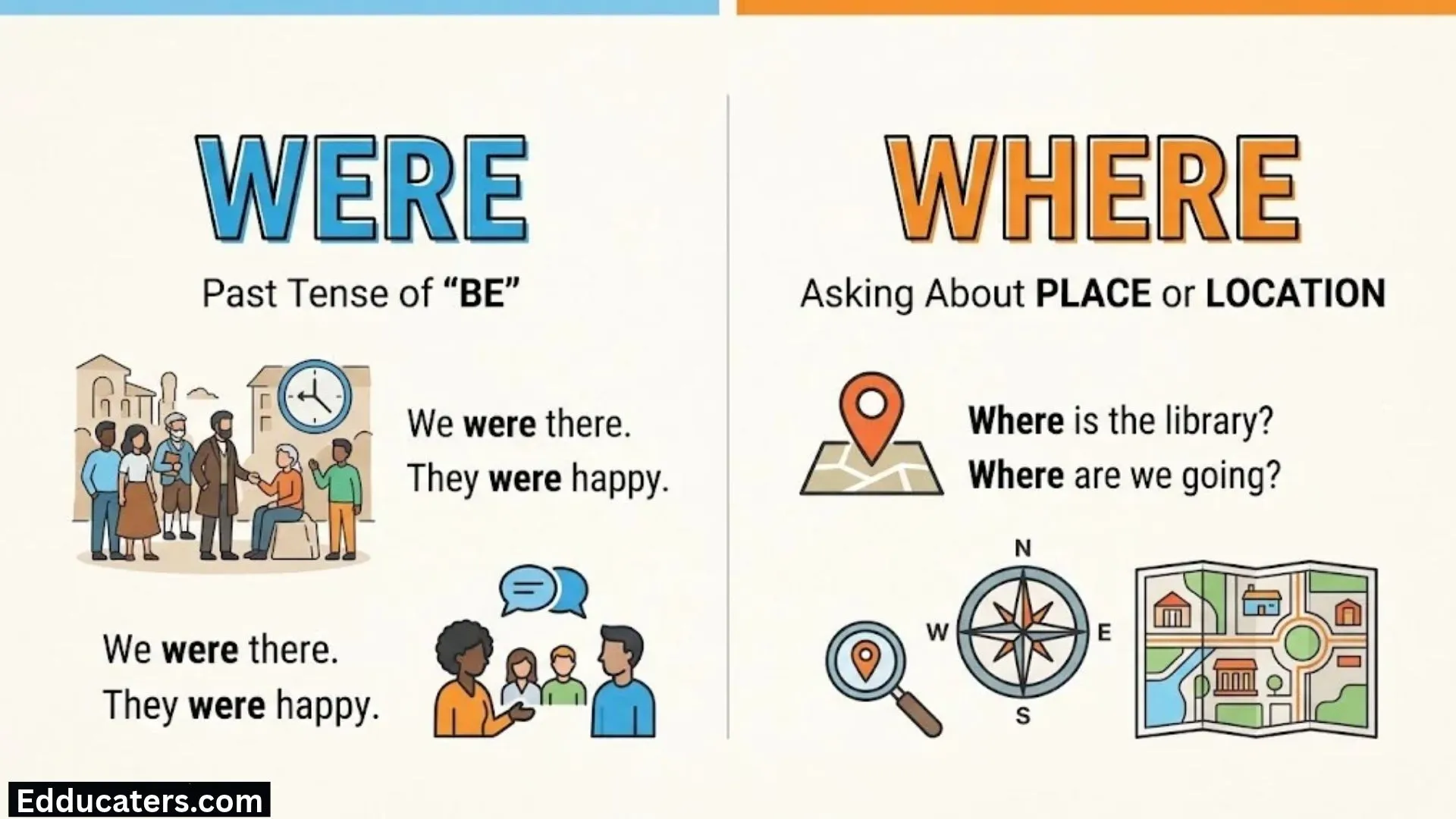
The difference between where or were is simple once you understand how each word works. Where refers to a place, position, or location. Were is the past-tense form of the verb to be, used with plural subjects, the pronoun you, and certain singular subjects in hypothetical situations.
For example:
- Where were you yesterday?
- We were at the library.
- Where did you put my keys?
- They were waiting outside.
Notice that the first and third sentences use where to ask about a location. The second and fourth use were to describe a past situation or action.
Although these words sometimes sound alike, you can’t use them interchangeably. Understanding their meanings, pronunciation, and grammatical roles will help you choose the correct spelling every time.
This guide explains the difference between were or where, their definitions, grammar rules, pronunciation, common mistakes, and practical sentence examples. You’ll also learn how to distinguish them from we’re and wear.
Were or Where: What’s the Difference?
The easiest way to distinguish these words is to look at what the sentence needs. Does it need a location or a verb?
| Word | Meaning | Grammatical function | Example |
| Where | In, at, or to what place | Adverb or conjunction | Where is your office? |
| Were | Past form of be | Verb | They were at the office. |
Where helps identify a location or introduces information about a place. It can also describe a situation or stage in certain expressions.
Were, on the other hand, connects a subject with a past state or condition. It also helps form past continuous and passive constructions.
Consider these examples:
- Where were the children?
- The children were at school.
- Do you know where they went?
- They were happy when they arrived.
The first sentence asks about a location. The second describes the children’s past location. The third asks indirectly about a destination. The fourth describes a past emotional state.
Quick Comparison of Where or Were
Here are some additional differences worth remembering:
| Feature | Where | Were |
| Word category | Adverb and conjunction | Verb |
| Refers to a place | Yes | No |
| Expresses a past condition | No | Yes |
| Introduces a question | Yes | No |
| Introduces a relative clause | Yes | No |
| Works with plural subjects | Not applicable | Yes |
| Works with singular you | Not applicable | Yes |
| Used in hypothetical statements | Not as a verb | Yes |
| Example | Where do you live? | We were busy. |
Remember that both words are correctly spelled. The right choice depends entirely on the sentence’s meaning and grammatical structure.
What Does Where Mean?
Where is a question word that asks about a place, position, or location. It can also connect clauses and introduce information about a particular place or situation.
In simple terms, use where whenever you want to ask or explain where something happens, exists, or belongs.
For example:
- Where is the nearest grocery store?
- Where did you leave your wallet?
- I know where she lives.
- This is the park where we played as children.
- Nobody knows where the missing documents went.
The word doesn’t always need to appear in a question. You can use it in statements, indirect questions, and longer sentences.
According to standard English grammar, where has several grammatical functions. Its most important uses include interrogative adverbs, relative clauses, and conjunctions.
Where as an Interrogative Adverb
An interrogative adverb is a word that introduces a question about a particular circumstance. These adverbs can ask about place, time, manner, or reason.
Where functions as an interrogative adverb when someone wants information about a location.
For example:
- Where do you work?
- Where is your brother?
- Where did you buy that laptop?
- Where are we meeting tomorrow?
- Where should I put these boxes?
In each example, where asks about a physical or intended location.
You can also use it to ask about a person’s destination or direction.
For example:
- Where are you heading?
- Where does this road lead?
- Where should we go next?
- Where can I find a good restaurant?
Important grammar rule: In most direct questions, where appears before the auxiliary verb or the main verb.
Compare these sentences:
| Correct sentence | What it asks |
| Where are you going? | Your destination |
| Where does he work? | His workplace |
| Where did they travel? | Their destination |
| Where can I park? | A parking location |
Don’t confuse the question structure with a statement. For example, “Where you are going?” is generally incorrect as a standard direct question. The correct form is “Where are you going?”
Where as a Relative Adverb
A relative adverb introduces a clause that provides additional information about a place.
Unlike an interrogative adverb, a relative adverb doesn’t necessarily ask a question. Instead, it connects two related ideas.
For example:
- This is the house where I grew up.
- We visited the city where my parents met.
- She remembers the restaurant where they celebrated their anniversary.
- That’s the school where I learned English.
In these sentences, where introduces a relative clause that describes a particular place.
Consider this example:
“This is the house where I grew up.”
The sentence contains two related pieces of information:
- This is the house.
- I grew up in that house.
The word where connects these ideas without repeating the location.
You can often replace where with a preposition followed by which.
For example:
- The house where I grew up.
- The house in which I grew up.
Both constructions communicate the same basic meaning. The first sounds more natural in everyday conversation.
Here are additional examples:
| Sentence | Relative clause |
| This is the office where I work. | Where I work |
| I visited the village where my grandfather lived. | Where my grandfather lived |
| We found a café where everyone can relax. | Where everyone can relax |
| That’s the stadium where the final took place. | Where the final took place |
One useful distinction: where generally refers to a place or location. It doesn’t replace every relative word. Use when for time and why for reasons.
Where in Indirect Questions
An indirect question reports or embeds a question within a larger statement or question.
You often use where in these constructions when you want to ask something politely, express uncertainty, or report what someone asked.
For example:
- I don’t know where she lives.
- Can you tell me where the station is?
- He asked where I bought my shoes.
- I wonder where they went.
- Do you remember where we parked?
Notice something important about these sentences: indirect questions usually follow statement word order rather than direct-question word order.
Compare the following:
| Direct question | Indirect question |
| Where is he? | I wonder where he is. |
| Where does she work? | I know where she works. |
| Where did they go? | Tell me where they went. |
| Where are the keys? | Do you know where the keys are? |
The auxiliary verb doesn’t usually move in front of the subject inside an indirect question.
For example:
- Incorrect: I don’t know where is she.
- Correct: I don’t know where she is.
This distinction matters in academic writing, professional emails, and everyday English.
Where as a Conjunction or Clause Connector
The word where can also function as a conjunction. In this role, it connects a subordinate clause to another part of the sentence.
It can mean in the place that, in situations where, or sometimes whereas, depending on context.
For example:
- Where there is smoke, there is usually fire.
- Where possible, submit your application online.
- Where necessary, additional information will be provided.
- Where others see failure, she sees an opportunity.
These examples don’t all refer to a specific physical location.
Sometimes, where introduces a situation, condition, or contrast between ideas.
Consider:
“Where some people prefer working alone, others enjoy teamwork.”
Here, where introduces a contrast between two groups. It has a meaning close to while or whereas.
This usage is especially common in formal explanations, comparisons, instructions, and academic writing.
Common Expressions Using Where
You can find where in several everyday expressions. Each one communicates a location, condition, or situation.
| Expression | Meaning | Example |
| Where possible | If circumstances allow | Work remotely where possible. |
| Where necessary | If needed | Add more details where necessary. |
| Where applicable | When relevant | Complete this section where applicable. |
| Where appropriate | When suitable | Include examples where appropriate. |
| Where available | If something can be obtained | Choose local products where available. |
| Where exactly | Asking for a specific location | Where exactly did you meet him? |
| Where else | Asking about another possible location | Where else can we look? |
| From where | Asking about an origin | From where did the package arrive? |
These expressions make where useful beyond ordinary location questions.
What Does Were Mean?
Were is the past-tense form of the irregular verb to be. It describes past states, conditions, identities, and situations.
You use it with plural subjects and the pronoun you. You also use it with certain singular subjects in hypothetical or unreal statements.
For example:
- We were tired after the journey.
- They were excited about the announcement.
- You were right about the weather.
- The students were ready for the examination.
- If I were rich, I would travel around the world.
The word were belongs to the verb family be. Its other common forms include am, is, are, was, been, and being.
Were as the Past Tense of To Be
The verb to be describes existence, identity, condition, or state. Its past-tense forms are was and were.
Use were with these standard subject patterns:
| Subject | Correct form | Example |
| We | Were | We were happy. |
| They | Were | They were outside. |
| You (singular) | Were | You were correct. |
| You (plural) | Were | You were invited. |
| Plural nouns | Were | The children were excited. |
The most important rule is that were is not exclusively a plural verb.
It also works with singular you.
For example:
- You were late yesterday.
- You were my favorite teacher.
- You were supposed to call me.
These sentences are grammatically correct even though you refers to one person.
Use was with I, he, she, and it in ordinary past-tense statements.
However, the subjunctive mood creates an important exception, which we’ll explain shortly.
Were in Past Continuous Tense
The past continuous tense describes an action that was happening at a particular time in the past.
You form it by combining was or were with the present participle of a verb.
The basic structure is:
Subject + was/were + verb-ing
Use were when the subject is you, we, they, or a plural noun.
For example:
- They were watching television.
- We were waiting for the bus.
- You were studying when I called.
- The children were playing in the garden.
- My friends were discussing their vacation plans.
These sentences describe activities that were already in progress.
You can also combine the past continuous with the simple past to show that one action interrupted another.
For example:
- We were eating dinner when the phone rang.
- They were sleeping when the storm started.
- You were driving when I sent the message.
In each example, were helps establish an ongoing past action.
Were in Passive Voice
The word were also helps form the past passive voice.
Use it with a past participle when the sentence focuses on the person or thing receiving an action rather than performing it.
The basic structure is:
Subject + were + past participle
For example:
- The invitations were delivered yesterday.
- The documents were signed by the manager.
- The winners were announced after the competition.
- Several houses were damaged during the storm.
- The applications were reviewed carefully.
Notice that were doesn’t describe an action by itself. It works with the past participle to create a passive construction.
Compare these examples:
| Active voice | Passive voice |
| The manager approved the documents. | The documents were approved. |
| The company invited the guests. | The guests were invited. |
| The committee selected the winners. | The winners were selected. |
The passive form is useful when the action or its recipient matters more than the person responsible.
Were in Hypothetical Situations and the Subjunctive Mood
One of the most interesting uses of were appears in hypothetical statements.
The subjunctive mood expresses wishes, suggestions, demands, possibilities, and situations that aren’t presented as ordinary facts.
In particular, English uses the past subjunctive were to describe certain imaginary or unreal situations.
For example:
- If I were rich, I would buy a beach house.
- If she were here, we could start the meeting.
- If he were taller, he could reach the shelf.
- I wish I were on vacation.
- If I were you, I’d accept the offer.
Notice that were appears with singular subjects such as I, she, and he.
Why?
Because these sentences express hypothetical situations rather than ordinary past events.
In standard formal English, were is traditionally preferred in these constructions.
Remember: The use of were in hypothetical statements doesn’t mean the event happened in the past. It expresses an unreal or imagined condition.
Consider this example:
“If I were a bird, I would fly across the ocean.”
The speaker isn’t claiming to have been a bird. They’re imagining an impossible or unreal situation.
You can also use were after expressions of wishes:
- I wish he were here.
- She wishes she were younger.
- They wish the weather were warmer.
- I wish it were easier to understand.
In everyday conversation, you’ll also hear was in some hypothetical statements. However, were remains the traditional choice in formal standard English.
Common Expressions Using Were
Here are some useful expressions that demonstrate how were appears in everyday English.
| Expression | Meaning | Example |
| We were | Describes a past situation involving us | We were at home. |
| They were | Describes a past situation involving others | They were busy. |
| You were | Describes a past situation involving you | You were very helpful. |
| There were | Indicates that something existed in the past | There were three books. |
| If I were | Introduces an unreal condition | If I were you, I’d wait. |
| I wish I were | Expresses an unreal wish | I wish I were there. |
| If they were | Introduces a hypothetical condition | If they were ready, we’d leave. |
These expressions appear frequently in conversations, stories, professional communication, and formal writing.
Were or Where: Example Sentences
Examples are one of the easiest ways to understand the difference between confusing English words. When you see were and where in different contexts, their grammatical functions become much clearer.
Let’s look at how each word works in everyday sentences.
Examples of Where in Sentences
Use where when asking about a place, identifying a location, or connecting information about a particular place.
Here are 15 examples:
- Where do you live?
- Where is the nearest hospital?
- Where did you buy that beautiful dress?
- Where are my car keys?
- Where will you spend your vacation?
- Do you know where she works?
- I can’t remember where I parked my car.
- This is the restaurant where we first met.
- Tell me where you found this information.
- Where should I send the package?
- Nobody knows where the missing documents are.
- That’s the school where my mother studied.
- Where can I find affordable furniture?
- I wonder where they went after the meeting.
- Please show me where you found the error.
What do these sentences have in common?
Every sentence uses where to identify or introduce a location, destination, or place-related idea. Some are direct questions, while others are statements or relative clauses.
Examples of Were in Sentences
Use were when describing past states, ongoing activities, passive actions, or hypothetical situations.
Here are 15 examples:
- We were happy to see our friends.
- They were waiting outside the building.
- You were right about the situation.
- The students were studying for their exams.
- My parents were traveling last weekend.
- We were excited about the competition.
- The invitations were delivered yesterday.
- They were watching a movie when I arrived.
- You were supposed to call me.
- The children were playing in the garden.
- If I were rich, I would buy a large house.
- I wish she were here with us.
- The documents were reviewed by the manager.
- There were several people waiting outside.
- If he were more careful, he wouldn’t make that mistake.
Each sentence uses were as part of a verb construction. Depending on the context, it expresses a past condition, an ongoing action, a passive construction, or an unreal situation.
Where or Were in the Same Sentence
You don’t have to choose only one of these words in every sentence. In fact, where and were often appear together naturally.
For example:
- Where were you yesterday?
- Do you remember where we were last night?
- Where were the children playing?
- I wonder where they were hiding.
- Where were you when the accident happened?
- Can you tell me where the keys were?
- Where were the documents before you moved them?
- Nobody knew where the missing tourists were.
These examples are particularly useful because they show both words performing different grammatical jobs.
Take this sentence:
“Where were you when the meeting started?”
- Where asks about a location.
- Were describes the past state or location of the subject you.
The words work together without repeating the same meaning.
Correct vs. Incorrect Usage of Where or Were
A small spelling difference can change an entire sentence. The following examples show common substitution errors and their corrections.
| Incorrect sentence | Correct sentence | Reason |
| Were are you going? | Where are you going? | The sentence asks about a destination. |
| Where you happy? | Were you happy? | The sentence asks about a past condition. |
| I don’t know were she lives. | I don’t know where she lives. | The sentence refers to a location. |
| They where waiting outside. | They were waiting outside. | The sentence describes an ongoing past action. |
| Were did you put my phone? | Where did you put my phone? | The sentence asks about a location. |
| We where tired yesterday. | We were tired yesterday. | The sentence describes a past state. |
| Tell me were you work. | Tell me where you work. | The sentence introduces an indirect question. |
| Where going to the party? | We’re going to the party. | The intended meaning is we are. |
The final example introduces another commonly confused word: we’re. Understanding that distinction will make your writing even more accurate.
Where or Were: Pronunciation and Spelling Differences
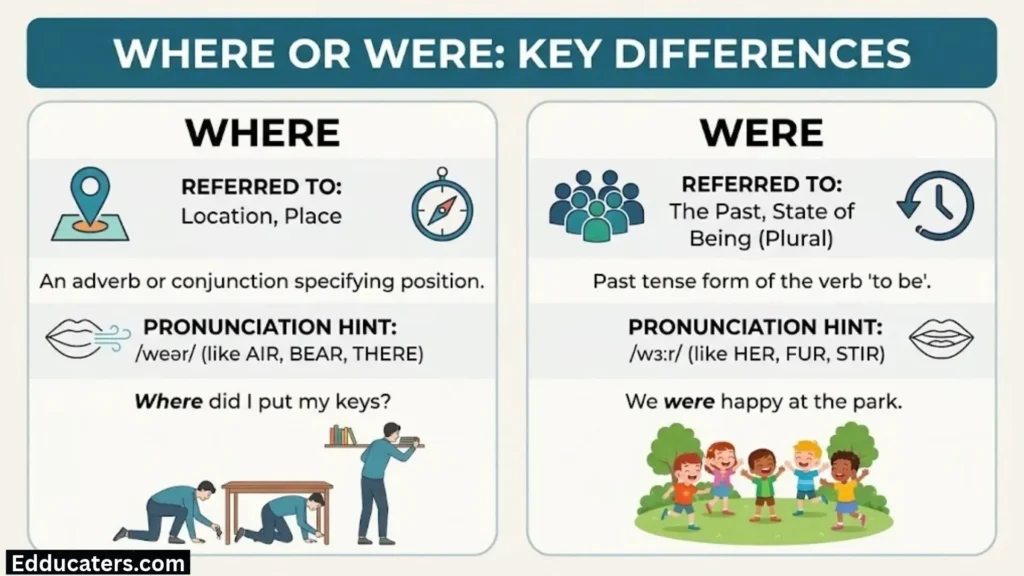
Although where and were have similar spellings, their pronunciation differs in standard American English.
The main difference involves their vowel sounds.
However, some speakers pronounce them similarly enough that the distinction becomes difficult to hear. This explains why people sometimes confuse them during conversations or when writing from memory.
How to Pronounce Where
In standard American English, where is commonly represented by the IPA transcription:
/wer/
The word begins with the /w/ sound, followed by a vowel sound similar to the one in air or care for many American speakers.
Break it into two basic sound elements:
- /w/: The opening sound in water.
- /er/: The vowel and R combination in the American pronunciation of care.
For example:
- Where is your house?
- Where did you go?
- Where are the children?
The pronunciation stays recognizable across these sentence patterns, although natural connected speech may change its rhythm.
How to Pronounce Were
In standard American English, the strong pronunciation of were is:
/wɝː/
It starts with the same /w/ sound but uses a different vowel.
The vowel is similar to the stressed sound in American English words such as bird, learn, and turn.
For example:
- We were happy.
- They were outside.
- You were correct.
In normal conversation, were often becomes unstressed. Its vowel may become shorter and more reduced.
This explains why some speakers pronounce it less distinctly than they would in an emphasized sentence.
Are Where and Were Homophones?
No, where and were aren’t generally considered true homophones in standard American English.
Homophones are words that sound exactly alike but have different meanings or spellings.
For example:
- Sea and see
- Right and write
- Flour and flower
In standard American pronunciation, where and were usually have different vowel sounds.
However, regional accents and individual speech patterns can make the words sound very similar. Some speakers may even pronounce them identically in everyday conversation.
This is why you shouldn’t rely entirely on pronunciation when choosing between them.
Instead, consider the sentence’s grammatical structure.
For example:
- “Where are you?” asks about a location.
- “You were there” describes a past situation.
Even if the words sound similar, their meanings and grammatical functions remain different.
American vs. British Pronunciation
American and British English share the same spelling and basic grammatical rules for where and were. However, their pronunciation differs.
One important distinction involves rhotic and non-rhotic accents.
- American English: Most standard American accents pronounce the R sound after the vowel.
- British English: Many standard southern British accents don’t pronounce the R unless another vowel sound follows.
Here is a basic comparison:
| Word | Standard American IPA | Standard British IPA |
| Where | /wer/ | /weə(r)/ |
| Were (strong form) | /wɝː/ | /wɜː(r)/ |
These are broad reference pronunciations. Actual pronunciation varies across regions and speakers.
The important point is that neither American nor British English changes the spelling of these words. Both varieties use where for locations and were as a form of the verb to be.
Where vs. Were vs. We’re vs. Wear
The confusion doesn’t stop with where and were. English has several similar-looking words that can create spelling mistakes.
The most common additional examples are we’re and wear.
Although these words look or sound similar, each has a different meaning and grammatical function.
Where vs. We’re
Where refers to a location or introduces information about a place.
We’re is a contraction of we are.
The apostrophe replaces the missing letter a in the contraction.
Examples:
- Where are we going?
- We’re going to the shopping mall.
- Do you know where they live?
- We’re planning to visit them tomorrow.
A useful trick is to expand we’re into we are.
If the sentence still makes sense, we’re is probably correct.
For example:
“We’re going home.”
Replace the contraction:
“We are going home.”
The sentence still makes sense.
However:
“Where going home” doesn’t communicate the intended meaning.
Where vs. Wear
Where asks about or identifies a location.
Wear is a verb that means having clothing, jewelry, or an accessory on your body.
For example:
- Where is your jacket?
- What should I wear to the wedding?
- Where did you buy those shoes?
- I usually wear comfortable shoes.
Remember that wear can also function as a noun in certain expressions, such as everyday wear or tear and wear—although the standard expression for damage caused by use is wear and tear.
Were vs. We’re
These two words have different grammatical functions.
- Were: Past-tense form of be.
- We’re: Contraction of we are.
Compare:
- We were tired yesterday.
- We’re tired today.
The first sentence describes a past condition. The second describes a present condition.
You can use the expansion test to identify we’re:
- We’re happy = We are happy.
- We were happy = We were happy.
You cannot replace were with we are without changing the tense and meaning.
Where, Were, We’re, and Wear: Quick Comparison
| Word | Meaning | Part of speech | Example |
| Where | Place or location | Adverb/conjunction | Where is the station? |
| Were | Past form of be | Verb | They were hungry. |
| We’re | We are | Contraction | We’re ready. |
| Wear | To have clothing on | Verb | I wear glasses. |
A simple way to remember all four:
- Where: Think of a place.
- Were: Think of the past tense.
- We’re: Think of we are.
- Wear: Think of clothing.
Were vs. Was: Understanding the Difference
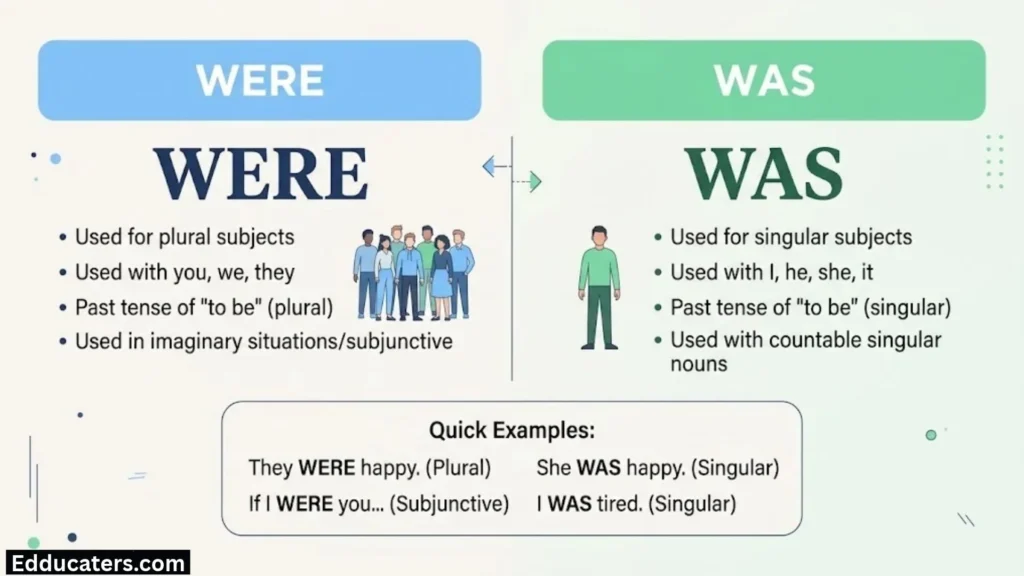
Another important grammar distinction involves were and was. Both words are past-tense forms of the verb to be, but they don’t work with exactly the same subjects.
Understanding this difference will help you avoid another common English grammar mistake.
When to Use Was
Use was with the following subjects in ordinary past-tense statements:
- I
- He
- She
- It
- Singular nouns
Examples:
- I was tired yesterday.
- He was at the office.
- She was happy about the news.
- It was cold last night.
- The teacher was absent.
These sentences describe past states, conditions, or situations involving singular subjects.
When to Use Were
Use were with:
- We
- They
- You
- Plural nouns
Examples:
- We were at the airport.
- They were excited about the trip.
- You were very helpful.
- The students were ready.
- My friends were waiting outside.
The subject-verb agreement rule is straightforward in ordinary past-tense statements.
However, hypothetical statements create an important exception.
If I Were vs. If I Was
Both if I were and if I was appear in modern English. However, they don’t always communicate the same meaning.
Use if I were when describing an imaginary, hypothetical, or unreal situation.
Use if I was when referring to a possible or actual past situation.
Consider these examples:
| Sentence | Meaning |
| If I were rich, I’d buy a mansion. | Imaginary financial situation |
| If I were you, I’d apologize. | Hypothetical advice |
| If I were taller, I’d play basketball. | Unreal condition |
| If I was rude yesterday, I’m sorry. | Possible past behavior |
| If I was at the office, I don’t remember. | Uncertainty about an actual past event |
The distinction becomes clearer when you consider what the speaker wants to communicate.
If I were traditionally uses the subjunctive mood. It presents a situation as unreal or contrary to fact.
For example:
“If I were the president, I would change the law.”
The speaker isn’t claiming to be president. They’re imagining a different situation.
On the other hand:
“If I was rude during the meeting, please forgive me.”
Here, the speaker considers a past event that may actually have happened.
In informal American English, people sometimes use was in hypothetical statements too. However, were remains the traditional choice in formal writing and established expressions such as if I were you.
Common Mistakes When Using Were or Where
Even experienced English speakers sometimes confuse where and were. The problem usually involves spelling, pronunciation, or sentence structure.
Understanding the mistakes below will help you recognize the correct word more quickly.
Using Were Instead of Where
This mistake happens when someone uses the past-tense verb instead of a word referring to a location.
For example:
- Incorrect: Were is the nearest supermarket?
- Correct: Where is the nearest supermarket?
The sentence asks about a place. Therefore, where is the appropriate choice.
Another example:
- Incorrect: I don’t know were she lives.
- Correct: I don’t know where she lives.
Here, where introduces an indirect question about someone’s location.
How to avoid this mistake: Ask yourself whether the sentence needs information about a place. If it does, where is probably the correct word.
Using Where Instead of Were
This mistake happens when someone needs a past-tense verb but accidentally writes the location word.
For example:
- Incorrect: They where happy yesterday.
- Correct: They were happy yesterday.
The sentence describes a past emotional state. It needs the verb were.
Another example:
- Incorrect: We where watching television.
- Correct: We were watching television.
The past continuous structure requires an appropriate form of be before the verb ending in -ing.
How to avoid this mistake: Check whether the sentence needs a verb to describe a past condition or action. If it does, consider were.
Confusing Were With We’re
The words were and we’re can create problems because they contain almost the same letters.
However, the apostrophe makes a major difference.
- Were: Past tense of be.
- We’re: Short for we are.
Incorrect: Were going to the cinema.
Correct: We’re going to the cinema.
The easiest way to identify we’re is to replace it with we are.
If the sentence still makes sense, you’ve probably chosen the right word.
Misusing Were With Singular Subjects
Some writers believe were can only accompany plural subjects. That’s not entirely correct.
In standard English, were also appears with singular you.
For example:
- You were late.
- You were correct.
- You were invited to the ceremony.
It also appears with singular subjects in certain subjunctive constructions.
For example:
- If I were famous, I’d travel more.
- I wish he were here.
- If she were available, we could ask her.
Don’t automatically replace were with was just because the subject is singular. First, identify the grammatical construction.
Relying Only on Pronunciation
Similar pronunciation can make spelling mistakes more likely.
Some speakers pronounce where and were very similarly. Others maintain a clear difference between their vowel sounds.
This variation makes pronunciation an unreliable way to determine the correct spelling in every situation.
Instead, examine the sentence’s meaning.
For example:
- Where were the guests?
- The guests were in the garden.
The first word asks about a location. The second describes the guests’ past location.
Why Spellcheck Doesn’t Always Catch Where and Were Mistakes
Spellcheck tools identify many spelling errors. However, they don’t always recognize incorrect word choices.
Both where and were are correctly spelled English words. Therefore, a basic spellchecker may accept either one even when the sentence uses the wrong word.
For example:
“I don’t know were he lives.”
A spelling checker may fail to flag were because it’s a valid English word.
The problem involves contextual meaning, not spelling.
To catch these mistakes:
- Read the entire sentence instead of checking individual words.
- Identify the sentence’s subject and verb.
- Check whether the sentence asks about a location.
- Replace we’re with we are when checking contractions.
- Read your writing aloud to identify awkward constructions.
- Use grammar-checking tools as a second layer of review.
Remember that automated tools can help, but they don’t replace careful proofreading.
How to Remember the Difference Between Were or Where
You don’t need complicated grammar rules to remember these words. A few simple techniques can help you choose the correct spelling whenever you write.
Remember That Where Refers to a Place
The simplest memory trick is to associate where with location.
Whenever you ask about a place, destination, or position, think of where.
For example:
- Where is the bathroom?
- Where did you go?
- Where should we meet?
You can also remember the question:
“In what place?”
If this question fits the meaning of your sentence, where is likely correct.
For example:
“Where is my phone?”
You can understand this as:
“In what place is my phone?”
The meaning stays essentially the same.
Remember That Were Is a Verb
Associate were with the past-tense verb to be.
For example:
- We were happy.
- They were tired.
- You were right.
In these sentences, were connects the subject with a past state or condition.
You can remember the basic verb forms using this table:
| Present tense | Past tense |
| I am | I was |
| He is | He was |
| She is | She was |
| It is | It was |
| We are | We were |
| They are | They were |
| You are | You were |
Keep in mind that hypothetical subjunctive constructions also use were with certain singular subjects.
Use the Sentence Replacement Test
A replacement test can help you identify the correct word without memorizing complicated definitions.
Test for where: Replace it with in what place.
Example:
“Where did you leave the bag?”
Replacement:
“In what place did you leave the bag?”
The sentence still makes sense.
Test for were: Check whether the sentence needs a past form of be.
Example:
“They were playing football.”
You can identify were because it helps form the past continuous tense.
Another example:
“We were happy.”
The word were connects the subject we with the past condition happy.
This technique works particularly well when you’re proofreading sentences.
A Quick Decision Guide: Where or Were?
Use this simple guide whenever you’re unsure.
| Question | Correct word |
| Am I asking about a place? | Where |
| Am I describing a location? | Where |
| Am I introducing a relative clause about a place? | Where |
| Am I asking an indirect location question? | Where |
| Am I describing a past state? | Were |
| Am I describing an ongoing past action? | Were |
| Am I forming a past passive construction with a plural subject? | Were |
| Am I expressing an unreal condition with the subjunctive? | Were |
The easiest rule to remember: If the sentence needs a location, use where. If it needs the past-tense form of be, use were.
Where or Were: Frequently Asked Questions
Here are answers to common questions about the difference between where and were.
What Is the Main Difference Between Where and Were?
Where refers to a place, position, or location. Were is the past-tense form of the verb to be, used with plural subjects, singular or plural you, and certain singular subjects in hypothetical statements.
For example:
- Where is your school?
- We were at school yesterday.
Which Is Correct: Where or Were?
Both words are correct. The right choice depends on the sentence’s meaning and grammatical structure.
Use where when referring to a location. Use were when describing a past state, condition, or action.
For example:
- Where are you?
- They were outside.
Can Where or Were Be Used Interchangeably?
No. These words have different meanings and grammatical functions.
Where identifies or asks about a location. Were functions as a verb.
Using one instead of the other can change a sentence’s meaning or make it grammatically incorrect.
Are Where or Were Homophones?
Not generally in standard American English. Where usually has the /wer/ pronunciation, while the strong form of were has the /wɝː/ pronunciation.
However, some regional accents and individual speech patterns make them sound very similar or identical.
Why Do People Confuse Where or Were?
People confuse these words because they have similar spellings and can sound alike in certain accents.
Their similar appearance also makes them easy to mistype, especially when writing quickly.
The best solution is to check the grammatical function of the word rather than relying entirely on pronunciation.
Is Were Always a Plural Verb?
No. Although were commonly appears with plural subjects, it also works with singular you.
Additionally, the subjunctive mood uses were with singular subjects in hypothetical or unreal statements.
For example:
- You were right.
- If I were rich, I’d travel more.
Can You Use Were With I, He, or She?
Yes. In standard English, were can accompany I, he, and she in certain subjunctive constructions.
For example:
- If I were you, I’d wait.
- If he were here, we could ask him.
- I wish she were available.
However, ordinary past-tense statements generally use was with these singular subjects.
Should I Say If I Was or If I Were?
Use if I were for hypothetical or unreal situations.
For example:
“If I were a millionaire, I’d buy a private island.”
Use if I was when discussing an actual or possible past event.
For example:
“If I was late yesterday, I apologize.”
Although informal speakers sometimes use was in hypothetical statements, were is traditionally preferred in formal standard English.
Can Where or Were Appear in the Same Sentence?
Yes. Both words can appear together because they perform different grammatical functions.
For example:
- Where were you yesterday?
- Do you remember where we were?
- Where were the children playing?
Where identifies the location, while were functions as the past-tense verb.
Do American and British English Spell Where or Were Differently?
No. Both American and British English use the same spellings and grammatical meanings.
However, their pronunciation can differ because of regional accents and differences in how speakers pronounce the R sound.
Is Where Ever Used as a Verb?
No. Where doesn’t function as a standard English verb.
It generally works as an adverb or conjunction and can introduce relative clauses.
For example:
“Where did you put the book?”
Here, where asks about a location. The verb is did put.
Why Doesn’t Spellcheck Catch Where or Were Mistakes?
Spellcheck tools recognize both words as correctly spelled English words. Therefore, they may not identify an incorrect substitution.
For example, “I don’t know were he lives” contains a valid spelling but an incorrect word choice.
Grammar-checking tools and careful proofreading can help identify these contextual mistakes.
Practice Quiz: Where or Were?
Now that you understand the grammar rules, test your knowledge with these fill-in-the-blank exercises.
Choose the correct word: where or were.
- ______ are you going after work?
- They ______ excited about the announcement.
- Do you remember ______ we parked the car?
- We ______ watching a movie last night.
- ______ were you when I called?
- I wonder ______ she bought her shoes.
- If I ______ you, I’d reconsider.
- The children ______ playing outside.
- This is the restaurant ______ we first met.
- ______ they at home yesterday?
- Nobody knows ______ the missing documents are.
- My parents ______ traveling last weekend.
- Can you tell me ______ the nearest bank is?
- If he ______ more careful, he wouldn’t make that mistake.
- Do you remember ______ we first met?
Answer Key With Explanations
| No. | Answer | Explanation |
| 1 | Where | Asks about a destination. |
| 2 | Were | Describes a past emotional state. |
| 3 | Where | Refers to a parking location. |
| 4 | Were | Forms the past continuous tense. |
| 5 | Where | Asks about a past location. |
| 6 | Where | Introduces an indirect question. |
| 7 | Were | Uses the subjunctive mood. |
| 8 | Were | Describes an ongoing past action. |
| 9 | Where | Introduces a relative clause. |
| 10 | Were | Forms a past-tense question. |
| 11 | Where | Refers to the documents’ location. |
| 12 | Were | Describes an ongoing past situation. |
| 13 | Where | Introduces an indirect location question. |
| 14 | Were | Expresses a hypothetical condition. |
| 15 | Where | Asks about the location of a meeting. |
15 questions completed
If you answered all 15 correctly, you’ve understood the main distinction between these words. If you missed a few, revisit the examples and pay particular attention to indirect questions and hypothetical statements.
Conclusion: Choose Where or Were Correctly
The difference between where or were becomes easy once you understand their meanings and grammatical functions. Although their spellings look similar and their pronunciation can overlap, these words serve entirely different purposes.
Use where when asking about or referring to a place, position, or location. It also introduces relative clauses, indirect questions, and certain conditional or contrasting expressions.
Use were as the past-tense form of to be. It works with plural subjects, singular you, and certain singular subjects in hypothetical constructions. You’ll also find it in past continuous and passive sentences.
Remember these two simple examples:
- Where were you yesterday?
- We were at home.
Whenever you’re unsure, check the sentence’s meaning and grammatical structure. If you’re asking about a location, choose where. If you need the past-tense verb to be, choose were.
With a little practice, you’ll stop mixing them up and use both words confidently in everyday conversations and professional writing.

Hi, I’m Nathan Whitmore, and I enjoy making English grammar easy for learners of all ages. I believe grammar should be practical, not confusing. I write simple, well-researched guides that help readers improve their writing, speaking, and overall communication skills.
I spend a lot of time studying grammar patterns, sentence construction, punctuation, and modern English usage. My goal is to create lessons that anyone can understand, whether they are students, teachers, or professionals.
Books
Clear English Grammar
The Smart Writer’s Grammar Handbook
 Julian Mercer