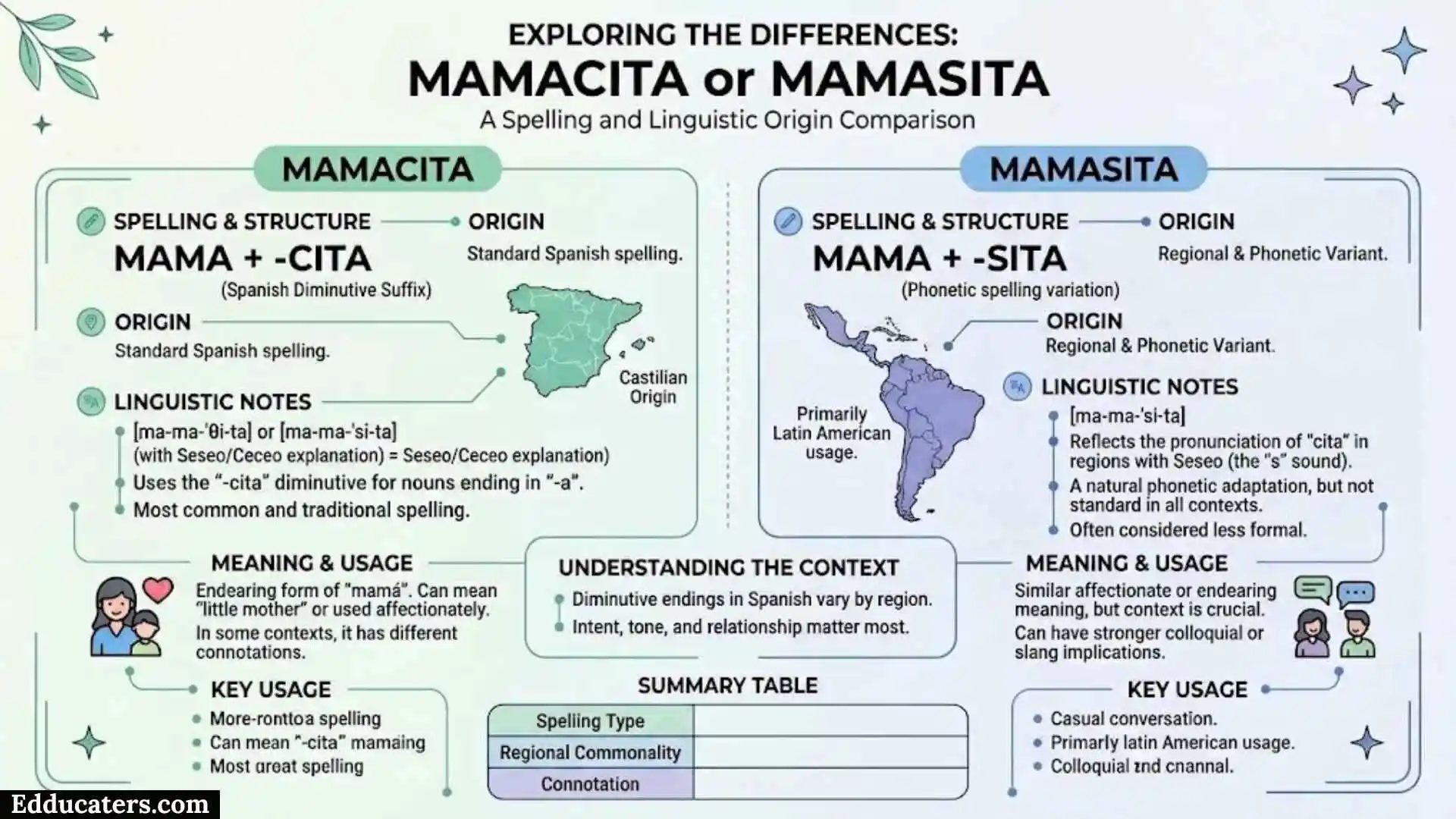
If you have seen the Spanish expression mamacita and wondered whether it should be spelled mamasita, the standard spelling is mamacita. The form mamasita is generally a misspelling of mamacita when the intended word is the Spanish diminutive of mamá.
Mamacita comes from mamá with the diminutive ending -cita. Depending on context, it can literally convey an affectionate meaning related to “mommy” or “little mom,” but in many informal contexts, especially when addressing an adult woman, mamacita can be used as a flirtatious or complimentary term roughly comparable to “beautiful,” “gorgeous,” or “babe.”
The important distinction is that mamacita is the standard spelling for this word. The c in the middle is not interchangeable with s.
If you are writing the Spanish word, use mamacita, not mamasita.
Mamacita Is the Standard Spelling
The correct spelling is:
mamacita
The commonly confused form is:
mamasita
When the intended word is the Spanish diminutive mamacita, the spelling with c is the standard form.
The confusion is understandable because the c in mamacita may sound similar to an s sound in some varieties of Spanish. In particular, before i, the pronunciation of c varies by region. In much of Latin America, it is pronounced with an s sound, while in much of Spain it can have a sound similar to the English th in think. This difference in pronunciation can make the spelling less obvious to someone who has learned the word primarily by hearing it.
For example:
She called her mother mamacita.
Not:
She called her mother mamasita.
The spelling does not change simply because the pronunciation may sound different from one Spanish-speaking region to another.
What Does Mamacita Mean?
Mamacita is a Spanish word formed from mamá, meaning “mom” or “mother,” using a diminutive form.
The diminutive does not always mean physically small. In Spanish, diminutive forms can express affection, familiarity, tenderness, or other shades of meaning depending on the word and context.
Therefore, mamacita can have different interpretations depending on who is saying it, who is being addressed, and the situation.
When used affectionately toward a mother, it can convey a sense similar to “mommy,” “dear mom,” or an affectionate form of “mom.”
However, mamacita is also widely encountered as an informal way of addressing or referring to an attractive woman. In that context, translating it literally as “little mother” would miss the intended meaning.
Mamacita as an affectionate term
A person may use mamacita affectionately when talking to or about a mother.
For example:
Mi mamacita siempre me cuida.
Depending on context and translation, this could convey an affectionate idea such as:
My dear mom always takes care of me.
The exact emotional nuance depends on the relationship between the speakers.
Mamacita as a term for an attractive woman
In informal speech, mamacita can also be used toward an attractive woman.
For example:
¡Hola, mamacita!
Depending on the speaker’s tone and the situation, this could be interpreted as something like:
Hi, beautiful!
or:
Hey, gorgeous!
This use is much more informal and can be flirtatious. It may also sound objectifying or inappropriate in some situations, particularly when directed at a stranger.
Therefore, understanding the context is important before using the expression.
Why Is Mamacita Spelled With a C?
The spelling mamacita is connected to the Spanish diminutive formation of mamá.
The base word is:
mamá
The diminutive form is:
mamacita
The -cita ending is an important part of the spelling. It is not written -sita simply because the resulting pronunciation may contain an /s/ sound in many varieties of Spanish.
This is similar to other Spanish words in which spelling and pronunciation cannot always be predicted directly from English spelling conventions.
For someone learning Spanish mainly through listening, mamasita may seem logical because the word can sound as though it contains an s. However, standard spelling uses c:
mamacita
That is why hearing the word is not always enough to determine its spelling.
Is Mamasita Correct?
If you mean the Spanish word mamacita, then mamasita is not the standard spelling.
For standard Spanish writing, use:
mamacita
rather than:
mamasita
The second form is commonly encountered as a misspelling, especially in informal English-language writing, social media, song titles, comments, usernames, and other contexts where Spanish words may be written phonetically.
That does not automatically mean every appearance of mamasita has exactly the same status in every possible context. Names, usernames, creative spellings, and individual branding can deliberately use nonstandard forms. But when the question is how to spell the Spanish word correctly, mamacita is the form to choose.
Mamacita or Mamasita Pronunciation
The pronunciation difference between mamacita or mamasita can cause much of the confusion.
In many Latin American varieties of Spanish, the c in mamacita occurs before i and is pronounced with an s sound. As a result, mamacita may sound approximately like:
mah-mah-SEE-tah
In much of Spain, the same c can be pronounced with the “th” sound found in English think, giving the word a different sound.
The spelling remains mamacita in both cases.
This is an important lesson for English speakers learning Spanish: pronunciation can vary by region, but that does not mean the written form changes with every pronunciation.
Does mamacita sound like mamasita?
In many varieties of Spanish, yes, the pronunciation of mamacita can make it sound similar to what an English speaker might spell as mamasita.
That similarity does not make mamasita the standard spelling of the word.
The correct spelling remains:
mamacita
Mamacita or Mamita Are Not Exactly the Same
Another useful distinction is between mamacita or mamita.
Both are related to mamá, but they are not simply two spellings of the same word.
Mamita is another affectionate or diminutive form related to “mom” or “mother.” Depending on the country and context, it can be used affectionately toward a mother or as an affectionate form of address.
Mamacita, on the other hand, has developed additional informal uses, particularly as a term directed toward an attractive woman.
For example:
Mi mamita vive cerca.
and:
¡Hola, mamacita!
may have very different meanings and social contexts.
This is one reason you should not automatically translate every diminutive word literally. Spanish diminutives can carry emotional and conversational meanings that depend heavily on context.
Is Mamacita a Spanish Word?
Yes. Mamacita is a Spanish word formed from mamá as a diminutive.
It is especially familiar to English speakers because the term appears in popular culture, music, movies, television, social media, and informal conversation.
However, its use in English-speaking contexts does not necessarily reflect every way the word is used by Spanish speakers. The meaning and tone can change depending on country, relationship, speaker, and situation.
For language learners, it is therefore better to understand mamacita as a context-dependent Spanish expression rather than assuming it has one fixed English translation.
How to Use Mamacita in a Sentence
The appropriate sentence depends on which meaning you intend.
Affectionate use related to mother
Mi mamacita es muy cariñosa.
This can express affection toward one’s mother.
Another example is:
Quiero mucho a mi mamacita.
The exact translation can vary naturally depending on context, but the expression conveys affection toward the speaker’s mother.
Informal use toward an attractive woman
Esa mamacita es muy bonita.
In an informal context, the speaker may be describing a woman as attractive.
However, learners should be careful with this usage. A word can be grammatically correct while still being socially inappropriate in a particular situation.
Calling a stranger mamacita may be perceived as flirtatious, overly familiar, or disrespectful depending on the circumstances.
Is Mamacita Formal or Informal?
Mamacita is generally informal.
It is not the kind of word you would normally choose in a formal business letter, academic paper, professional report, or other formal communication.
Its tone depends heavily on context:
| Context | Likely use of mamacita |
| Talking affectionately about your mother | Affectionate |
| Talking to your mother | Familiar or affectionate |
| Addressing a romantic partner | Affectionate or flirtatious |
| Talking about an attractive woman | Informal or flirtatious |
| Addressing a stranger | Potentially overly familiar or inappropriate |
| Formal writing | Generally unsuitable |
This contextual difference matters because knowing the dictionary meaning of a word does not necessarily tell you when it is socially appropriate to use it.
Common Mistakes With Mamacita
Writing mamasita instead of mamacita
This is the most obvious spelling mistake.
Incorrect for the intended Spanish word:
mamasita
Standard spelling:
mamacita
The confusion usually comes from pronunciation. In many Spanish-speaking regions, the c in this position sounds like s, so someone unfamiliar with Spanish spelling may naturally write mamasita.
Assuming mamacita always means “mother”
Although the word is derived from mamá, its actual meaning in conversation can vary.
In one context, it may be an affectionate reference to someone’s mother. In another, it may be an informal term for an attractive woman.
Context determines the intended meaning.
Treating mamacita as a formal expression
The word has an informal and often affectionate or flirtatious character. It should not be treated as a formal equivalent of “woman,” “mother,” or “madam.”
Translating it literally in every situation
A literal translation can sometimes be misleading.
If someone uses mamacita as a flirtatious term, translating it simply as “little mother” does not communicate the intended meaning in English.
Likewise, if someone uses it affectionately for their mother, translating it only as “gorgeous” would lose the original context.
Mamacita in Popular Culture
English speakers often encounter mamacita outside ordinary Spanish conversation because it has become recognizable through popular culture.
The word appears in songs, movies, television, social media, advertising, and informal English-language speech. This widespread exposure has made mamacita familiar even to people who do not speak Spanish.
However, popular-culture usage can simplify or exaggerate the meaning of a word. A person learning Spanish should therefore distinguish between how mamacita is portrayed in entertainment and how it may actually function in everyday conversation.
A word becoming popular in English does not remove its Spanish cultural and linguistic context.
Mamacita or Mamasita: Quick Comparison
| Feature | Mamacita | Mamasita |
| Standard spelling for the Spanish word | Yes | No |
| Related to mamá | Yes | Intended to be, when used as the misspelling |
| Meaning | Context-dependent | Usually intended to mean mamacita |
| Pronunciation | Varies by Spanish variety | Often represents a phonetic spelling |
| Formality | Informal | Nonstandard spelling |
| Common use | Spanish and informal contexts | Informal English-language writing and misspellings |
| Recommended spelling | Yes | No |
The key point is that mamasita should not be substituted for mamacita when you want the standard Spanish spelling.
What Is the Difference Between Mamacita or Mamasita?
The main difference is spelling.
Mamacita is the standard Spanish spelling of the word.
Mamasita is generally a nonstandard spelling used when someone writes the word according to how it sounds or simply confuses the letters c and s.
The two forms are therefore not normally different words with different meanings.
If you are writing Spanish and mean the familiar expression derived from mamá, write:
mamacita
not:
mamasita
Frequently Asked Questions About Mamacita or Mamasita
Is it mamacita or mamasita?
The standard spelling is mamacita. Mamasita is generally a misspelling when the intended word is the Spanish diminutive of mamá.
What does mamacita mean?
Depending on context, mamacita can be an affectionate form related to “mom” or “mother,” or an informal and sometimes flirtatious term for an attractive woman.
Is mamacita a compliment?
It can be, particularly when used informally to describe or address an attractive woman. However, its tone depends on the relationship and situation. What sounds affectionate or complimentary in one context can sound overly familiar or inappropriate in another.
Why do people spell mamacita as mamasita?
The confusion is largely related to pronunciation. In many varieties of Spanish, the c in mamacita is pronounced with an s sound, making the word sound as though it could be spelled with s.
Is mamacita formal?
No. Mamacita is generally informal and context-dependent. It is not normally appropriate for formal professional or academic writing.
Is mamacita the same as mamita?
No. Both can be affectionate forms related to “mother,” but they are not identical expressions. Mamacita can also have an informal or flirtatious meaning when referring to an attractive woman.
How do you pronounce mamacita?
The pronunciation varies among Spanish-speaking regions. In many Latin American varieties, it is approximately mah-mah-SEE-tah. In much of Spain, the c before i has a different pronunciation.
Can mamacita be used for a mother?
Yes. Depending on the speaker and context, mamacita can be used affectionately in reference to a mother.
Is mamasita a Spanish word?
If you mean the standard diminutive related to mamá, the correct spelling is mamacita, not mamasita. The latter may appear as an informal or creative spelling, but it should not be presented as the standard spelling of the word.
Final Answer: Mamacita or Mamasita?
If you are asking how to spell the Spanish word correctly, choose mamacita.
Mamacita is the standard spelling, while mamasita is generally a misspelling or phonetic spelling of the same expression. The confusion happens because the c in mamacita can be pronounced like an s in many Spanish-speaking regions.
The word itself is related to mamá and can express affection toward a mother. In informal contexts, it can also be used as a flirtatious or complimentary term for an attractive woman. Because of these different uses, the surrounding context is important.
The simple rule to remember is:
Correct: mamacita
Generally incorrect as the standard spelling: mamasita
If you are writing the Spanish expression in standard form, mamacita is the spelling to use.

I’m Julian Mercer, an English language writer dedicated to helping people master grammar through practical examples and clear explanations. I enjoy teaching grammar in a way that is both engaging and easy to remember.
My work focuses on grammar rules, punctuation, word usage, and writing techniques that readers can apply in everyday life. I believe learning English should be simple, enjoyable, and useful.
Books
English Grammar in Practice
Writing with Precision
 Nathan Whitmore
 Claire Holloway