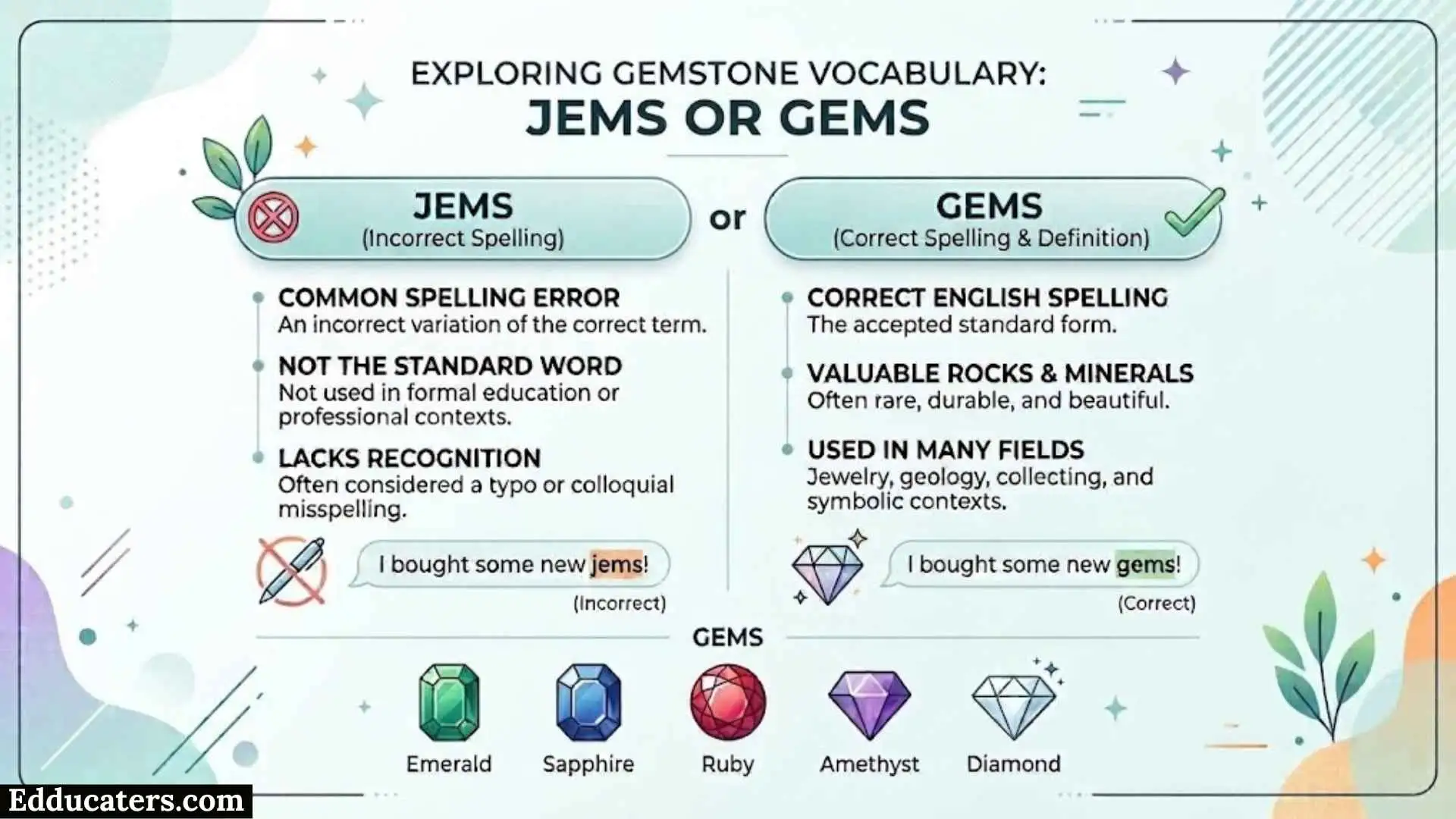
Jems or gems? If you mean the plural of gem, the correct spelling is gems. The spelling jems is generally incorrect when you are referring to precious stones or to people, places, things, or ideas described as especially valuable or good.
The singular form is gem, while the plural form is gems:
One gem → two gems
The confusion usually comes from pronunciation. Gem begins with the /dʒ/ sound, which is also heard at the beginning of words such as jump or jelly. However, the standard spelling uses g, not j.
There is more to this spelling question than changing one letter. Gem has both a literal meaning and a common figurative meaning. Forms such as gem’s, gems’, gemstone, jewel, and hidden gems can also cause confusion.
This guide explains jems or gems, shows how to use the correct form in real sentences, explains why gem is spelled with a g, covers related vocabulary, and gives you a practical way to remember the correct spelling.
Jems or Gems: Quick Answer
Gems is the correct spelling when you mean more than one gem.
| Form | Correct? | Use |
| gem | Yes | One precious stone or one especially valuable person or thing |
| gems | Yes | More than one gem |
| jem | No, for the standard noun | Not the standard spelling of gem |
| jems | No, for the standard plural | Not the standard plural of gem |
| gem’s | Yes | Singular possessive, or a contraction in some contexts |
| gems’ | Yes | Plural possessive |
For example:
The jeweler displayed several beautiful gems.
Not:
The jeweler displayed several beautiful jems.
The same rule applies when gem is used figuratively:
We discovered several hidden gems in the city.
The word gems is the regular plural form of gem. A plural form refers to more than one person or thing, and regular English nouns commonly form the plural by adding -s.
What Does Gem Mean?
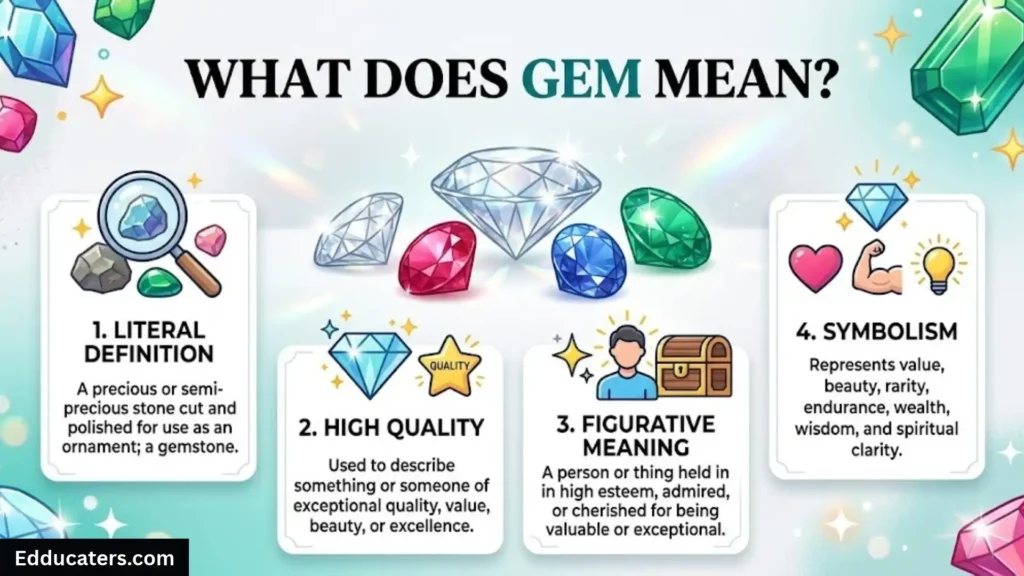
Gem is a noun with two important meanings.
Gem definition
A gem is a precious stone, such as a diamond, ruby, emerald, or sapphire. The word can also describe a person, place, object, or idea that is especially good, beautiful, useful, or valuable. For example, a rare gemstone can be called a gem, while a small restaurant with excellent food might be described as a hidden gem. The exact meaning depends on the context.
First, it can mean a precious stone, especially one that has been cut or polished for use in jewelry. Examples include diamonds, rubies, emeralds, and sapphires.
The spelling jem is not the standard spelling of the ordinary English noun gem. If you are referring to a precious stone or something especially valuable, use gem. The confusion usually comes from pronunciation because gem begins with the same /dʒ/ sound heard in jump, jelly, and jam. Although jem may appear as a name or creative spelling, gem is the correct form in standard English writing.
The word gem has both a literal and a figurative meaning. Literally, it refers to a precious or semiprecious stone valued for its beauty or other qualities. Figuratively, it describes someone or something considered particularly good, special, or valuable. For example, a beautiful emerald is a gem, and a helpful friend can also be called a gem. Expressions such as hidden gem, literary gem, and architectural gem use the word in this broader sense.
For example:
The necklace contains a rare gem.
The crown was decorated with precious gems.
Second, gem can describe a person, place, thing, or idea that is considered especially good, useful, beautiful, or valuable.
For example:
This little bookstore is a hidden gem.
She is a real gem.
That old photograph is a gem.
Oxford defines gem as a precious stone that has been cut or polished for use in jewelry. It also defines the word as a person, place, or thing that is especially good. Cambridge gives the same two broad senses. These definitions establish why gem can be used both literally and figuratively.
Gem as a Precious Stone
When gem refers to a stone, it is closely related to terms such as:
- gemstone
- jewel
- precious stone
- diamond
- ruby
- emerald
- sapphire
For example:
The ring contains a large green gem.
The museum has a collection of historical gems.
The jeweler examined the gem under a magnifying lens.
The plural is gems:
diamonds or other gems
Gem as Something Especially Good
The figurative meaning is equally important in everyday English.
A gem can describe something that stands out because of its quality or value.
For example:
That small restaurant is a real gem.
The restaurant is not literally a precious stone. The speaker means that it is unusually good or valuable.
This meaning appears in expressions such as:
- hidden gem
- rare gem
- real gem
- little gem
- literary gem
- architectural gem
- gem of an idea
The plural remains gems:
The city is full of hidden gems.
What Does Gems Mean?
Gems is simply the plural of gem.
When you are talking about two or more gems, use gems.
Physical Objects
The jewelry box contained several precious gems.
The crown was covered with diamonds or other gems.
She collects unusual gems from different parts of the world.
Figurative Uses
The plural also works when gem has its figurative meaning:
We found several hidden gems during our trip.
The book contains some gems of practical advice.
The old film is one of the forgotten gems of its era.
This is important because gems does not always refer to gemstones. Context determines whether the word is literal or figurative.
Why Is It “Gems” Instead of “Jems”?
The spelling can seem strange because gem begins with a sound that is often represented by the letter j.
The pronunciation of gem is /dʒem/. The same initial sound occurs in words such as:
- jam
- job
- jump
- jelly
- jacket
That can make jem look logical, especially to English learners.
However, English spelling does not always follow pronunciation exactly. The standard spelling of the word is historically established as gem.
Therefore:
gem → gems
Gem vs Jem
The difference between gem and jem is primarily a matter of standard spelling. Gem is the accepted spelling of the English noun for a precious stone or something especially good or valuable. Jem is not the standard spelling of that noun, although it can appear as a personal name or in a proper name. For example, write “The ring contains a beautiful gem,” not “The ring contains a beautiful jem.” When you mean more than one, use gems.
not:
jem → jems
The pronunciation does not change the spelling.
The Letter G Can Represent the /dʒ/ Sound
The letter g has more than one common pronunciation in English.
Compare these examples:
go — /ɡ/
game — /ɡ/
with:
gem — /dʒ/
giant — /dʒ/
general — /dʒ/
This is why hearing the word gem does not tell you that it must begin with j.
The spelling must be learned as part of the word.
How Do You Spell the Plural of Gem?
The correct plural is:
gem → gems
There is no spelling change inside the word.
You simply add -s.
| Singular | Plural |
| gem | gems |
| book | books |
| ring | rings |
| stone | stones |
| jewel | jewels |
This is a normal regular plural pattern.
Why “Gems” Is Grammatically Correct
A plural noun refers to more than one person, animal, object, place, or idea.
So:
one gem
becomes:
two gems
The spelling does not need an apostrophe.
This is important because people sometimes write gem’s when they simply mean the plural.
That is incorrect.
Gems or Gem’s or Gems’: What Is the Difference?
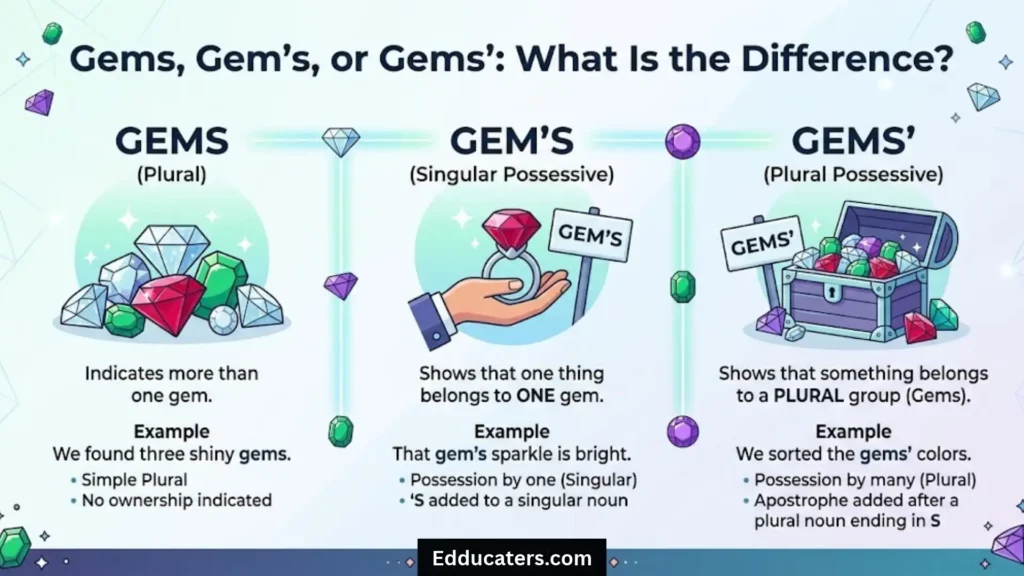
These three forms look similar but have different grammatical functions.
Gems: Regular Plural
Use gems when you mean more than one gem.
The necklace contains several gems.
The museum displays rare gems.
We found three gems in the collection.
No apostrophe is needed.
Gem’s: Singular Possessive
Use gem’s when something belongs to or is associated with one gem.
For example:
The gem’s color is unusually bright.
Here, gem’s color means the color of one gem.
Another example:
The gem’s surface was carefully polished.
The apostrophe indicates possession or association.
Gems’: Plural Possessive
Use gems’ when something is associated with multiple gems.
For example:
The gems’ colors were carefully recorded.
Here, the colors are associated with several gems.
Another example:
The gems’ value was difficult to estimate.
Quick Grammar Guide
| Form | Function | Example |
| gem | Singular | This gem is beautiful. |
| gems | Plural | These gems are beautiful. |
| gem’s | Singular possessive | The gem’s color is unusual. |
| gems’ | Plural possessive | The gems’ colors are unusual. |
Remember that apostrophes do not normally create ordinary plurals.
Is “Jems” Ever Correct?
For the ordinary English noun gem, jems is not the standard plural spelling.
If someone writes:
The jewelry shop sells rare jems.
and intends jems to mean several precious stones, the spelling should normally be corrected to:
The jewelry shop sells rare gems.
There can be other uses of words or names that happen to contain Jem or Jems, but that does not change the spelling of the ordinary English noun.
This distinction matters when proofreading. A word can appear online without being the standard spelling of the word you are looking for.
How to spell jem
If you intend to write the ordinary English word for a precious stone or something especially valuable, spell it gem, not jem. The initial sound can cause confusion because the letter g sometimes represents the /dʒ/ sound in English. Remember the spelling in familiar expressions such as precious gem and hidden gem. The same spelling rule applies when you use the word figuratively to describe a person, place, book, or idea.
“Jem” as a Name
Jem can occur as a personal name or nickname. A name may have its own spelling conventions.
Therefore, it would be too broad to say that the sequence of letters Jem can never appear in English.
The useful rule is narrower:
If you mean the standard English noun referring to a precious stone or something especially valuable, use gem.
If you mean more than one, use:
gems
Jem and the Holograms
Jem and the Holograms is a proper name, not an example of the standard spelling of the ordinary noun gem. Proper names and entertainment titles can use spellings that differ from standard vocabulary. When you are writing about a precious stone or something especially valuable, use gem or gems.
Gem or Gemstone: What Is the Difference?
Gem or gemstone are closely related terms, but they are not interchangeable in every sentence.
A gemstone generally refers to a stone used as a decorative or valuable stone, particularly when it has been cut or prepared for use in jewelry.
A gem can refer to a gemstone, but it also has a broader figurative meaning.
Compare:
The jeweler examined the gemstone.
with:
This small bookstore is a gem.
The second sentence does not refer to a stone at all.
Why the Distinction Matters
If you are writing about jewelry, mineral identification, or gemology, gemstone may be the more specific term in some contexts.
If you are describing something as unusually good or valuable, gem is usually more natural.
For example:
The collection includes several rare gemstones.
but:
The collection contains several literary gems.
The first is literal. The second is figurative.
Gem or Jewel: What Is the Difference?
Gem or jewel can overlap when referring to precious stones.
For example:
The crown was decorated with precious jewels.
The crown was decorated with precious gems.
Both sentences can be natural, depending on the intended context.
However, jewel has additional meanings, including jewelry or decorative objects containing precious stones.
This means the two words overlap without being identical in every situation.
What Are “Hidden Gems”?
Hidden gems is one of the most common figurative expressions involving the plural form.
A hidden gem is something especially good that is not widely known or noticed.
For example:
The little café is a hidden gem.
This does not mean the café contains a gemstone. It means the café is excellent but not well known.
The plural is:
hidden gems
For example:
The neighborhood has several hidden gems.
You may see the expression used for:
- restaurants
- travel destinations
- books
- movies
- websites
- shops
- museums
- buildings
- products
- ideas
- local businesses
Why “Hidden Gems” Is So Common
The expression works as a metaphor.
A physical gem is valuable or attractive. A hidden gem is something valuable or excellent that has not yet been widely discovered.
For example:
We found several hidden gems while exploring the old town.
The phrase is natural because the value is metaphorical.
How Do You Pronounce Gem or Gems?
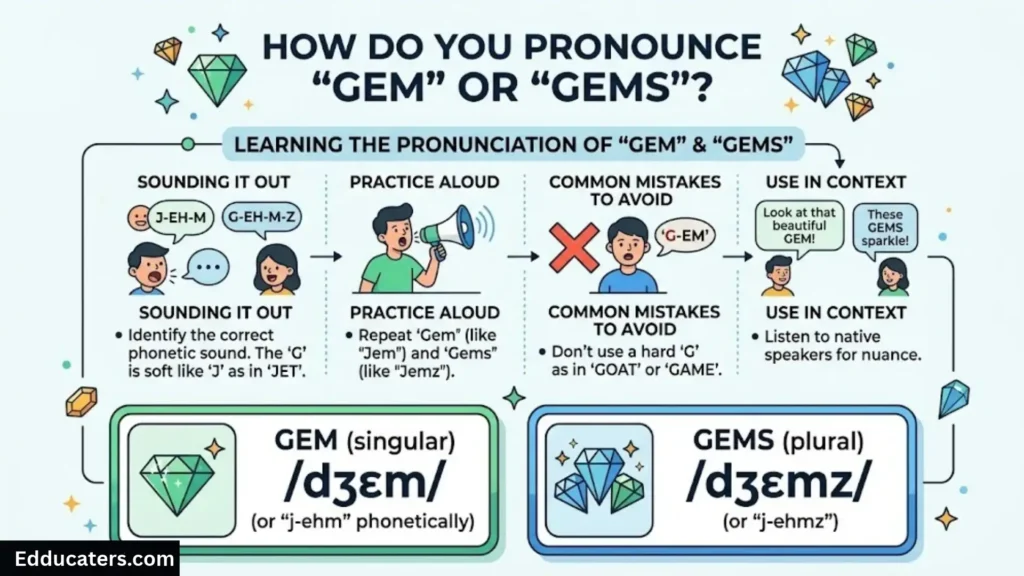
Gem is pronounced /dʒem/ in both British or American English.
It sounds approximately like:
JEM
The plural gems adds a final /z/ sound:
JEMZ
The spelling and pronunciation therefore create an interesting contrast:
gem → written with g, pronounced with /dʒ/
This is one reason learners may incorrectly write jem.
Gems Pronunciation
Gems is pronounced with a soft initial sound like the beginning of jam and a final /z/ sound. The letter g represents the /dʒ/ sound in this word. Although the pronunciation may sound similar to the nonstandard spelling jems, the correct spelling remains gems.
Does Gem Sound Like Jem?
Yes, the standard pronunciation of gem begins with the /dʒ/ sound represented by j in words such as jump.
But the spelling is still:
gem
This is a good example of why English pronunciation cannot always be used to predict spelling.
Where Does the Word “Gem” Come From?
The history of the word also explains why its spelling does not simply follow modern pronunciation.
Oxford traces gem to Old English gim, from Latin gemma, meaning “bud” or “jewel.” The word was influenced in Middle English by Old French gemme.
The spelling and form developed over time as the word became established in English.
This history shows that gem is not a modern spelling created from its pronunciation. It is an old English word with a long linguistic history.
The modern spelling gem is therefore the established standard form.
Common Mistakes With Jems or Gems
The spelling mistake usually comes from writing the word according to its sound.
Mistake 1: Using “Jems” for the Plural
Incorrect:
The box contained several valuable jems.
Correct:
The box contained several valuable gems.
Mistake 2: Writing “Jem” for the Singular
Incorrect:
She found a beautiful jem.
Correct:
She found a beautiful gem.
Mistake 3: Using an Apostrophe for the Plural
Incorrect:
The shop sells rare gem’s.
Correct:
The shop sells rare gems.
The apostrophe is unnecessary because gems is a regular plural.
Mistake 4: Confusing “Gems” or “Gems’”
Incorrect:
The gems’ are displayed in a glass case.
Correct:
The gems are displayed in a glass case.
The second form is plural possessive and needs a noun after it:
The gems’ colors are striking.
Mistake 5: Assuming Every “Gem” Means a Stone
Not every use of gem refers to jewelry.
For example:
She is a gem.
This means the speaker thinks she is especially good, kind, helpful, or valuable.
Likewise:
This book is a gem.
Here, gem is figurative.
Real-World Examples of Gems
Understanding the word in different contexts is more useful than memorizing a spelling rule alone.
Jewelry
The necklace was decorated with diamonds or other precious gems.
Here, gems refers to physical stones.
Travel
The guide introduced us to several hidden gems outside the main tourist areas.
Here, gems refers to excellent but less-known places.
Restaurants
This small family-owned restaurant is one of the city’s hidden gems.
Again, the meaning is figurative.
Books
The collection contains several literary gems.
The phrase refers to especially valuable or impressive pieces of writing.
Architecture
The historic district is filled with architectural gems.
Here, gems describes buildings that are especially notable or beautiful.
People
Our new assistant is a real gem.
Here, gem describes a person who is especially good or helpful.
Ideas
The meeting produced several gems of practical advice.
The ideas are being described as valuable.
How to Choose the Correct Form
When proofreading jems or gems, ask one simple question:
Am I referring to the English noun “gem”?
If the answer is yes, use gem for one or gems for more than one.
Decision Guide
Are you talking about one precious stone or one especially valuable thing or person?
→ Use gem
Are you talking about two or more?
→ Use gems
Are you showing possession by one gem?
→ Use gem’s
Are you showing possession by several gems?
→ Use gems’
Are you using Jem as a person’s name or another proper name?
→ Follow that name’s established spelling.
This simple decision tree handles most situations.
A Practical Editing Checklist
If you are proofreading an article, assignment, product description, or website, use this checklist:
- Use gem for one.
- Use gems for more than one.
- Do not use jem as the standard spelling of the noun.
- Do not use jems as the standard plural.
- Use gem’s for singular possession.
- Use gems’ for plural possession.
- Do not add an apostrophe just to create a plural.
- Check whether gem is being used literally or figuratively.
- Keep proper names separate from ordinary vocabulary.
- Use gemstone when that more specific term fits the context.
This checklist is especially useful for editors and writers because most errors involving gem are simple spelling or apostrophe mistakes.
How to Remember “Gems”
The easiest memory rule is:
Gem + s = gems
Start with the correct singular:
gem
Then add the regular plural ending:
gems
Do not change the first letter because of the pronunciation.
Another useful connection is:
gem → gemstone → gems → gemstones
All of these words retain the g.
If you remember the phrase “precious gems,” the correct spelling becomes easier to recognize.
Jems or Gems in Formal Writing
In school assignments, professional writing, journalism, business content, product descriptions, or general web writing, use gems when referring to multiple gems.
For example:
The exhibition features a collection of rare gems.
The travel guide highlights several hidden gems.
The jewelry store specializes in precious gems.
Using jems in these contexts would normally be treated as a spelling error if the intended word is gems.
What About Informal Writing?
Informal writing sometimes contains deliberate misspellings, creative spellings, usernames, brand names, or personal names.
Those are separate from standard English spelling.
For standard English content, the safe choice remains:
gem
or:
gems
Frequently Asked Questions
Is “jems” or “gems” correct?
Gems is correct when you mean the plural of gem. Jems is not the standard plural spelling.
What is the plural of gem?
The plural of gem is gems.
One gem → several gems
Is “jem” a correct spelling?
Not as the standard spelling of the English noun meaning a precious stone or something especially valuable. The standard spelling is gem.
Why do people spell gem as “jem”?
The most likely reason is pronunciation. Gem begins with the /dʒ/ sound, which is also commonly represented by j. However, the established spelling is gem.
How is gem pronounced?
Gem is pronounced /dʒem/ in both British or American English.
How do you pronounce gems?
Gems is pronounced approximately JEMZ, with a /z/ sound at the end.
Is “gems” a plural noun?
Yes. Gems is the regular plural of the countable noun gem.
Is “gem’s” the plural of gem?
No. Gem’s is normally the singular possessive form.
The gem’s color is beautiful.
What is the difference between gems or gems’?
Gems is the plural:
The gems are expensive.
Gems’ is the plural possessive:
The gems’ value is difficult to determine.
Is “hidden gems” correct?
Yes. Hidden gems is a standard and common figurative expression for people, places, things, or experiences that are especially good but not widely known.
Is “hidden jems” correct?
No, not when you mean the standard expression hidden gems.
Are gem or gemstone the same?
They are closely related but not identical in every context. Gem can mean a precious stone, while gemstone is a more specific term for a stone used as a gem. Gem also has a figurative meaning that gemstone does not.
Are gems or jewels the same?
They overlap in meaning, especially when referring to precious stones, but jewel has additional meanings, including jewelry or decorative objects containing precious stones.
Can gem describe a person?
Yes. If someone says:
She’s a real gem.
they mean that the person is especially good, kind, helpful, or valuable.
Can gem describe a place?
Yes. For example:
This village is a hidden gem.
The speaker means the village is especially attractive, interesting, or worthwhile but not widely known.
Is “gems” used only for jewelry?
No. It can also be used figuratively for excellent people, places, ideas, books, movies, restaurants, buildings, or experiences.
Is “Jems” ever used as a name?
It can occur in names or other special uses, but that does not make jems the standard plural of the ordinary noun gem. Context matters.
Is jem a word in Scrabble?
If jem is accepted in Scrabble depends on the official word list used for the game. Do not assume that a spelling is playable simply because it appears as a name or informal spelling. If you want to play the ordinary English noun for a precious stone, check the applicable official word list rather than relying on the pronunciation.
Key Takeaways
The answer to jems or gems is simple:
- Gem is the correct singular spelling.
- Gems is the correct regular plural.
- Jem is not the standard spelling of the ordinary noun gem.
- Jems is therefore not the standard plural when you mean precious stones or figuratively valuable things.
- The pronunciation /dʒem/ can make the spelling confusing.
- Gem’s normally indicates singular possession.
- Gems’ indicates plural possession.
- Gemstone is a related but more specific word.
- Jewel overlaps with gem but has additional meanings.
- Hidden gems is a common figurative expression.
- The correct spelling stays gem/gems, even when the word is pronounced with the /dʒ/ sound.
Conclusion
Jems or gems? Use “gems.”
If you are referring to more than one gem, the correct spelling is gems. The singular is gem, and the plural is formed normally by adding -s.
The spelling jems is generally incorrect when the intended word is the standard English noun gem. The confusion comes mainly from pronunciation: gem begins with the /dʒ/ sound, which can make jem seem like a logical spelling. English spelling, however, does not always match pronunciation letter for letter.
The word gem can refer to a precious stone, but it can also describe something or someone especially good or valuable. That is why expressions such as precious gems, hidden gems, literary gems, or architectural gems are all natural English.
For everyday writing, the rule is easy to remember:
One gem → two gems
If you are writing about precious stones, valuable things, excellent places, helpful people, or hidden treasures, choose gems, not jems.
References
- Oxford Advanced Learner’s Dictionary — “gem”: definition, figurative meaning, pronunciation, examples, and word origin.
- Cambridge English Dictionary — “gem”: definitions for the precious-stone and figurative meanings, pronunciation, and usage examples.
- Cambridge Pronunciation Dictionary — “gem”: British or American pronunciation.
- Cambridge English Dictionary — “plural”: explanation of plural forms and regular plural formation.

I’m Julian Mercer, an English language writer dedicated to helping people master grammar through practical examples and clear explanations. I enjoy teaching grammar in a way that is both engaging and easy to remember.
My work focuses on grammar rules, punctuation, word usage, and writing techniques that readers can apply in everyday life. I believe learning English should be simple, enjoyable, and useful.
Books
English Grammar in Practice
Writing with Precision
 Nathan Whitmore
 Claire Holloway