The English language is notorious for words that sound identical but possess vastly different meanings and origins. Few pairings cause as much frustration in writing as cue and queue. Whether you are drafting a professional email, writing a script, or simply sending a text, choosing the wrong word can instantly undermine your credibility.
Because these words are homophones words that sound exactly the same the confusion is entirely understandable. However, mastering the distinction is simpler than it seems once you understand the context of their use. In this guide, you will learn the precise definitions, grammatical roles, and practical memory tricks to ensure you never confuse cue and queue again.
Quick Answer: Cue or Queue
A cue is a signal or prompt, such as an actor’s line or a suggestion to start an action. A queue is a sequence of people, vehicles, or items waiting in a line. To remember the difference, think of the “ue” at the end of the “queue” as a line of people waiting to get into a theater.
Comparison at a Glance
| Feature | Cue | Queue |
| Meaning | A signal or prompt | A line of people or items |
| Part of Speech | Noun / Verb | Noun / Verb |
| Primary Usage | Acting, music, psychology | Logistics, computing, retail |
| Pronunciation | /kjuː/ | /kjuː/ |
| Memory Tip | The ‘C’ stands for ‘Command’ | The ‘ueue’ looks like a line |
| Correct Usage | “Wait for your cue.” | “Join the checkout queue.” |
| Incorrect Usage | “Wait on the cue.” | “Give me the queue.” |
Understanding Cue
A cue serves as a signal, hint, or trigger that prompts a specific reaction or behavior. In a theatrical context, it is the line or action that tells an actor it is time to speak or move. In broader conversation, it refers to a non-verbal gesture like a nod or a wink that suggests someone should take the next step.
- As a noun: The stage manager gave the lead actor his cue to enter.
- As a verb: Please cue the music when the bride starts walking down the aisle.
Understanding Queue
A queue refers to a waiting line of people, objects, or data. While more commonly used in British English, it is standard terminology in technical fields worldwide, particularly in computing and networking. It signifies an orderly arrangement where the first entity to enter is the first to be processed (First-In, First-Out).
- As a noun: We stood in the queue for three hours to buy tickets.
- As a verb: You can queue your favorite songs to play in order on the app.
Key Differences
The primary difference lies in the concept of timing versus arrangement.
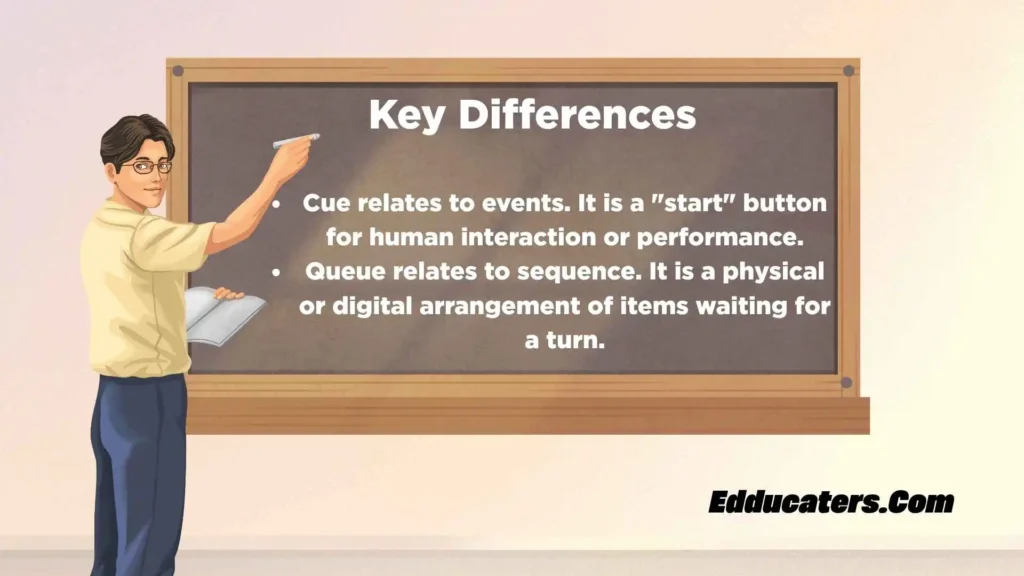
- Cue relates to events. It is a “start” button for human interaction or performance.
- Queue relates to sequence. It is a physical or digital arrangement of items waiting for a turn.
If you are waiting for something to happen, you need a cue. If you are waiting for your turn in a long line, you are in a queue.
Also Check This Post: Yea or Yeah: A Beginner’s Guide to These Similar Words
Grammar Rules and Usage
Both words function as both nouns and verbs. In formal writing, ensure you are not using them interchangeably. In American English, the word “line” is often preferred over “queue” for people waiting, but “queue” remains the standard term in computer science and data management globally.
- Formal/Academic: Use “queue” when discussing data structures or algorithmic processes.
- Daily Conversation: Use “cue” for suggestions or signals.
- Professional Emails: Use “queue” when referring to a list of tasks or customer service tickets.
Common Mistakes
The most frequent mistake involves using “cue” when referring to a physical line. Because “cue” is shorter, many writers gravitate toward it, leading to errors like “I waited in the cue at the store.” Remember: the word with more letters (queue) is the one that represents a long line of people.
Original Examples
- The director whispered a secret cue to the lead performer.
- Please add the remaining invoices to the processing queue.
- She took his silence as a cue to leave the room immediately.
- Hundreds of shoppers formed a queue outside the store at dawn.
- Social cues are often difficult for children to interpret correctly.
- You can queue your videos to watch them later tonight.
- The band waited for the drum cue before starting the song.
- There is a long queue of traffic stretching down the main highway.
- He used a subtle facial cue to indicate he was bored.
- If the server is busy, your request will enter a virtual queue.
- Taking a deep breath was the cue he needed to start his speech.
- Students formed a single-file queue to enter the cafeteria.
- The software will automatically queue the print jobs in order.
- An actor must be highly sensitive to every cue provided by his peers.
- I noticed a massive queue for the new museum exhibit.
The Ultimate Memory Trick
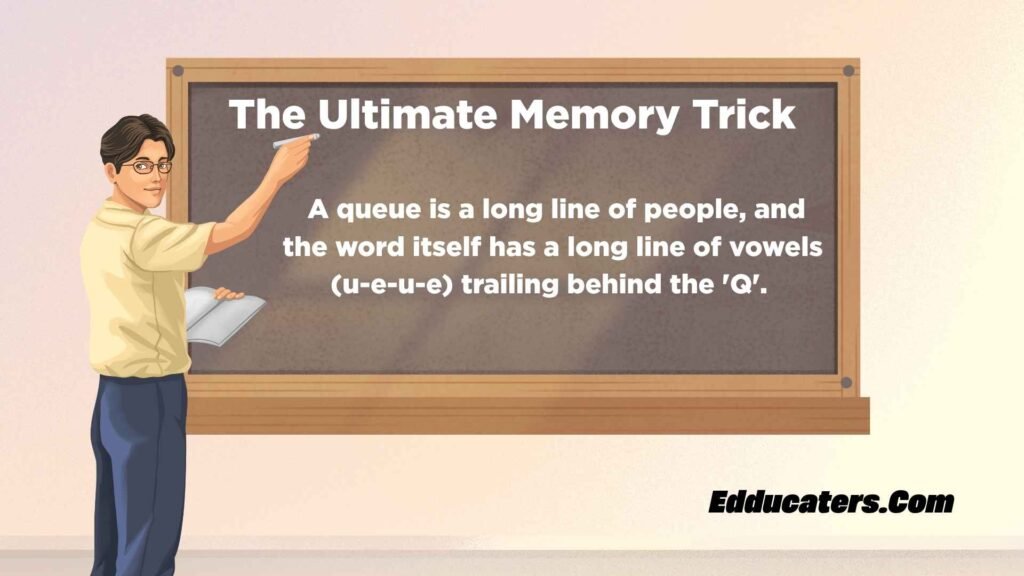
To remember which is which, look at the spelling. A queue is a long line of people, and the word itself has a long line of vowels (u-e-u-e) trailing behind the ‘Q’. If you are thinking of a signal, use the short, three-letter word cue. If you are thinking of a long line, use the long, five-letter word queue.
Also Check This Post:Towards or Toward: How to Choose the Right One
Mini Quiz
- Which word represents a signal or prompt?
a) Queue
b) Cue
Answer: b - Which word is commonly used in computing to describe data waiting to be processed?
a) Queue
b) Cue
Answer: a - “Please wait in the ____ at the bank.”
a) Cue
b) Queue
Answer: b - “He waited for his ____ to speak.”
a) Cue
b) Queue
Answer: a - What part of speech can both words be?
a) Noun only
b) Noun and Verb
Answer: b
Frequently Asked Questions
Is “queue” only used in British English?
While “queue” is the standard term for a waiting line in British English, American English speakers use it frequently in technical, professional, and digital contexts. In general American conversation, people often prefer “line,” but “queue” remains grammatically correct in all regions.
Can I use “cue” to mean a line?
No. Using “cue” to mean a line is a misspelling. Always use “queue” when referring to a line of people, vehicles, or items waiting for their turn.
Why do “cue” and “queue” sound the same?
They are homophones. Despite their different origins—”cue” likely coming from the Latin quando (when) and “queue” from the French word for “tail”—they evolved to share an identical pronunciation in modern English.
How do I use “queue” as a verb?
You use it when you want to arrange things in a sequence. For example, “I am going to queue up these emails to send later” means you are ordering them in a list to be processed one after another.
Are there any other spellings for “queue”?
No, “queue” is the correct and only accepted spelling. “Que” is a common misspelling or a word in Spanish, and “cue” has an entirely different meaning. Never use “que” as an abbreviation for “queue” in formal writing.
Does “cue” have any relation to billiards?
Yes, the stick used to strike the ball in billiards is spelled “cue” (a cue stick). It acts as the “signal” or instrument used to propel the ball.
Key Takeaways
- Cue refers to a signal or prompt.
- Queue refers to a line of people or things.
- Cue is used for timing and performance.
- Queue is used for logistics and organization.
- The extra vowels in the queue represent the “long line” of people waiting.
- Both words function as both nouns and verbs.
Conclusion
Distinguishing between cue and queue is an essential skill for clear, professional communication. By associating cue with a “signal” and queue with a “line” of waiting items, you eliminate the confusion caused by their shared pronunciation.
If you are managing a task list or signaling a colleague, using these terms correctly ensures your message is both professional and precise. Always remember that a cue prompts action, while a queue organizes the wait.
Also Check This Post: Speach or Speech: Complete Guide to Using the Right Word

Hi, I’m Nathan Whitmore, and I enjoy making English grammar easy for learners of all ages. I believe grammar should be practical, not confusing. I write simple, well-researched guides that help readers improve their writing, speaking, and overall communication skills.
I spend a lot of time studying grammar patterns, sentence construction, punctuation, and modern English usage. My goal is to create lessons that anyone can understand, whether they are students, teachers, or professionals.
Books
Clear English Grammar
The Smart Writer’s Grammar Handbook
 Claire Holloway
 Julian Mercer